
Concrete Volume Calculator
Calculate cubic yards, bags & weight for any shape
Table of Contents
What Is a Concrete Volume Calculator and Why Do You Need One?
A concrete volume calculator is a tool that converts your project dimensions — length, width, depth, diameter — into the exact volume of concrete you need to order. It gives you results in cubic yards (what ready-mix suppliers sell), cubic feet (what bag yields are measured in), and bags (what you buy at the store). Some calculators, including ours, also show weight, car loads, mixing time, and a recommendation on whether to use bags or order a truck.
Why does this matter? Because concrete is sold in fixed quantities — you order by the yard or buy by the bag — and getting the number wrong costs real money. Order too little and your pour stops mid-project, leaving a cold joint that weakens the entire slab. Order too much and you pay for material you cannot return. A volume calculator eliminates both problems by doing the math before you place the order.
Here is what our concrete volume calculator covers that most others skip:
- 6 project shapes — Slab/pad, cylinder/column, wall, footing, triangle, and trapezoid. No need to run separate calculators for different shapes.
- Instant results — No “Calculate” button. Results update live as you type each dimension.
- Live SVG preview — A real-time diagram so you can visually confirm your measurements before ordering.
- Physical effort data — Total weight, car loads, and estimated mixing time so you know the full scope of work.
- Smart bags vs ready-mix recommendation — The calculator tells you whether to mix bags by hand or order a truck, based on your volume.
How to Calculate Concrete Volume (Step-by-Step)
Whether you use our calculator or want to understand the math yourself, here is the process for calculating concrete volume for any project.
Step 1: Identify Your Project Shape
Every concrete pour fits one of these basic geometric shapes:
- Rectangle / Square — Slabs, pads, patios, driveways, garage floors, sidewalks
- Cylinder / Circle — Sonotube footings, round columns, post holes, round patios
- Wall — Foundation walls, retaining walls, stem walls
- Footing — Continuous strip footings, spread footings
- Triangle — Corner fills, decorative sections, ramp transitions
- Trapezoid — Tapered sections, curb profiles, sloped areas
For L-shaped or irregular areas, break the shape into basic rectangles, triangles, or trapezoids. Calculate each section separately and add the volumes together.
Step 2: Measure Your Dimensions
Use a tape measure to get accurate dimensions. For rectangular shapes, measure length and width in feet. For circular shapes, measure the diameter. Then measure the thickness or depth in inches (the vertical dimension of the concrete pour).
Tip: Measure at multiple points if the ground is uneven. Use the deepest measurement as your thickness — a dip of even half an inch across a 400 ft² slab adds roughly 0.6 yd³ of unplanned concrete.
Step 3: Apply the Volume Formula
The universal concrete volume formula is:
Volume (yd³) = Area (ft²) × Thickness (in) ÷ 324
The 324 divisor combines two conversions at once: inches to feet (÷ 12) and cubic feet to cubic yards (÷ 27). Since 12 × 27 = 324, this single number handles both steps.
Step 4: Add a Waste Factor
Never order exactly the calculated volume. Add a waste factor to account for spillage, uneven sub-grade, form movement, and mixing losses:
- 5% — Simple rectangular pours with experienced crew and good forms
- 10% — Standard for most residential projects (recommended default)
- 15% — Complex shapes, sloped surfaces, uneven ground, or first-time pours
Step 5: Convert to Bags or Ready-Mix
Once you have your total volume in cubic yards, convert to your ordering format. Ready-mix is ordered in cubic yards. Bags are ordered by count using these yields:
- 80 lb bag = 0.60 ft³ → 45 bags per cubic yard
- 60 lb bag = 0.45 ft³ → 60 bags per cubic yard
- 40 lb bag = 0.30 ft³ → 90 bags per cubic yard
These yields are confirmed on both Quikrete (TDS #1101) and Sakrete official data sheets.
Volume Formulas for Every Concrete Shape
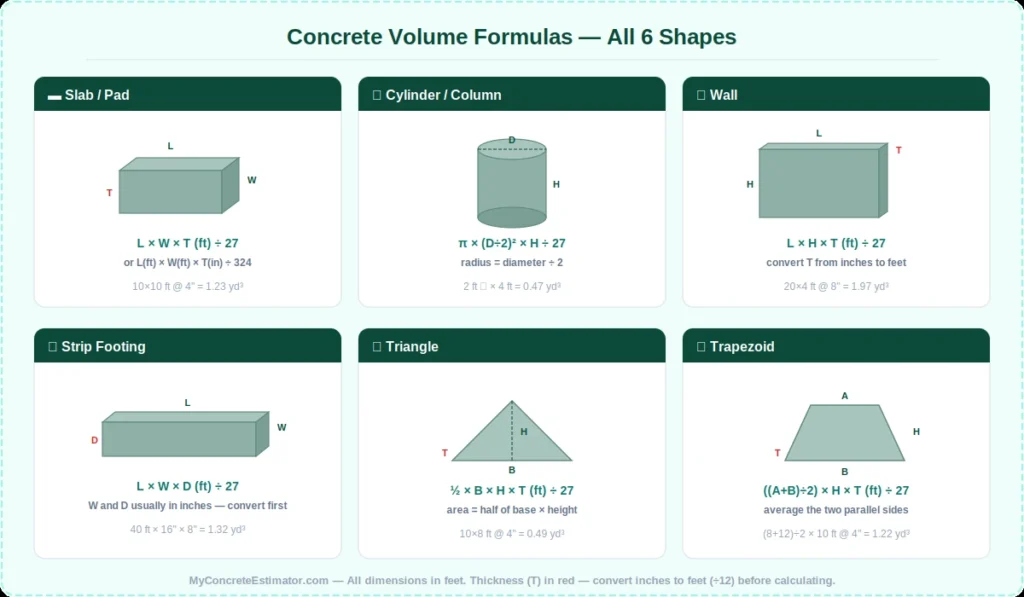
| Shape | Formula (Cubic Feet) | To Get Cubic Yards | Example |
|---|---|---|---|
| Rectangle / Slab | Length (ft) × Width (ft) × Thickness (ft) | ÷ 27 | 10 × 10 × 0.33 = 33 ft³ = 1.22 yd³ |
| Circle / Cylinder | π × Radius² (ft) × Height (ft) | ÷ 27 | π × 1² × 4 = 12.57 ft³ = 0.47 yd³ |
| Wall | Length (ft) × Height (ft) × Thickness (ft) | ÷ 27 | 20 × 4 × 0.67 = 53.3 ft³ = 1.97 yd³ |
| Footing (strip) | Length (ft) × Width (ft) × Depth (ft) | ÷ 27 | 40 × 1.33 × 0.67 = 35.6 ft³ = 1.32 yd³ |
| Triangle | ½ × Base (ft) × Height (ft) × Thickness (ft) | ÷ 27 | ½ × 10 × 8 × 0.33 = 13.3 ft³ = 0.49 yd³ |
| Trapezoid | ((Top + Bottom) ÷ 2) × Height (ft) × Thickness (ft) | ÷ 27 | ((8 + 12) ÷ 2) × 10 × 0.33 = 33 ft³ = 1.22 yd³ |
Shortcut for any rectangular slab at 4 inches thick: Divide the total square footage by 81 to get cubic yards. A 20 × 20 ft slab = 400 ft² ÷ 81 = 4.94 yd³. This shortcut works because 1 cubic yard covers exactly 81 ft² at 4 inches thick.
Quick Reference Table — Concrete Volume by Slab Size
This table shows concrete volume, bag counts, and estimated cost for common slab sizes at 4 inches thick with 10% waste. Ready-mix pricing uses $150/yd³ (national average). Bag pricing uses $6.50 per 80 lb bag.
| Slab Size | Area (ft²) | Cubic Yards (w/ waste) | 80 lb Bags | Weight (lbs) | Ready-Mix Cost |
|---|---|---|---|---|---|
| 4×4 ft | 16 | 0.22 | 10 | 880 | $33 |
| 8×8 ft | 64 | 0.87 | 39 | 3,520 | $131 |
| 10×10 ft | 100 | 1.36 | 62 | 5,500 | $204 |
| 12×12 ft | 144 | 1.96 | 88 | 7,920 | $294 |
| 15×15 ft | 225 | 3.06 | 138 | 12,375 | $459 |
| 20×20 ft | 400 | 5.43 | 245 | 22,000 | $815 |
| 24×24 ft | 576 | 7.83 | 352 | 31,680 | $1,174 |
| 30×30 ft | 900 | 12.22 | 550 | 49,500 | $1,833 |
| 30×40 ft | 1,200 | 16.30 | 733 | 66,000 | $2,444 |
| 40×60 ft | 2,400 | 32.59 | 1,467 | 132,000 | $4,889 |
Concrete Unit Conversions Explained
Concrete volume gets confusing because suppliers, bag manufacturers, and project plans all use different units. Here are the key conversions you need:
| Conversion | Value | When You Use It |
|---|---|---|
| 1 cubic yard | 27 cubic feet | Converting bag yields to truck orders |
| 1 cubic yard | 0.765 cubic meters | International or metric specifications |
| 1 cubic foot | 0.037 cubic yards | Quick bag-to-yard conversion |
| 1 cubic yard of concrete | ~4,050 lbs (2 tons) | Weight planning and vehicle loading |
| 1 cubic foot of concrete | ~150 lbs | Estimating per-bag lifting effort |
| Inches to feet | ÷ 12 | Converting thickness measurements |
| The “324” shortcut | 12 × 27 = 324 | L(ft) × W(ft) × T(in) ÷ 324 = yd³ |
Why this matters: The single most common calculation error is mixing inches and feet. If your thickness is 4 inches and you enter “4” into a formula expecting feet, your estimate will be 12× too high. Always convert thickness to feet (4 inches = 0.333 ft) before multiplying, or use the ÷ 324 shortcut.
Bags vs Ready-Mix: When to Use Each
The decision between bagged concrete and a ready-mix truck comes down to volume — and a concrete volume calculator makes that volume obvious:
| Volume (yd³) | Recommendation | Why | Approx. Bag Count (80 lb) | Bag Cost | Ready-Mix Cost |
|---|---|---|---|---|---|
| Under 0.5 | Bags | Small project, no minimum order | Under 23 bags | ~$150 | N/A (below minimum) |
| 0.5 – 1.0 | Bags or Ready-Mix | Compare costs — call for a quote | 23–45 bags | $150–$290 | $130–$180 + delivery |
| 1.0 – 1.5 | Ready-Mix | Cheaper per yard, faster pour | 45–68 bags | $290–$440 | $130–$270 + delivery |
| 1.5 – 3.0 | Ready-Mix (strongly) | Bag mixing is impractical at this volume | 68–135 bags | $440–$880 | $225–$450 + delivery |
| Over 3.0 | Ready-Mix (required) | Cannot maintain pour pace with bags | 135+ bags | $880+ | $390+ (often cheaper) |
So, ready-mix is the best method for any pour over 1.5 cubic yards because it is cheaper per yard, delivers consistent quality, and pours fast enough to finish before the concrete begins to set. For small projects under 0.5 cubic yards — like fence post holes or a small AC pad — bagged concrete wins because there is no delivery fee and no minimum order.
How Much Extra Concrete Should You Order?
The waste factor is not optional — it is part of every professional estimate. Here is what actually consumes the extra concrete:
- Uneven sub-grade — Even a well-prepared base has low spots that consume more concrete than the calculated thickness assumes.
- Spillage during placement — Concrete that misses the forms, overflows, or falls off the chute. With a pump, this is minimal. With wheelbarrows, it adds up.
- Form movement — Stakes shift under concrete pressure, pushing forms outward and increasing the actual pour volume.
- Over-excavation — Digging slightly deeper or wider than planned is common and unavoidable.
- Mixing losses (bags only) — Concrete that sticks to the mixer, the wheelbarrow, and your tools.
Bottom line: 10% waste is the industry standard for residential pours. Use 5% only if you have precise forms on flat, compacted ground. Use 15% if the ground is rough, the shape is complex, or you are mixing bags by hand for the first time.
Concrete Weight and Delivery Planning
Standard concrete weighs 150 lbs per cubic foot — or about 4,050 lbs (just over 2 tons) per cubic yard. This weight matters for three reasons:
Vehicle loading: A sedan or SUV can safely carry about 800 lbs of bagged concrete per trip. For a 1 yd³ project using 80 lb bags (45 bags = 3,600 lbs), that is 5 car loads. Our calculator shows car loads so you can plan trips to the store.
Physical effort: Mixing 45 bags of 80 lb concrete by hand takes approximately 3.5 to 4 hours at a steady pace (about 5 minutes per bag including mixing, carrying, and pouring). That is 3,600 lbs of lifting and mixing. This is why ready-mix is recommended for anything over 1 cubic yard.
Structural loading: A 20 × 20 ft garage slab at 6 inches thick weighs approximately 30,000 lbs (15 tons). The sub-grade must support this weight plus any live loads on top. Proper compaction and a gravel base are not optional — they are structural requirements.
Comparison Table: All Volume Calculation Methods
| Method | Accuracy | Shapes Supported | Speed | Best For |
|---|---|---|---|---|
| Online Calculator (this tool) | High | 6 shapes | Instant | Any project — fast, free, visual confirmation |
| Manual formula (L × W × T ÷ 324) | High | Rectangle only | 2–5 min | Quick field estimates, simple slabs |
| ÷ 81 shortcut (4″ slabs only) | Medium | Rectangle at 4″ | 10 sec | Ballpark on-site — not for ordering |
| Supplier app (Quikrete, Sakrete) | High | 2–3 shapes | 1–2 min | Brand-specific bag counts |
| Contractor estimate | Highest | Any | 1–3 days | Large or structural pours — includes site conditions |
So, an online volume calculator is the best method for planning because it handles multiple shapes, adds waste automatically, and gives you bag counts and cost in one step. For large structural projects, always cross-check with a contractor who can account for site-specific conditions like soil type and access.
Tips for Accurate Concrete Volume Estimates
Always measure twice. A 1-foot error on a 20-foot slab changes the volume by 5%. Walk the tape measure across the full length, pull it taut, and read from the same side each time.
Measure thickness at the deepest point. If your ground dips 1 inch below grade across a 400 ft² slab, that dip alone adds about 0.6 yd³ of concrete. Use the deepest measurement, not the average.
Use the right units from the start. Length and width go in feet. Thickness goes in inches. The calculator converts automatically — but if you are doing the math by hand, convert inches to feet (÷ 12) before multiplying. This is the most common error in volume calculation.
Round up to the nearest quarter yard for ready-mix. Batch plants measure in quarter-yard increments. If your calculation says 3.12 yd³, order 3.25 yd³. The extra 0.13 yd³ costs about $20 — far less than a short-load callback.
Break irregular shapes into simple shapes. An L-shaped patio is two rectangles. A keyhole-shaped pool deck is a rectangle plus a semicircle. Calculate each piece, add the volumes, then add your waste factor to the total (not to each piece individually).
Do not forget the sub-base. A 4-inch gravel sub-base under a slab also has a volume you need to calculate and order. Use the same L × W formula with the gravel depth. One cubic yard of crushed stone covers about 100 ft² at 3 inches deep.
Account for forms and keyways. Thickened edges (common on garage slabs and monolithic foundations) add volume that a simple L × W × T formula does not capture. Measure the thickened section separately and add it to the main slab volume.
Call the batch plant to confirm minimums. Most ready-mix suppliers have a minimum order of 1–2 yd³, and short-load fees of $30–$75 per yard below 3–4 yd³. A quick phone call before ordering prevents surprise charges.
Order concrete for weather, not just volume. Hot weather (over 85°F) accelerates setting — you may need to pour in smaller batches. Cold weather (below 40°F) slows curing and risks freeze damage. Neither condition changes the volume, but both affect how you schedule the pour.
Keep a bag or two extra for small fills. Even with a well-calculated ready-mix order, you will likely find a small void, a corner that overflowed, or a form that shifted. Having two 80 lb bags on standby ($13 total) saves a $200 emergency callback delivery.
Multiply length (ft) × width (ft) × thickness (in) and divide by 324. For example, a 10 × 10 ft slab at 4 inches thick = 10 × 10 × 4 ÷ 324 = 1.23 cubic yards. Add 10% waste for a total order of 1.36 yd³.
There are 27 cubic feet in 1 cubic yard (3 ft × 3 ft × 3 ft = 27). To convert cubic feet to cubic yards, divide by 27. To convert cubic yards to cubic feet, multiply by 27.
One cubic yard of standard concrete weighs approximately 4,050 lbs, or just over 2 tons. This weight assumes normal-weight concrete at 150 lbs per cubic foot (27 × 150 = 4,050). Lightweight concrete mixes weigh less, typically 90–120 lbs per cubic foot.
You need 45 bags of 80 lb concrete to make 1 cubic yard. Each 80 lb bag yields 0.60 cubic feet, and 1 cubic yard = 27 cubic feet. So 27 ÷ 0.60 = 45 bags. For 60 lb bags (0.45 ft³), you need 60 bags per yard. For 40 lb bags (0.30 ft³), you need 90 bags per yard.
Use the cylinder formula: π × radius² × height. Measure the diameter and divide by 2 to get the radius. For example, a 12-inch diameter Sonotube (radius = 0.5 ft) at 4 feet deep = 3.14159 × 0.25 × 4 = 3.14 cubic feet, or 0.12 cubic yards per tube. Multiply by the number of post holes for the total volume.
For projects under 0.5 cubic yards, bagged concrete is cheapest because there is no delivery fee or minimum order. For anything over 1 cubic yard, ready-mix truck delivery is cheaper per yard ($130–$180/yd³) compared to bags ($290–$390/yd³ equivalent). The crossover point is typically around 0.75 to 1 cubic yard.
A 10 × 10 ft slab at 4 inches thick needs 1.23 cubic yards (1.36 yd³ with 10% waste). That equals about 62 bags of 80 lb concrete. At 6 inches thick, the same slab needs 1.85 yd³ (2.04 yd³ with waste) — about 92 bags.
A 20 × 20 ft slab at 4 inches thick requires 4.94 cubic yards (5.43 yd³ with 10% waste). At 6 inches thick, it jumps to 7.41 yd³ (8.15 yd³ with waste). This volume absolutely requires ready-mix delivery — mixing 245 bags by hand is not practical.
A short load is a ready-mix order below the supplier’s full-load threshold, typically 3–4 cubic yards. Most plants charge a short-load fee of $30–$75 per yard below the threshold. For example, ordering 2 yd³ from a plant with a 4 yd³ threshold might add $60–$150 in surcharges. Always ask about minimums and short-load pricing before ordering.
For a wall: Length (ft) × Height (ft) × Thickness (ft) ÷ 27 = cubic yards. For a continuous strip footing: Length (ft) × Width (ft) × Depth (ft) ÷ 27. Remember to convert inches to feet before multiplying. An 8-inch thick wall is 0.67 ft, and a 16-inch wide footing is 1.33 ft.
A standard full-size ready-mix truck holds 8–10 cubic yards. Smaller “short load” or mini-mix trucks hold 1–4 cubic yards and are available from some suppliers for residential projects. If your project needs more than 10 yd³, you will need multiple truck loads.
Multiply cubic feet by 0.0283168 to get cubic meters. Or multiply cubic yards by 0.764555. For example, 27 cubic feet = 0.765 cubic meters = 1 cubic yard. Our calculator shows all three units automatically.
Suppliers often add their own waste factor (typically 5–10%) on top of your calculated volume. They also round up to the nearest quarter or half yard. If your calculator says 3.12 yd³ and the supplier quotes 3.5 yd³, the difference is their waste buffer and rounding. This is normal and usually worth accepting.
Ready-mix concrete costs $130–$180 per cubic yard delivered in 2026, depending on PSI rating and region. Standard 3,000 PSI averages about $135/yd³. Add $75–$125 for delivery and potential short-load fees. Bagged concrete costs $290–$390 per cubic yard equivalent. For installed costs including labor, expect $6–$12 per square foot.
Yes. Break the irregular shape into simple rectangles, triangles, or trapezoids. Calculate each section separately using the appropriate formula. Add all the volumes together, then apply your waste factor to the total. Our calculator supports all six basic shapes to cover any section of an irregular layout.