
Concrete Mix Calculator
Calculate cement, sand, gravel & water for any ratio
Table of Contents
What Is a Concrete Mix Calculator?
A concrete mix calculator tells you exactly how much cement, sand, gravel, and water to buy for a site-mixed concrete project. You enter your slab dimensions and choose a mix ratio — like 1:2:3 (the most common for residential work) — and the calculator converts that into a practical shopping list: cement bags, tons of sand, tons of gravel, and gallons of water.
This matters because site-mixing your own concrete from raw materials can save 30–50% compared to buying premixed bags — but only if you get the proportions right. The wrong ratio produces weak concrete that cracks, spalls, or cannot support the intended load. Too much water makes it easy to pour but kills the strength. Too little cement makes it cheap but porous.
Our concrete mix calculator gives you four things most competitors skip:
- A practical shopping list — Cement in bags, sand in tons, gravel in tons, water in gallons. Not abstract volumes — quantities you actually buy at the supply yard.
- Site-mix vs premix cost comparison — See the exact dollar difference between mixing your own and buying premixed 80 lb bags.
- Correct dry volume factor per ratio — A 1:2:3 mix uses a DVF of 1.50, not the generic 1.54 that most calculators apply to every ratio.
- Instant results with visual ratio preview — A proportional bar chart and material piles update as you change inputs.
Concrete Mix Ratios Explained
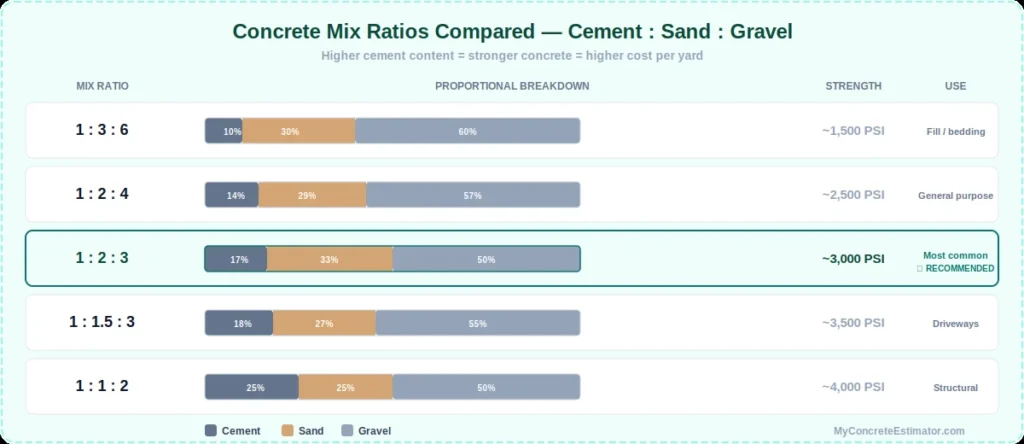
A concrete mix ratio describes the proportion of cement : sand (fine aggregate) : gravel (coarse aggregate) by volume. The notation “1:2:3” means for every 1 part of cement, you add 2 parts sand and 3 parts gravel. All parts are measured using the same container — a 5-gallon bucket works well.
Standard Mix Ratios and Their Uses
| Mix Ratio | Approx. Strength (PSI) | Common Uses | Cement Content |
|---|---|---|---|
| 1 : 3 : 6 | ~1,500 PSI | Lean fill, non-structural bases, bedding | Low (10%) |
| 1 : 2 : 4 | ~2,500 PSI | General purpose, light-duty slabs, footings | Medium (14%) |
| 1 : 2 : 3 | ~3,000 PSI | Standard residential — patios, sidewalks, slabs | Medium (17%) |
| 1 : 1.5 : 3 | ~3,500 PSI | Driveways, garage floors, freeze-thaw zones | Higher (18%) |
| 1 : 1 : 2 | ~4,000 PSI | Structural, heavy-duty, columns, beams | High (25%) |
For most residential DIY projects, use 1:2:3. It produces approximately 3,000 PSI strength — above the 2,500 PSI structural minimum in ACI 318 — and balances cost, workability, and durability. Use 1:1.5:3 for driveways or any surface exposed to vehicle traffic and freeze-thaw cycles.
How to Mix Concrete From Raw Materials (Step-by-Step)
Step 1: Calculate Your Volume
Measure your project dimensions (length × width in feet, thickness in inches) and use the calculator above to determine the wet volume in cubic feet. The calculator adds your waste factor and applies the dry volume factor automatically.
Step 2: Buy the Materials
The calculator produces a shopping list. Here is what to expect at the supply yard:
- Portland cement — Sold in 94 lb bags (1 cubic foot each). About $15–$20 per bag at Home Depot or Lowe’s in 2026. Type I/II is standard for all residential work.
- Sand (fine aggregate) — Sold by the ton or cubic yard. About $30–$45 per ton delivered. Use concrete sand (also called sharp sand or mason sand), not play sand or beach sand.
- Gravel (coarse aggregate) — Sold by the ton or cubic yard. About $35–$50 per ton. Use ¾-inch or 1-inch crushed stone or pea gravel. Clean, angular crushed stone produces stronger concrete than rounded river rock.
- Water — Clean tap water. About 5 gallons per 94 lb bag of cement at a 0.50 water-cement ratio.
Step 3: Measure and Mix
Use a consistent measuring container (a 5-gallon bucket is the standard site tool). For a 1:2:3 mix: add 1 bucket of cement, 2 buckets of sand, and 3 buckets of gravel to the mixer. Add water gradually — start with about half the calculated amount, mix for 2 minutes, then add water slowly until the mix reaches a thick, workable consistency.
Do not eyeball the water. The water-cement ratio is the single biggest factor controlling concrete strength. A ratio of 0.45–0.50 (by weight of cement) is the target for most residential work. Every extra gallon of water above the design amount reduces 28-day compressive strength by approximately 200 PSI.
Step 4: Test Consistency
The properly mixed concrete should hold its shape when squeezed in your hand but still be slightly plastic — not soupy or crumbly. If it is too stiff, add water in small amounts (half a gallon at a time). If it is too wet, add a small amount of cement and aggregate in the correct ratio — never just add more dry cement alone.
What Is the Dry Volume Factor (DVF)?
When you mix dry cement, sand, and gravel with water, the volume shrinks. The dry ingredients do not simply add up to the wet concrete volume — they compact as the cement paste fills the voids between sand and gravel particles. The dry volume factor (DVF) accounts for this shrinkage.
Most calculators use a universal DVF of 1.54. That is a simplification. In reality, the DVF varies by mix ratio because richer mixes (more cement) compact more tightly than lean mixes:
| Mix Ratio | Dry Volume Factor | Meaning |
|---|---|---|
| 1 : 1 : 2 | 1.48 | Need 1.48 ft³ dry material for 1 ft³ wet concrete |
| 1 : 2 : 3 | 1.50 | Standard — most common residential mix |
| 1 : 1.5 : 3 | 1.52 | High-strength driveway mix |
| 1 : 2 : 4 | 1.54 | General purpose — the “universal” factor many calculators use |
| 1 : 3 : 6 | 1.55 | Lean mix — loosest packing |
Our calculator uses the correct DVF for each ratio, which means your material quantities are more accurate than calculators that apply 1.54 to everything.
Site-Mix vs Premix Bags: Which Is Cheaper?
| Volume | Site-Mix Cost | Premix Cost (80 lb bags) | Savings | Verdict |
|---|---|---|---|---|
| 0.25 yd³ | ~$55 | ~$75 (12 bags) | $20 | Premix — not worth sourcing raw materials |
| 0.5 yd³ | ~$80 | ~$150 (23 bags) | $70 | Either — small savings, more effort |
| 1.0 yd³ | ~$130 | ~$290 (45 bags) | $160 | Site-mix — clear savings + better control |
| 2.0 yd³ | ~$230 | ~$585 (90 bags) | $355 | Site-mix — major savings |
| 3.0+ yd³ | ~$320+ | ~$878+ (135 bags) | $550+ | Ready-mix truck — neither site-mix nor bags are practical |
So, site-mixing from raw materials is the cheapest method for projects between 0.5 and 3 cubic yards — saving 30–50% on materials compared to premix bags. Below 0.5 yd³, the savings are not worth the hassle of sourcing and storing separate materials. Above 3 yd³, order a ready-mix truck instead — site-mixing becomes physically impractical and a truck delivers better quality.
The Water-Cement Ratio: Why It Matters More Than the Mix
The water-cement (w/c) ratio is the weight of water divided by the weight of cement in the mix. It is the single most important factor determining concrete strength — more important than the aggregate ratio.
| W/C Ratio | Approx. 28-Day Strength | Workability | Use When |
|---|---|---|---|
| 0.40 | 5,000+ PSI | Very stiff — needs vibrator | Structural, precast, high-performance |
| 0.45 | 4,000–4,500 PSI | Stiff but workable | Driveways, freeze-thaw exposure |
| 0.50 | 3,000–3,500 PSI | Standard workability | Most residential slabs and patios |
| 0.55 | 2,500–3,000 PSI | Easy to place | Footings, non-critical fills |
| 0.60+ | Under 2,500 PSI | Soupy — too wet | Avoid — weak, porous, cracks |
The practical target for site-mixed residential concrete is a w/c ratio of 0.50. For a single 94 lb bag of cement, that means roughly 47 lbs of water — about 5.6 gallons. Start with 4 gallons per bag, mix thoroughly, and add small amounts until workable. The concrete should slump 3–4 inches, not flow.
Tips for Mixing Concrete from Raw Materials
Always measure — never eyeball. Use the same 5-gallon bucket for all materials. One bucket of cement, two buckets of sand, three buckets of gravel. Consistency between batches depends on consistent measurement.
Mix dry ingredients first. Combine cement, sand, and gravel before adding water. Mix the dry materials for at least 1 minute until the color is uniform — no streaks of gray cement or brown sand visible.
Add water gradually. Start with half the calculated water, mix for 2 minutes, then add the rest in small amounts. You can always add more water, but you cannot take it out. Every gallon of excess water reduces final strength by about 200 PSI.
Rent a mixer for anything over 0.5 cubic yards. Hand-mixing in a wheelbarrow is feasible for very small batches. But for a full cubic yard — which requires 6 batches of about 4.5 ft³ each — a mixer ($50–$75/day rental) saves hours of labor and produces more consistent concrete.
Use the right sand. Concrete sand (sharp sand, coarse sand) has angular grains that interlock and create strong concrete. Play sand, beach sand, and masonry sand are too fine and round — they produce weak, workability-poor mixes.
Keep aggregates dry before mixing. Wet sand or gravel adds uncontrolled water to the mix, throwing off the w/c ratio. If your aggregates are wet from rain, reduce the added water proportionally — the calculator assumes dry materials.
Mix each batch within 5 minutes of the previous one. If a batch sits in the wheelbarrow while you are mixing the next one, it starts to set. Work in a continuous rhythm — mix, pour, mix, pour — or have a helper placing while you mix.
Never add water to concrete that has started to set. If a batch becomes stiff before you can place it, discard it. Adding water to partially-set concrete (called retempering) destroys the internal structure and produces concrete with 30–50% lower strength.
Cure properly for 7 days. The best mix ratio in the world produces weak concrete if it dries out too fast. Keep the surface moist for at least 7 days — spray lightly with water twice daily or cover with plastic sheeting. Concrete reaches 70% of its strength in the first 7 days and 99% by 28 days.
Plan for leftover materials. You will have leftover sand and gravel — they are sold in bulk quantities larger than most single projects need. Store them on a tarp in a dry area. Sand and gravel do not expire and can be used for future projects, landscaping, or fill.
Comparison Table: Mixing Methods
| Method | Cost per yd³ | Quality Control | Physical Effort | Best For |
|---|---|---|---|---|
| Site-mix (raw materials) | $100–$140 | High (you control the ratio) | Very high | 0.5–3 yd³ projects, budget-conscious DIY |
| Premix bags (80 lb) | $270–$390 | Consistent (factory mixed) | High | Under 0.5 yd³, convenience over savings |
| Ready-mix truck | $130–$200 | Highest (batch plant QC) | Low | Over 1.5 yd³, any structural work |
So, site-mixing wins on cost for mid-size DIY projects (0.5–3 yd³) where you have a mixer and are comfortable with the physical work. For very small pours, premix bags are simpler. For anything over 1.5 yd³ where quality matters, a ready-mix truck is both cheaper per yard and higher quality than either manual method.
Use a 1:2:3 mix ratio (1 part cement, 2 parts sand, 3 parts gravel) for a standard patio. This produces approximately 3,000 PSI — more than enough for foot traffic and outdoor furniture. Use a water-cement ratio of 0.50 for good workability.
A 1:2:3 ratio means 1 part cement, 2 parts sand, and 3 parts gravel measured by volume (not weight). Use any consistent container as your measuring unit — a 5-gallon bucket is standard. This ratio produces approximately 3,000 PSI concrete suitable for most residential projects.
For a 1:2:3 mix, you need approximately 7 bags of 94 lb Portland cement per cubic yard of finished concrete. The exact count depends on the dry volume factor and waste — our calculator gives you the precise number for your specific volume and ratio.
Site-mixing from raw materials costs $100–$140 per cubic yard, compared to $270–$390 per cubic yard for premix bags. That is a 30–50% savings. However, the savings only justify the extra effort for projects over 0.5 cubic yards. Below that, premix bags are simpler and the dollar difference is small.
For a 94 lb bag of Portland cement at a 0.50 water-cement ratio, add approximately 5.6 gallons of water. Start with 4 gallons, mix thoroughly, then add small amounts until the mix is workable but not soupy. Less water produces stronger concrete — never add more than needed to achieve a 3–4 inch slump.
The water-cement ratio is the weight of water divided by the weight of cement. A ratio of 0.50 means 50 lbs of water per 100 lbs of cement. It is the single biggest factor controlling concrete strength — every extra gallon of water above the design amount reduces strength by approximately 200 PSI. Target 0.45–0.50 for residential work.
The dry volume factor (DVF) accounts for the fact that dry materials shrink when mixed with water. You need more dry material (by volume) than the final wet concrete volume. A typical DVF ranges from 1.48 to 1.55 depending on the mix ratio. For a 1:2:3 mix, the DVF is 1.50 — meaning you need 1.50 ft³ of dry materials to produce 1 ft³ of wet concrete.
Use concrete sand (also called sharp sand or coarse sand) — it has angular grains that interlock and create strong concrete. Do not use play sand, beach sand, or fine masonry sand — they are too fine and rounded, producing weak mixes with poor workability. Concrete sand is available at any aggregate supply yard for $30–$45 per ton.
Use a 1:1.5:3 mix ratio for driveways — it produces approximately 3,500 PSI, which handles vehicle weight and freeze-thaw exposure better than the standard 1:2:3 mix. Use a water-cement ratio of 0.45 for maximum durability. Air-entrained cement is also recommended for freeze-thaw climates.
You can mix by hand in a wheelbarrow or mixing tub for very small batches — under 0.5 cubic yards. For anything larger, rent a portable concrete mixer ($50–$75 per day). Hand mixing takes 10–15 minutes per batch and produces less consistent results. A mixer handles the job in 3–5 minutes per batch with better uniformity.
One 94 lb bag of Portland cement mixed with a 1:2:3 ratio produces approximately 4.5 cubic feet of finished concrete. That is about 0.17 cubic yards — enough to fill a small post hole or patch. You need roughly 6–7 bags per cubic yard of concrete.
Too much water lowers 28-day compressive strength, increases shrinkage cracking, makes the surface dusty and weak, and increases porosity (which accelerates freeze-thaw damage). If the mix is too stiff, add water in very small amounts — half a gallon at a time — rather than pouring freely. A properly mixed batch should slump 3–4 inches, not flow like soup.
Site-mixed concrete costs approximately $100–$140 per cubic yard for materials in 2026. That includes 6–7 bags of cement ($108–$126), about 0.7 tons of sand ($25–$30), and 1 ton of gravel ($35–$50). This is 30–50% cheaper than premix bags ($270–$390/yd³) and comparable to ready-mix truck pricing ($130–$200/yd³).
A nominal mix (like 1:2:3 or 1:1.5:3) uses fixed volume proportions — simple to measure and good for most residential work. A design mix is engineered in a laboratory using specific material properties, target strength, exposure conditions, and aggregate grading. Design mixes are required for structural concrete, commercial projects, and anything over 4,000 PSI.
Cure for at least 7 days — keep the surface moist by spraying with water twice daily or covering with plastic sheeting. Concrete reaches about 70% of its final strength in the first 7 days and 99% by 28 days. Skipping the cure process can reduce final strength by 30–50%, regardless of how good the mix ratio was.