
By Mike Richardson, construction estimator with 10+ years of experience.
Concrete Bag Calculator
Calculate bags needed for Quikrete, Sakrete & more
📐 Project Type
⚙️ Bag Options
👁️ Live Preview
Table of Contents
What Is a Concrete Bag Calculator?
A concrete bag calculator tells you exactly how many bags of pre-mixed concrete to buy for your project. You enter the dimensions of your slab, footing, post hole, or wall, and the calculator returns the number of bags needed in every standard size — 40 lb, 50 lb, 60 lb, and 80 lb — along with cost estimates, water requirements, and mixing time.
Why does this matter? Because buying the wrong number of bags is one of the most common mistakes in DIY concrete work. Buy too few and your pour stops halfway — forcing a trip back to the store while your first batch starts setting. Buy too many and you are stuck with expensive bags that absorb moisture and harden in storage within months.
Our calculator goes beyond basic bag counts. It includes a live SVG preview of your project, a side-by-side comparison of all 4 bag sizes, a physical effort estimate (total weight you will carry and mixing time), and a smart recommendation on whether bags or ready-mix makes more sense for your volume.
How to Calculate Bags of Concrete (Step-by-Step)
The process is the same regardless of brand — Quikrete, Sakrete, or any other pre-mixed concrete. Here is how to do it by hand, or let our calculator handle it automatically.
Step 1: Calculate Your Project Volume in Cubic Feet
Every bag calculation starts with volume. Use the right formula for your project shape:
Rectangular slab or footing: Length (ft) × Width (ft) × Thickness (ft) = Cubic Feet
Circular post hole or column: π × Radius² (ft) × Depth (ft) = Cubic Feet
Convert inches to feet by dividing by 12. For example, a 4-inch slab thickness = 4 ÷ 12 = 0.333 feet.
Step 2: Add a Waste Factor
Multiply your volume by 1.05 to 1.15 depending on project complexity. A 10% waste factor (× 1.10) is standard for most residential projects. This covers spillage, uneven sub-grade, and mixing losses.
Step 3: Divide by Bag Yield
Each bag size yields a specific volume of mixed concrete. Divide your total cubic feet (with waste) by the yield per bag to get your bag count:
- 80 lb bag = 0.60 ft³ per bag → 45 bags per cubic yard
- 60 lb bag = 0.45 ft³ per bag → 60 bags per cubic yard
- 50 lb bag = 0.375 ft³ per bag → 72 bags per cubic yard
- 40 lb bag = 0.30 ft³ per bag → 90 bags per cubic yard
These yields are published on Quikrete Technical Data Sheet #1101 and Sakrete product specifications. Always round up to the nearest whole bag — you cannot buy a fraction of a bag.
Step 4: Multiply by Number of Units (If Applicable)
For post holes and columns, multiply the per-unit bag count by the number of holes or columns. Our calculator handles this automatically when you enter the quantity.
Concrete Bag Yield Chart — All Sizes
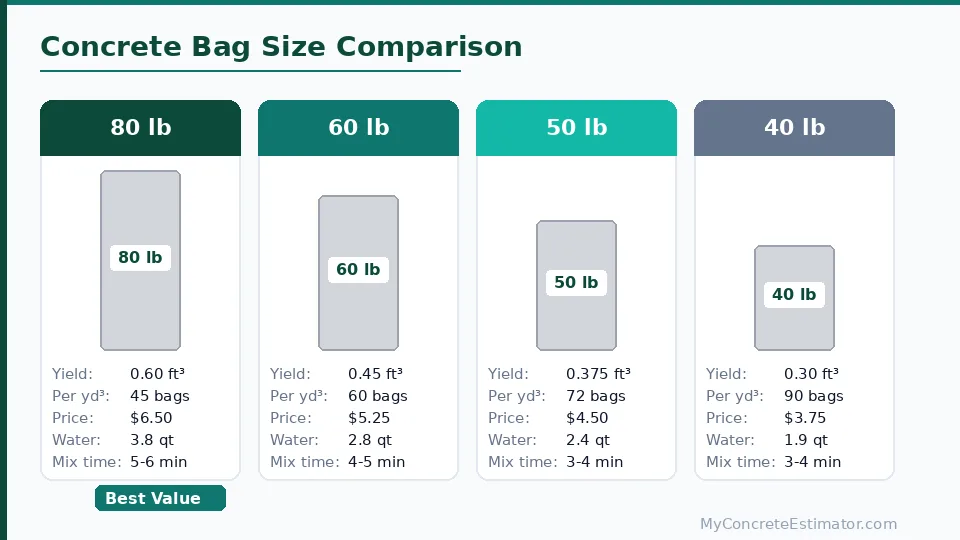
This reference table shows how many bags you need per cubic yard and per cubic foot for every standard bag size. These numbers are based on manufacturer data from Quikrete and Sakrete.
| Bag Size | Yield (ft³/bag) | Bags per yd³ | Coverage at 4″ thick | Weight per yd³ | Avg Price (2026) | Cost per yd³ |
|---|---|---|---|---|---|---|
| 80 lb | 0.60 | 45 | 1.80 ft² | 3,600 lbs | $6.50–$8.50 | $293–$383 |
| 60 lb | 0.45 | 60 | 1.35 ft² | 3,600 lbs | $5.25–$6.50 | $315–$390 |
| 50 lb | 0.375 | 72 | 1.13 ft² | 3,600 lbs | $4.50–$5.50 | $324–$396 |
| 40 lb | 0.30 | 90 | 0.90 ft² | 3,600 lbs | $3.75–$4.50 | $338–$405 |
The 80 lb bag is the most cost-effective option — it gives you the most concrete per dollar. But it is also the heaviest to carry and mix. If you have back concerns or limited lifting ability, 60 lb or 50 lb bags are a reasonable trade-off for slightly higher total cost.
Quikrete vs Sakrete — Which Brand to Choose?
Both Quikrete and Sakrete are the two dominant pre-mixed concrete brands in the US. For bag calculation purposes, their yields are identical — an 80 lb bag of either brand produces 0.60 cubic feet of finished concrete. The formula is the same.
Where they differ is availability and product range:
| Feature | Quikrete | Sakrete |
|---|---|---|
| Standard Mix PSI | 4,000 PSI (28-day) | 4,000 PSI (28-day) |
| High-Strength Mix | Quikrete 5000 (5,000 PSI) | Sakrete High Strength (5,000 PSI) |
| Fast-Setting Mix | Yes — sets in 20–40 min | Yes — sets in 30 min |
| Bag Sizes | 40, 50, 60, 80 lb | 40, 60, 80 lb |
| 80 lb Bag Yield | 0.60 ft³ | 0.60 ft³ |
| Availability | Home Depot, Lowe’s, Ace | Home Depot, Lowe’s, Menards |
| Market Share | Larger — wider variety | Strong second — competitive pricing |
Bottom line: use whichever brand your local store stocks. The bag count from our Quikrete bag calculator and Sakrete bag calculator is exactly the same because the yields are identical.
How Many Bags of Concrete Do I Need? (Quick Reference)
This table shows bag counts for the most commonly searched project sizes. All calculations use a 4-inch thickness and 10% waste factor. See our detailed slab guides: how many bags of concrete for a 10×10 slab, 12×12 slab, and 8×12 slab. See also our 10×20 slab guide and fence-post guide.
| Project | Size | 80 lb Bags | 60 lb Bags | 40 lb Bags | Cubic Yards |
|---|---|---|---|---|---|
| Small pad | 4×4 ft | 10 | 13 | 20 | 0.22 |
| AC pad | 4×6 ft | 15 | 20 | 30 | 0.33 |
| Shed base | 8×10 ft | 49 | 66 | 98 | 1.09 |
| Patio | 10×10 ft | 62 | 82 | 123 | 1.36 |
| Patio | 10×12 ft | 74 | 98 | 147 | 1.63 |
| Garage | 12×12 ft | 88 | 118 | 177 | 1.96 |
| Driveway (4″) | 10×20 ft | 123 | 164 | 245 | 2.72 |
| Driveway (5″) | 10×20 ft | 154 | 205 | 306 | 3.40 |
| Fence post (each) | 10″ dia × 36″ | 3 | 4 | 6 | 0.07 |
| Deck post (each) | 12″ dia × 48″ | 6 | 8 | 12 | 0.12 |
For projects over 1.5 cubic yards (68+ bags of 80 lb), strongly consider ordering ready-mix instead. Mixing that many bags by hand takes hours and the quality is harder to keep consistent across a large pour.
When to Use Bags vs Ready-Mix Concrete
The decision between bagged concrete and a ready-mix truck comes down to volume, time, and cost:
- Under 0.5 yd³ (under 23 bags of 80 lb) — Bags are the clear winner. No delivery fee, no minimum order, and manageable to mix by hand in a few hours.
- 0.5–1.0 yd³ (23–45 bags) — Bags still work, but the labor gets real. You will carry 1,800–3,600 lbs of material and spend 2–4 hours mixing.
- 1.0–1.5 yd³ (45–68 bags) — Transition zone. Call a ready-mix supplier for a quote. Factor in the short-load fee ($50–$150) and compare.
- Over 1.5 yd³ (68+ bags) — Ready-mix strongly recommended. At $130–$180 per yard delivered, it is cheaper than bags and far less labor.
Bagged concrete costs $290–$405 per cubic yard in materials alone (depending on bag size and local pricing). Ready-mix runs $130–$180 per cubic yard delivered in full loads. Bags cost more per yard but have no minimum order — which is why they win on small projects like post holes, patch repairs, and small pads.
Water Requirements for Concrete Bags
Getting the right water-to-cement ratio is critical. Too much water is the number one cause of weak concrete — adding just 1 extra quart per 80 lb bag can reduce strength by up to 40%.
| Bag Size | Water Needed | Mixing Method | Mix Time per Bag |
|---|---|---|---|
| 80 lb | 3.8 quarts (approx. 1 gallon) | Wheelbarrow or mixer | 5–6 minutes |
| 60 lb | 2.8 quarts | Wheelbarrow or mixer | 4–5 minutes |
| 50 lb | 2.4 quarts | Bucket or wheelbarrow | 3–4 minutes |
| 40 lb | 1.9 quarts | Bucket or wheelbarrow | 3–4 minutes |
Always add water gradually. Pour about three-quarters of the required water first, mix thoroughly, then add the rest in small amounts until you reach a thick, workable consistency. The concrete should hold its shape when sliced with a trowel — if it slumps flat, you have added too much water.
Tips for Buying and Mixing Bagged Concrete
Buy 10% more bags than your calculated number. Running out mid-pour is far worse than having a few extras. Unopened bags stored in a dry area last about 12 months before the cement starts absorbing moisture.
Check bags before purchasing. Squeeze the bag — if it feels lumpy or hard in spots, the cement has already partially hydrated. Those bags produce weak concrete. Only buy bags that feel uniformly powdery.
Use 80 lb bags for cost efficiency, 60 lb bags for comfort. The 80 lb bag gives you the lowest cost per cubic foot, but carrying and lifting 80 lbs repeatedly takes a toll. If you are mixing more than 20 bags, the 60 lb size is a practical compromise — slightly more expensive total but significantly easier on your body.
Rent a portable mixer for anything over 10 bags. A portable electric mixer handles 2 bags at a time in 3–4 minutes versus 5–6 minutes per bag by hand in a wheelbarrow. For a 45-bag project, that cuts your mixing time from roughly 4 hours to under 2 hours. Most equipment rental shops charge $50–$75 per day.
Mix 3–4 bags at a time, not more. Mixing too many bags at once makes it hard to achieve a consistent mix and increases the risk of the concrete starting to set before you can place it. Work in batches and place each batch before mixing the next.
Never add extra water to make mixing easier. The temptation is real — a soupy mix is easier to pour and spread. But excess water creates weak, porous concrete that cracks and crumbles. Follow the manufacturer’s water ratio exactly and use a shovel or mixer to work the stiff mix instead.
Pre-wet your forms and sub-base before pouring. Dry wood forms and dry gravel will absorb water from your concrete mix, weakening the bottom and edges. Mist everything with a hose before placing concrete — damp, not puddled.
Work in cooler temperatures when possible. Concrete sets faster in heat. On a 95°F day, you may only have 30–45 minutes of working time per batch. On a 70°F day, you get 60–90 minutes. Start early morning in summer.
Store unused bags off the ground. Never stack bags directly on bare concrete or soil — they absorb moisture through the bottom and harden within weeks. Place bags on a pallet or plastic sheeting in a covered, dry area.
Dispose of leftover mixed concrete properly. Never pour wet concrete into drains or waterways. Let any unused mix harden completely in the wheelbarrow or on a tarp, then break it up and dispose of it as solid waste or use it as fill material.
Concrete Bag Calculator — Frequently Asked Questions
One 80 lb bag yields 0.60 cubic feet. Calculate your project volume in cubic feet, add 10% for waste, then divide by 0.60 and round up. For a quick reference: 1 cubic yard needs 45 bags, a 10×10 ft slab at 4 inches needs about 62 bags.
One cubic yard (27 cubic feet) requires approximately 45 bags of 80 lb, 60 bags of 60 lb, 72 bags of 50 lb, or 90 bags of 40 lb concrete. The total weight is about 3,600 lbs regardless of bag size.
A 10×10 ft slab at 4 inches thick (with 10% waste) needs about 62 bags of 80 lb concrete, 82 bags of 60 lb, or 123 bags of 40 lb. At this volume (1.36 yd³), consider calling for a ready-mix quote to compare costs.
A standard fence post hole (10 inches diameter, 36 inches deep) needs about 3 bags of 80 lb concrete per post. For a 4×4 post, a 10-inch diameter hole provides about 3 inches of concrete around the post on all sides. Use Quikrete Fast-Setting mix to set posts without mixing — just pour dry mix into the hole and add water.
Quikrete bag counts are the same as any standard pre-mix. An 80 lb Quikrete bag yields 0.60 ft³. Calculate your volume in cubic feet, add waste, and divide by 0.60. Our calculator handles Quikrete and Sakrete identically because their yields are the same.
About 3.8 quarts (roughly 1 gallon) per 80 lb bag. Add water gradually — start with three-quarters of the recommended amount, mix thoroughly, then add small amounts until you reach a thick, workable consistency. Over-watering is the number one cause of weak concrete.
The concrete mix inside is the same — same PSI, same ingredients. The only difference is the amount per bag. An 80 lb bag yields 0.60 ft³ and costs about $6.50. A 60 lb bag yields 0.45 ft³ and costs about $5.25. The 80 lb bag gives you more concrete per dollar, but the 60 lb bag is easier to lift and carry.
Standard concrete mix (like Quikrete Original) sets in 24–48 hours for light use and reaches full strength (4,000 PSI) at 28 days. Fast-setting mix (like Quikrete Fast-Setting) sets in 20–40 minutes — ideal for post holes where you need quick results.
Approximately 12 months when stored properly in a dry, covered area off the ground. Bags stored on bare concrete or soil absorb moisture through the bottom and harden prematurely. If a bag feels lumpy and the lumps do not break apart when squeezed, discard it.
Yes. Quikrete and Sakrete use the same yields per bag size (0.60 ft³ for 80 lb, 0.45 ft³ for 60 lb, 0.30 ft³ for 40 lb). Our calculator works for both brands. The bag count will be identical regardless of which brand you buy.
A standard sedan or SUV can safely carry about 20–30 bags of 80 lb concrete (1,600–2,400 lbs) depending on the vehicle’s weight rating. A pickup truck handles 30–40 bags. Check your vehicle’s payload capacity in the owner’s manual. Our calculator shows how many car loads you will need.
Standard mix (4,000 PSI) works for most residential projects — patios, sidewalks, footings, and post holes. Use high-strength mix (5,000 PSI) for driveways, garage floors, and cold climates. Fast-setting mix is best for post holes and small repairs where you need quick results.
Ready-mix is cheaper per cubic yard ($130–$180 vs $290–$405 for bags). But bags have no delivery fee or minimum order. The crossover point is roughly 1–1.5 cubic yards — below that, bags are more practical. Above that, ready-mix saves both money and labor.
Use the Column project type in our calculator. Enter the Sonotube’s inner diameter and height, plus the number of tubes. A standard 12-inch diameter Sonotube that is 4 feet deep needs about 6 bags of 80 lb concrete per tube.
A standard deck post footing (12-inch diameter Sonotube, 48 inches deep) requires about 6 bags of 80 lb concrete per post. For a typical 12×16 ft deck with 6 posts, plan on about 36 bags total (with waste). Use the Post Hole or Column type in our calculator.