
Concrete Weight Calculator
Calculate weight in lbs, tons & kg for any pour
Table of Contents
What Is a Concrete Weight Calculator?
A concrete weight calculator converts your project dimensions into the total weight of the concrete pour — in pounds, tons, and kilograms. You need this number for three practical reasons: planning how to transport bagged concrete to the site, knowing whether your sub-grade can support the load, and sizing crane or lifting equipment for precast pieces.
The math is simple — weight equals volume times density — but the density is not always 150 lbs/ft³. Standard concrete, reinforced concrete, lightweight mixes, and heavyweight mixes all have different densities, and using the wrong one can throw your estimate off by 40% or more.
Our concrete weight calculator adds practical details most competitors skip:
- 4 concrete types — Standard (150 lbs/ft³), Reinforced (156 lbs/ft³), Lightweight (110 lbs/ft³), and Heavyweight (250 lbs/ft³). Each uses the correct density for accurate results.
- Transport planning — Car loads, pickup loads, mixer trucks, and dump trucks calculated automatically so you know how many trips to plan.
- Wet vs cured weight — Fresh concrete weighs about 4% more than cured concrete due to excess water. The calculator shows both.
- Weight per square foot — Useful for structural load calculations and sub-grade requirements.
- Direct volume input — Already know your cubic yards? Enter it directly instead of dimensions.
How Much Does Concrete Weigh?
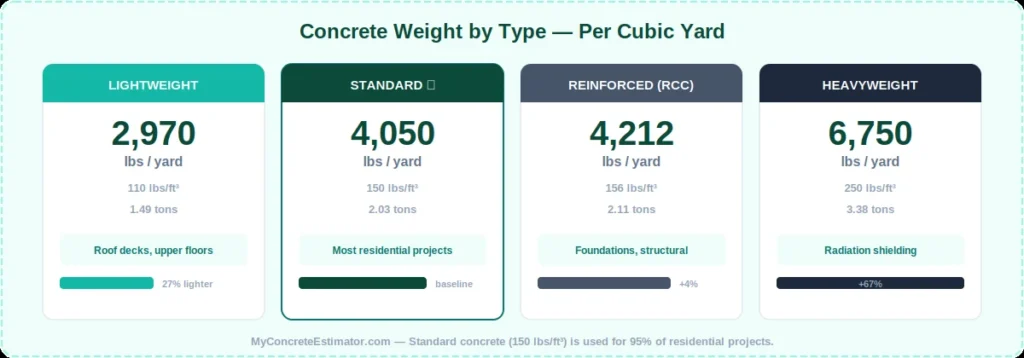
The weight depends on the type of concrete and the aggregates used. Here are the standard densities:
| Concrete Type | Density (lbs/ft³) | Weight per Cubic Yard | Weight per Cubic Meter | Common Uses |
|---|---|---|---|---|
| Standard (normal weight) | 150 | 4,050 lbs (2.03 tons) | 2,400 kg | Slabs, patios, sidewalks, driveways — most residential work |
| Reinforced (RCC) | 156 | 4,212 lbs (2.11 tons) | 2,500 kg | Foundations, columns, structural slabs — concrete with rebar |
| Lightweight | 110 | 2,970 lbs (1.49 tons) | 1,760 kg | Upper floors, roof decks, insulating fills — pumice/perlite aggregate |
| Heavyweight | 250 | 6,750 lbs (3.38 tons) | 4,000 kg | Radiation shielding, ballast, counterweights — barite/iron aggregate |
For most residential projects, use 150 lbs/ft³. This is the standard density for concrete made with Portland cement, sand, and crushed stone aggregate. The ACI 318-19 standard defines normal-weight concrete as having a density between 135 and 160 lbs/ft³.
Quick Reference — Concrete Weight by Common Sizes
This table shows the weight of standard concrete (150 lbs/ft³) at 4 inches thick for common slab sizes:
| Slab Size | Volume (yd³) | Weight (lbs) | Weight (tons) | Car Loads (~800 lbs) | Pickup Loads (~2,000 lbs) |
|---|---|---|---|---|---|
| 4×4 ft | 0.20 | 800 | 0.40 | 1 | 1 |
| 8×8 ft | 0.79 | 3,200 | 1.60 | 4 | 2 |
| 10×10 ft | 1.23 | 5,000 | 2.50 | 7 | 3 |
| 12×12 ft | 1.78 | 7,200 | 3.60 | 9 | 4 |
| 15×15 ft | 2.78 | 11,250 | 5.63 | 15 | 6 |
| 20×20 ft | 4.94 | 20,000 | 10.00 | 25 | 10 |
| 24×24 ft | 7.11 | 28,800 | 14.40 | 36 | 15 |
| 30×30 ft | 11.11 | 45,000 | 22.50 | 57 | 23 |
| 30×40 ft | 14.81 | 60,000 | 30.00 | 75 | 30 |
| 40×60 ft | 29.63 | 120,000 | 60.00 | 150 | 60 |
These numbers assume exactly 4 inches of thickness with no waste factor. Add 10% to all figures for a realistic order estimate.
Wet Concrete vs Cured Concrete: Weight Difference
Fresh wet concrete weighs approximately 4% more than fully cured concrete. The difference is the excess mix water that evaporates during the curing process over 28 days.
| State | Density (lbs/ft³) | Weight per Cubic Yard | When |
|---|---|---|---|
| Wet (fresh pour) | ~156 | ~4,212 lbs | During placement and first 24 hours |
| Setting (1–7 days) | ~152 | ~4,104 lbs | Reaches ~70% strength |
| Cured (28 days) | ~145 | ~3,915 lbs | Full design strength |
Why this matters: When planning transport, use the wet weight — that is what the truck or vehicle actually carries. When calculating structural dead loads, use the cured weight — that is the permanent load on the foundation.
Transport Planning: How to Move Concrete
Concrete is heavy. A single cubic yard weighs over 2 tons. Here is how different vehicles handle concrete transport:
| Vehicle | Safe Capacity | Concrete per Trip | Best For |
|---|---|---|---|
| Sedan / SUV | ~800 lbs | 10 bags of 80 lb | Very small pours, post holes, patches |
| Half-ton pickup | ~1,500–2,000 lbs | 18–25 bags of 80 lb | Small DIY projects under 1 yd³ |
| Three-quarter-ton pickup | ~2,500–3,000 lbs | 30–38 bags of 80 lb | Mid-size DIY projects |
| Utility trailer | ~3,000–5,000 lbs | 38–63 bags of 80 lb | Larger bag orders, sand/gravel pickup |
| Ready-mix truck | ~40,000 lbs (10 yd³) | 10 cubic yards | Any project over 1 yd³ |
| Dump truck | ~20,000 lbs (10 tons) | Demolition debris only | Removing old concrete |
So, for anything over 1 cubic yard (4,050 lbs), order ready-mix delivery rather than hauling bags. A single ready-mix truck replaces 25+ car trips or 5+ pickup loads — and delivers better quality concrete.
Structural Load: Why Concrete Weight Matters for Foundations
Every concrete slab, wall, or footing creates a dead load — the permanent weight the underlying soil or structure must support. This dead load must be calculated during design to ensure the sub-grade or supporting structure can handle it.
Here is how concrete thickness translates to dead load per square foot:
| Thickness | Dead Load (lbs/ft²) | Dead Load (PSF) | Typical Application |
|---|---|---|---|
| 3 inches | 37.5 | 37.5 PSF | Overlay, topping slab |
| 4 inches | 50.0 | 50.0 PSF | Standard patio, sidewalk |
| 5 inches | 62.5 | 62.5 PSF | Driveway, garage floor |
| 6 inches | 75.0 | 75.0 PSF | Heavy-duty driveway, garage |
| 8 inches | 100.0 | 100.0 PSF | Foundation wall, commercial slab |
| 12 inches | 150.0 | 150.0 PSF | Spread footing, structural element |
The soil must support both the dead load (concrete weight) and the live load (people, vehicles, equipment). A compacted gravel sub-base typically supports 2,000–3,000 PSF. Native soil varies widely — from 1,000 PSF (soft clay) to 8,000+ PSF (bedrock). For any structural pour, verify soil bearing capacity with a geotechnical engineer.
Tips for Concrete Weight Planning
Never overload your vehicle. An 80 lb bag of concrete does not feel heavy by itself, but 25 bags (2,000 lbs) exceeds the payload capacity of most sedans and many SUVs. Check your vehicle’s payload rating in the owner’s manual — not the towing capacity, the payload capacity. These are different numbers.
Distribute weight evenly. When loading bags into a car or truck, stack them evenly across the cargo area. Concentrated weight on one side affects handling, braking, and suspension. Never stack bags higher than the bed rails of a pickup.
Plan for return trips. Our calculator shows car loads and pickup loads so you can estimate the number of trips before you start. Two trips planned in advance are better than one overloaded trip that damages your vehicle.
Account for reinforcement weight. A typical rebar grid adds 3–5% to the total concrete weight. For a 20×20 ft slab with #4 rebar at 18 inches on center, the steel adds about 300–500 lbs. Select “Reinforced (RCC)” in the calculator to include this.
Use wet weight for transport, cured weight for structures. Fresh concrete weighs about 4% more than cured concrete. When planning delivery or vehicle loading, use the higher wet weight. When calculating foundation loads, use the lower cured weight.
Verify sub-grade capacity for heavy pours. A 6-inch garage slab weighs 75 lbs per square foot before you park a car on it. Add a 4,000 lb vehicle and you are at 85+ PSF concentrated on four tire patches. The sub-grade must handle this — proper compaction and a 4-inch gravel base are not optional for heavy-load slabs.
Consider demolition weight before removing old concrete. A 20×20 ft slab at 4 inches thick weighs 10 tons when you break it up for removal. That is a full dump truck load. Factor demolition hauling into your removal budget — it is often the most expensive part of the job.
Use lightweight concrete where weight matters. Upper-floor slabs, roof decks, and elevated structures benefit from lightweight concrete (110 lbs/ft³ vs 150 lbs/ft³). The weight savings — 27% less per cubic yard — can reduce structural steel requirements and foundation costs on multi-story buildings.
Round up for safety. When estimating weight for transport or lifting, always round up to the next practical unit. If the calculator shows 1,950 lbs, plan for 2,000 lbs. A 5% error in volume translates directly to a 5% error in weight — and overloaded equipment is a safety hazard.
Weight data helps you compare delivery options. If your project needs 5 yd³ (20,000 lbs), you can haul 250 bags in 10 pickup loads — or order one ready-mix truck. The truck costs $750–$900 delivered. Ten pickup loads at $6.50/bag cost $1,625 in bags plus fuel and 5+ hours of driving. Weight data makes the math obvious.
Comparison Table: Weight by Concrete Type
| Type | Density (lbs/ft³) | Weight per yd³ | Aggregates Used | Cost Premium | Applications |
|---|---|---|---|---|---|
| Standard | 150 | 4,050 lbs | Sand + crushed stone | Baseline | Most residential and commercial |
| Reinforced (RCC) | 156 | 4,212 lbs | Sand + stone + steel rebar | +$0.50–$1.50/ft² | Structural slabs, foundations, columns |
| Lightweight | 110 | 2,970 lbs | Pumice, perlite, expanded clay | +15–25% | Upper floors, roof decks, insulation |
| Heavyweight | 250 | 6,750 lbs | Barite, magnetite, iron pellets | +50–100% | Nuclear shielding, ballast, counterweights |
So, standard 150 lbs/ft³ concrete covers 95% of residential projects. Switch to reinforced (156 lbs/ft³) when rebar is included, lightweight (110 lbs/ft³) for elevated pours, or heavyweight (250 lbs/ft³) for specialized industrial applications.
A cubic yard of standard concrete weighs approximately 4,050 lbs (2.03 tons or 1,837 kg). This assumes a density of 150 lbs per cubic foot, which is standard for concrete made with Portland cement, sand, and crushed stone aggregate.
One cubic foot of standard concrete weighs approximately 150 lbs (68 kg). Reinforced concrete with rebar weighs about 156 lbs/ft³, lightweight concrete about 110 lbs/ft³, and heavyweight concrete up to 250 lbs/ft³.
A 20×20 ft slab at 4 inches thick weighs approximately 20,000 lbs (10 tons). At 6 inches thick, it weighs about 30,000 lbs (15 tons). The formula is: 20 × 20 × (thickness in ft) × 150 lbs/ft³.
Yes. Fresh wet concrete weighs about 4% more than fully cured concrete — approximately 156 lbs/ft³ vs 145 lbs/ft³ for standard mix. The difference is excess mix water that evaporates during the 28-day curing process. Use wet weight for transport planning and cured weight for structural load calculations.
An 80 lb bag of dry premix concrete weighs approximately 90 lbs when mixed with water (about 1.3 gallons of water weighing ~10.8 lbs). Once cured, it weighs slightly less as excess water evaporates. The mixed bag yields 0.60 cubic feet of concrete.
A half-ton pickup truck (F-150, Silverado 1500, Ram 1500) can safely carry 18–25 bags of 80 lb concrete (1,440–2,000 lbs), depending on payload rating. A three-quarter-ton truck can carry 30–38 bags. Always check your vehicle’s payload capacity in the owner’s manual — not the towing capacity.
A standard 2-car driveway (20×24 ft at 5 inches thick) weighs approximately 30,000 lbs (15 tons). A single-car driveway (12×24 ft at 5 inches) weighs about 18,000 lbs (9 tons). This weight must be supported by properly compacted sub-grade and gravel base.
A standard 8×8×16 inch concrete block (CMU) weighs 28–35 lbs for a normal-weight hollow block and 38–43 lbs for a solid block. Lightweight CMU blocks weigh 22–28 lbs. The weight varies by manufacturer and aggregate type.
Multiply the volume in cubic feet by the density in lbs/ft³. For standard concrete: Weight (lbs) = Length (ft) × Width (ft) × Thickness (ft) × 150. To convert thickness from inches to feet, divide by 12. For example: 20 × 20 × (4÷12) × 150 = 20,000 lbs.
A fully loaded ready-mix truck carrying 10 cubic yards weighs approximately 66,000–70,000 lbs (33–35 tons) — about 40,000 lbs of concrete plus 26,000–30,000 lbs for the truck itself. This is why ready-mix trucks can damage residential driveways and require proper access planning.
Lightweight concrete uses low-density aggregates like pumice, perlite, or expanded clay instead of standard stone. It weighs 90–120 lbs per cubic foot (about 2,970 lbs per cubic yard) — 27% lighter than standard concrete. It is used for upper floors, roof decks, and insulating fills where reducing dead load matters.
A properly poured 4-inch concrete slab at 3,000 PSI can support approximately 3,000 lbs per square foot of compressive load. However, the practical load capacity depends on the sub-grade support, reinforcement, and how the load is distributed. For residential patios, a 4-inch slab handles foot traffic and furniture easily. For vehicle parking, use 5–6 inches.
Divide pounds by 2,204.62 to get metric tons. Or multiply by 0.000453592 to get metric tons. For example: 4,050 lbs ÷ 2,204.62 = 1.837 metric tons. One cubic yard of standard concrete = 1.837 metric tons. Our calculator shows both short tons (2,000 lbs) and metric tons automatically.
Broken concrete debris weighs about the same as the original slab — 150 lbs per cubic foot for standard concrete. A 20×20 ft slab at 4 inches thick produces about 10 tons of debris. A standard dump truck holds 10–12 tons. Budget $300–$600 per dump truck load for hauling and disposal at a concrete recycling facility.
Yes, but only by 3–5%. Reinforced concrete (with rebar) weighs about 156 lbs per cubic foot compared to 150 lbs/ft³ for unreinforced standard concrete. That adds about 160 lbs per cubic yard. The difference comes from the embedded steel, which is denser than the concrete it displaces.