
By Mike Richardson, construction estimator with 10+ years of experience.
Concrete Driveway Calculator
Estimate volume, bags, cost & materials for any driveway
🧱 Materials Breakdown
💰 Estimated Cost
💪 Physical Effort
📋 Driveway Size Quick Reference — Concrete Needed
▼| Driveway Size | Sq Ft | 4″ Thick (yd³) | 5″ Thick (yd³) | 6″ Thick (yd³) | Est. Cost Range |
|---|
Volumes include 10% waste. Cost range based on $8–$15/sq ft installed (plain finish). Ready-mix at ~$155/yd³.
This calculator provides estimates only. Always get quotes from local concrete contractors and verify with your ready-mix supplier before ordering. This website is not affiliated with any concrete supplier.
Table of Contents
What Is a Concrete Driveway and Why Choose It?
A concrete driveway is a paved vehicle surface made from Portland cement concrete, typically poured 4 to 6 inches thick over a compacted gravel sub-base. Concrete driveways are the most popular paved driveway material in the United States, chosen for their combination of strength, longevity, and curb appeal.
Why concrete over other materials? It lasts 25 to 30 years with minimal maintenance — roughly twice the lifespan of asphalt. It handles heavier vehicle loads without rutting. It can be finished in dozens of decorative styles (stamped, stained, exposed aggregate) that asphalt and gravel can’t match. And while the upfront cost is higher than asphalt or gravel, the per-year cost of ownership is lower because concrete requires almost no ongoing maintenance beyond occasional sealing.
How to Calculate Concrete for a Driveway
Driveway concrete is calculated the same way as any slab — length × width × thickness, converted to cubic yards. Here’s the step-by-step process:
Step 1: Measure the Driveway Area
Measure the length (garage to street) and width (side to side) in feet. For L-shaped or irregular driveways, break the shape into rectangles, calculate each separately, and add the results.
Driveway Area (sq ft) = Length × Width
Step 2: Calculate Volume
Convert thickness from inches to feet by dividing by 12, then multiply by the area. Divide the result by 27 to convert cubic feet to cubic yards.
Volume (yd³) = Area (sq ft) × (Thickness in inches ÷ 12) ÷ 27
Step 3: Add Waste
Add 10% for a standard rectangular driveway. Use 15% for curved driveways, L-shapes, or driveways with thickened edges.
Worked Example
A standard 2-car driveway measuring 20 feet wide by 20 feet long, poured 5 inches thick:
Area: 20 × 20 = 400 sq ft. Volume: 400 × (5 ÷ 12) ÷ 27 = 400 × 0.4167 ÷ 27 = 6.17 yd³. With 10% waste: 6.17 × 1.10 = 6.79 yd³. Supplier order (quarter-yard rounding): 7.00 yd³. At $155/yd³, that’s about $1,085 in concrete material.
Concrete Driveway Calculator: Step-by-Step Guide
Step 1: Use a Preset or Enter Dimensions
Tap a preset for common driveway sizes — single-car (10×20), two-car (20×20), wide two-car (24×24), long drive (12×50), or RV pad (14×40). Or type your own length and width in feet.
Step 2: Select Thickness
Use the thickness buttons: 4 inches for standard passenger vehicles, 5 inches for trucks and SUVs (recommended for most driveways), and 6 inches for RVs, delivery trucks, and heavy equipment. Tap “Custom” to enter any thickness.
Step 3: Toggle Extras
Check “Include gravel sub-base” to add a 6-inch compacted gravel estimate (enabled by default — every driveway needs a gravel base). Check “Include rebar / wire mesh” for reinforcement quantities.
Step 4: Adjust Options
Set waste allowance (10% default) and enter your local ready-mix price per cubic yard ($155 default).
Step 5: Read Your Results
Results update instantly. You’ll see concrete volume in cubic yards, cubic feet, and square footage, plus supplier order quantity (rounded to quarter-yard increments — matching how suppliers actually bill), bag counts, gravel tonnage, rebar quantities, cost estimates (material + installed range), and physical effort data including total weight, number of ready-mix trucks, and estimated pour time.
How Thick Should a Concrete Driveway Be?
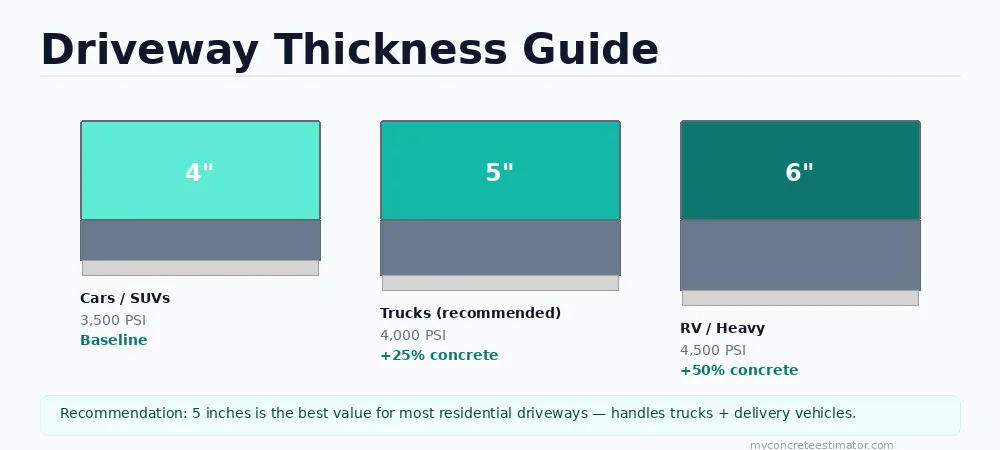
Thickness is the single most important structural decision for a driveway. Every extra inch adds 25% more concrete but dramatically increases load capacity and lifespan.
| Thickness | Best For | Min PSI | Volume per 100 ft² | Cost Impact |
|---|---|---|---|---|
| 4 inches | Passenger cars, light SUVs | 3,500 PSI | 1.23 yd³ | Baseline |
| 5 inches | Full-size trucks, heavy SUVs | 4,000 PSI | 1.54 yd³ | +25% concrete |
| 6 inches | RVs, delivery trucks, equipment | 4,500 PSI | 1.85 yd³ | +50% concrete |
I really want to suggest going with 5 inches for most residential driveways. A 4-inch driveway is the code minimum, but it leaves almost no margin for heavy vehicles, delivery trucks, or moving vans. The cost difference between 4 and 5 inches on a 400 sq ft driveway is roughly $150–$250 in concrete — a tiny price for a slab that needs to last 30 years.
Driveway Size and Cost Quick Reference
Use this table to ballpark your project before running the calculator. All volumes include 10% waste. Cost range is for plain broom-finish concrete, professionally installed.
| Driveway Size | Square Feet | Concrete at 5″ (yd³) | Material Cost | Installed Cost |
|---|---|---|---|---|
| Single-Car (10×20) | 200 | 3.4 | $525 | $1,600–$3,000 |
| 2-Car (20×20) | 400 | 6.8 | $1,050 | $3,200–$6,000 |
| 2-Car Wide (24×24) | 576 | 9.8 | $1,520 | $4,600–$8,600 |
| Long Drive (12×50) | 600 | 10.2 | $1,580 | $4,800–$9,000 |
| RV Pad (14×40) | 560 | 9.5 | $1,475 | $4,500–$8,400 |
| 2-Car + Turnaround (24×36) | 864 | 14.7 | $2,280 | $6,900–$13,000 |
Material cost is concrete only at $155/yd³. Installed cost includes excavation, gravel base, forming, concrete, finishing, and cleanup at $8–$15 per square foot (plain broom finish). Decorative finishes (stamped, stained, exposed aggregate) add $6–$15 per square foot on top.
Concrete vs. Asphalt vs. Pavers: Driveway Comparison
| Factor | Concrete | Asphalt | Pavers |
|---|---|---|---|
| Installed Cost | $8–$15/ft² | $4–$8/ft² | $12–$25/ft² |
| Lifespan | 25–30 years | 12–20 years | 25–50 years |
| Maintenance | Seal every 2–3 years | Seal every 2–5 years, patch cracks | Re-sand joints, replace individual pavers |
| Appearance | Many finishes (stamped, stained, exposed) | Black only (fades to gray) | Wide variety of colors/patterns |
| Heavy Vehicle Support | Excellent (at 5–6″) | Good (can soften in extreme heat) | Excellent (flexible base) |
| Cold Weather | Resistant with air-entrained mix | Good (flexible in freeze-thaw) | Excellent (joints flex) |
| Time to Use After Install | 7 days minimum | 2–3 days | Immediate |
| DIY Feasibility | Difficult (large pour, finishing skill) | Not DIY (hot mix, equipment) | Moderate (labor-intensive but doable) |
So, concrete is the best overall value for most residential driveways. It costs less than pavers, lasts twice as long as asphalt, and offers the widest range of decorative options. Asphalt is the budget pick for very long driveways (over 1,000 sq ft) where the per-square-foot savings add up. Pavers are the premium choice for curb appeal and areas with significant frost heave, but the installation cost is substantially higher.
Gravel Sub-Base: Why Every Driveway Needs One
Pouring concrete directly on bare soil is a recipe for cracking and settlement. Every concrete driveway needs a 4 to 6 inch layer of compacted crushed gravel beneath the slab. The gravel sub-base does three critical things: it provides uniform support so the slab doesn’t develop stress points over soft spots, it drains water away from the bottom of the concrete to prevent frost heave, and it creates a stable platform that won’t compress or shift under vehicle loads.
Our calculator estimates the gravel needed when you check “Include gravel sub-base.” The calculation assumes a 6-inch compacted depth with a 20% compaction factor (you need to order 20% more loose gravel than the finished compacted volume). For a 400 sq ft driveway, that’s about 4.4 cubic yards or roughly 6 tons of crushed gravel — typically $175–$220 delivered.
Reinforcement: Rebar vs. Wire Mesh
Reinforcement prevents cracking by holding the concrete together when it shifts. For driveways, you have two common options:
| Option | Description | Best For | Cost per sq ft |
|---|---|---|---|
| 6×6 Welded Wire Mesh | Pre-made wire grid in 5×150 ft rolls | Standard residential driveways | $0.15–$0.30 |
| #3 Rebar Grid (18″ o.c.) | 3/8″ rebar tied in a grid pattern | Heavy-load driveways, RV pads | $0.50–$1.00 |
| Fiber Reinforcement | Polypropylene fibers mixed into concrete | Crack control (not structural) | $0.10–$0.20 (added to mix price) |
For most residential driveways, 6×6 welded wire mesh is sufficient and the most cost-effective option. It controls shrinkage cracking and holds the slab together if cracks do develop. For driveways supporting heavy vehicles (RVs, delivery trucks, equipment), upgrade to a #3 rebar grid at 18-inch spacing — the cost increase is modest but the structural benefit is significant.
Tips for Pouring a Concrete Driveway
Get at least 3 contractor quotes before committing
Concrete driveway prices vary 30–50% between contractors in the same market. Get written quotes that itemize every line: demolition, gravel base, forming, concrete, finishing, sealing, and cleanup. The cheapest bid isn’t always the best — ask what thickness, PSI, and reinforcement each contractor specifies.
Specify 4,000 PSI minimum — 4,500 PSI in freeze-thaw zones
The minimum concrete strength for exterior flatwork is 3,500 PSI, but 4,000 PSI is the practical standard for driveways. In regions that experience freeze-thaw cycling (most of the northern US), specify 4,500–5,000 PSI with air entrainment. Air-entrained concrete contains microscopic air bubbles that let the concrete expand when water inside it freezes — preventing the surface scaling and spalling that destroys driveways in cold climates.
Compact the gravel base before pouring — then compact it again
Gravel must be compacted in lifts (layers) of 2–3 inches at a time using a plate compactor. Dumping 6 inches of loose gravel and running a compactor over the top once is not adequate — the bottom 3 inches won’t be compacted, and the slab will settle unevenly. Two passes of compaction at 3-inch lifts is the minimum.
Install control joints every 8 to 12 feet
Concrete cracks. The question is where. Control joints are saw-cut or tooled grooves that create intentional weak points where the concrete will crack in a straight, hidden line rather than randomly across the surface. The rule of thumb: control joint spacing (in feet) should be no more than 2.5 to 3 times the slab thickness (in inches). For a 4-inch driveway, that’s every 10–12 feet. For a 5-inch driveway, every 12–15 feet.
Pour the entire driveway in one session
Cold joints — seams where one batch of concrete cured before the next was poured against it — are the weakest points in any slab. A driveway should be poured as a single continuous operation. For large driveways requiring multiple trucks, coordinate delivery timing so the second truck arrives before the first load begins to set (typically within 60–90 minutes).
Broom finish is the best all-around surface
A broom finish is created by dragging a broom across the wet concrete surface, leaving fine parallel lines that provide excellent wet-weather traction. It’s included in the standard pour price, lasts as long as the slab, and never needs refinishing. Smooth trowel finishes look sleek but become dangerously slick when wet — avoid them for driveways.
Don’t drive on it for at least 7 days
Concrete reaches about 70% of its design strength at 7 days and full strength at 28 days. Light foot traffic is fine after 24–48 hours. Passenger vehicles can drive on it after 7 days. Wait 10–14 days before parking heavy trucks or RVs. Rushing this schedule causes surface damage and cracking that can’t be repaired.
Seal the driveway 28 days after pouring
A penetrating concrete sealer protects the surface from water absorption, de-icing salt damage, oil stains, and UV degradation. Apply the first coat 28 days after pouring (once the concrete reaches full cure), then re-seal every 2–3 years. In freeze-thaw climates, sealing is not optional — it’s the difference between a 15-year and a 30-year driveway.
Slope the driveway 1–2% away from the garage
A properly graded driveway directs rainwater away from the garage and foundation. The minimum slope is 1% (1/8 inch per foot), and 2% (1/4 inch per foot) is preferred. Your contractor should verify the grade with a laser level before pouring.
Order 10% more concrete than calculated — always
Subgrade is never perfectly flat. Forms flex. Concrete sticks to the chute and the truck drum. Running short during a driveway pour is a disaster — you can’t stop, clean up, and call for another truck without creating a cold joint. The extra concrete costs $30–$50 per quarter-yard; the cold joint costs $2,000+ to fix.
Common Driveway Mistakes to Avoid
Skipping the gravel base. Pouring concrete directly on topsoil or clay is the most common DIY mistake. The soil will compact unevenly under vehicle weight, causing the slab to crack and settle. Every driveway needs at least 4–6 inches of compacted crushed gravel beneath the concrete.
Using 4-inch thickness for all driveways. A 4-inch driveway handles passenger cars on well-compacted soil. But if a delivery truck, moving van, or fire engine drives on it — which happens to every driveway eventually — 4 inches is marginal. Use 5 inches as the standard and save 4 inches only for dedicated passenger-vehicle areas with confirmed good soil.
Forgetting isolation joints where the driveway meets the garage. The driveway slab and the garage floor are separate structures that move independently. Without an isolation joint (a strip of compressible material) between them, one will crack the other. The same applies where the driveway meets the sidewalk or the street apron.
Ordering the exact calculated volume. Ready-mix suppliers bill in quarter-yard increments. If your calculator shows 5.19 yd³, the supplier rounds to 5.25 — and you should round to 5.50 or 5.75 to have a safety margin. The cost of an extra quarter-yard ($40) is nothing compared to running short and creating a cold joint.
Skipping sealer in freeze-thaw climates. Unsealed concrete absorbs water. When that water freezes, it expands inside the concrete, popping the surface layer off in flakes (spalling). In the northern US, an unsealed driveway can start spalling within 3–5 years. Sealing costs $0.50–$1.50 per square foot and should be done at 28 days and every 2–3 years after.
Multiply length (ft) × width (ft) × thickness (in inches ÷ 12), then divide by 27 for cubic yards. Add 10% for waste. For example, a 20×20-foot driveway at 5 inches thick needs about 6.8 cubic yards of concrete including waste. Our calculator does this automatically and rounds up to the quarter-yard increments that suppliers actually bill.
A standard concrete driveway costs $8 to $15 per square foot installed for a plain broom finish, or $3,200 to $6,000 for a typical 20×20 two-car driveway. Decorative finishes (stamped, stained, exposed aggregate) add $6–$15 per square foot. Concrete material alone runs $120–$210 per cubic yard depending on your region. Our calculator estimates both material cost and installed cost ranges.
Use 4 inches for light passenger vehicles only, 5 inches for most residential driveways (recommended — handles trucks and SUVs), and 6 inches for RVs, delivery trucks, and heavy equipment. Each additional inch adds 25% more concrete but significantly increases load capacity and lifespan. Going from 4 to 5 inches is the single best investment you can make in driveway longevity.
A 20×20 concrete driveway (400 sq ft) costs $3,200 to $6,000 installed with a plain broom finish. Concrete material alone at 5 inches thick is about 6.8 cubic yards, costing $1,050–$1,400 depending on your local ready-mix price. Add gravel sub-base ($175–$220), forming, labor, and finishing for the total installed cost.
A standard 2-car driveway is 20×20 feet (400 sq ft). At 4 inches thick: 5.4 yd³. At 5 inches thick: 6.8 yd³. At 6 inches thick: 8.1 yd³. All figures include 10% waste. Most 2-car driveways are poured from a single ready-mix truck (9–10 yd³ capacity).
Asphalt is cheaper upfront at $4–$8 per square foot installed vs. $8–$15 for concrete. But asphalt lasts only 12–20 years and requires resealing every 2–5 years, while concrete lasts 25–30 years with minimal maintenance. Over a 30-year period, concrete is typically cheaper per year of service. For a 400 sq ft driveway, asphalt saves $1,600–$2,800 upfront but costs more in lifetime maintenance.
Not always, but it’s strongly recommended. At minimum, use 6×6 welded wire mesh — it controls shrinkage cracking and holds the slab together if cracks develop. For driveways supporting heavy vehicles (trucks, RVs, equipment), upgrade to a #3 rebar grid at 18-inch spacing. Fiber reinforcement (mixed into the concrete) helps with surface cracking but is not a structural substitute for steel reinforcement.
A properly poured and maintained concrete driveway lasts 25 to 30 years. Key factors that affect lifespan: adequate thickness (5 inches minimum recommended), proper gravel sub-base, correct PSI for your climate, control joints at proper spacing, and regular sealing every 2–3 years. In freeze-thaw climates, air-entrained concrete and sealing are essential — without them, surface spalling can start within 3–5 years.
Use 4,000 PSI minimum for standard residential driveways. In freeze-thaw climates (most of the northern US), specify 4,500–5,000 PSI with air entrainment. For heavy-vehicle driveways (RVs, commercial trucks), 4,500 PSI is the minimum. ACI 302.1R recommends a minimum of 4,000 PSI for all exterior flatwork exposed to weather.
You need 4 to 6 inches of compacted crushed gravel (3/4-inch minus or road base) beneath every concrete driveway. For a 400 sq ft driveway with a 6-inch base, that’s about 4.4 cubic yards or 6 tons of gravel (including 20% compaction factor). Budget $175–$220 for gravel delivery. Our calculator estimates this automatically when you check “Include gravel sub-base.”
Technically yes, but it’s one of the hardest DIY concrete projects. A 20×20 driveway at 5 inches needs about 7 cubic yards — over 300 bags if mixed by hand (not practical) or a ready-mix truck delivery that must be placed, screeded, and finished within 60–90 minutes before it begins to set. You’ll need at least 3–4 experienced helpers, a screed board, bull float, edger, broom, and control joint groover. If you’ve never worked with concrete, hire a professional — a botched driveway costs more to fix than to do right the first time.
Wait at least 7 days for passenger vehicles, 10–14 days for heavy trucks or RVs. Light foot traffic is safe after 24–48 hours. The concrete reaches about 70% strength at 7 days and full design strength at 28 days. Don’t apply sealer until 28 days. In cold weather, extend all cure times by 50% — concrete cures much more slowly below 50°F.
A control joint is a tooled or saw-cut groove in the concrete surface that creates a planned weak point where the slab will crack in a straight, hidden line. Without control joints, concrete cracks randomly across the surface. Space them every 8–12 feet for a 4-inch slab, or every 10–15 feet for a 5-inch slab. The joint depth should be at least 1/4 of the slab thickness. Saw-cut joints within 6–18 hours of finishing, before shrinkage cracking begins.
Ready-mix concrete costs $120 to $210 per cubic yard across most US markets in 2026. Coastal and dense urban markets (Boston, Seattle, San Francisco) run $170–$260. Southern and Midwest markets are typically $125–$155. Most suppliers also charge a flat delivery fee ($50–$150) and short-load surcharges ($50–$150) for orders below 5–7 cubic yards. Always call your local plant for a current quote.
Yes — especially in freeze-thaw climates. A penetrating concrete sealer costs $0.50–$1.50 per square foot and protects against water absorption, de-icing salt damage, oil stains, and UV degradation. Apply the first coat 28 days after pouring (after full cure), then re-seal every 2–3 years. In freeze-thaw zones, sealing is the difference between a 15-year and a 30-year driveway. Acrylic sealers enhance appearance; silane/siloxane sealers provide the best water repellency.