
Concrete Cost Calculator
Estimate material, labor & total project cost
Table of Contents
What Is a Concrete Cost Calculator and Why Do You Need One?
A concrete cost calculator estimates the total price of a concrete project by combining material cost, delivery fees, and labor — based on your exact dimensions, mix strength, and region. Instead of guessing or getting blindsided by a contractor’s quote, you enter your slab size and the calculator shows a detailed cost breakdown in seconds.
Most homeowners dramatically underestimate concrete costs because they only think about the price of concrete itself. But the material — typically $125–$200 per cubic yard — usually accounts for just 30–45% of the total bill. Labor, delivery, short-load fees, and finishing add up fast. A 20×20 ft patio that looks like a “$500 project” in material actually runs $2,400–$5,200 installed.
Our concrete cost calculator gives you the full picture that most competitors skip:
- 6 project presets — Slab/Patio, Driveway, Sidewalk, Garage Floor, Footing, and Custom. Each preset auto-fills typical thickness and labor rates so you get a realistic estimate instantly.
- Regional pricing — Concrete costs vary up to 40% between regions. A Midwest pour runs 15% below national average while the West Coast runs 20% above. The calculator adjusts automatically.
- DIY vs Professional comparison — See the actual cost difference between mixing bags yourself and hiring a contractor with ready-mix. For small pours, DIY can save 50–60%. For larger projects, ready-mix is often cheaper.
- Full cost breakdown — Material, delivery, labor, area, volume, weight, and bag count — all itemized so you know exactly where every dollar goes.
- Instant results with live preview — No “Calculate” button. Results and the 3D preview update as you type.
How Much Does Concrete Cost in 2026?
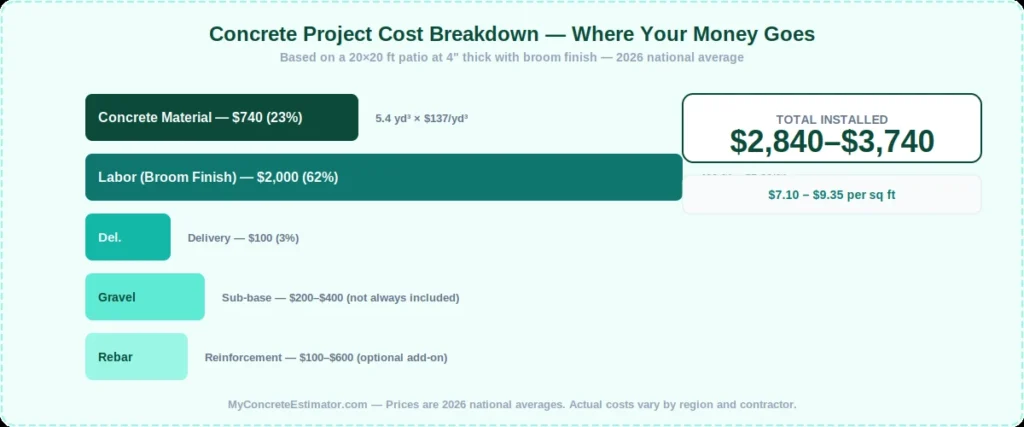
Concrete pricing has three components: the material itself, delivery, and labor. Here is what each costs in 2026 across the United States:
Ready-Mix Concrete Prices by PSI (2026)
| Mix Strength (PSI) | Price per Cubic Yard | Common Uses |
|---|---|---|
| 2,500 PSI | $120–$130 | Residential footings, non-structural slabs |
| 3,000 PSI | $130–$145 | Standard slabs, patios, sidewalks (most common) |
| 3,500 PSI | $145–$160 | Driveways, garage floors, cold climates |
| 4,000 PSI | $155–$175 | Commercial floors, heavy traffic, freeze-thaw |
| 4,500 PSI | $175–$195 | Industrial, structural, high-load applications |
| 5,000+ PSI | $190–$220 | Pre-stressed, specialty structural, bridges |
These prices include the concrete delivered within 10–15 miles of the batch plant. Beyond that, expect distance surcharges of $10–$15 per additional mile.
Delivery Fees and Short-Load Charges
Every ready-mix order includes a delivery fee of $75–$150, regardless of volume. On top of that, most plants charge a short-load fee for orders under their minimum (usually 3–4 yd³). Short-load fees run $30–$75 per yard below the threshold. For example, ordering 2 yd³ from a plant with a 4 yd³ minimum could add $60–$150 in surcharges — sometimes doubling the effective per-yard cost on small pours.
Labor Costs by Finish Type
| Finish Type | Labor Cost (per sq ft) | Description |
|---|---|---|
| Broom finish | $3–$5 | Standard textured surface — most common for patios, sidewalks, driveways |
| Smooth / trowel finish | $4–$6 | Flat, smooth surface — garage floors, interior slabs |
| Exposed aggregate | $6–$10 | Decorative surface showing stone — patios, pool decks |
| Stamped concrete | $8–$15 | Pattern pressed into wet concrete — mimics stone, brick, tile |
| Colored / stained | $7–$12 | Integral color or acid stain — decorative applications |
Regional Price Variation
Concrete prices vary significantly by region due to differences in raw material costs, labor rates, fuel prices, and demand. Here is how each region compares to the national average:
| Region | Price Adjustment | Avg. Ready-Mix (3,000 PSI) | Avg. Labor (broom finish) |
|---|---|---|---|
| Midwest | −15% | $110–$125/yd³ | $3–$4/sq ft |
| South | −10% | $115–$130/yd³ | $3–$5/sq ft |
| National Average | Baseline | $130–$145/yd³ | $4–$5/sq ft |
| Northeast | +10% | $140–$160/yd³ | $5–$7/sq ft |
| West Coast | +20% | $155–$175/yd³ | $5–$8/sq ft |
| Hawaii / Alaska | +25% | $165–$185/yd³ | $6–$9/sq ft |
Concrete Cost by Project Type (2026)
This table shows installed costs (materials + labor + delivery) for common residential projects at national average pricing with standard broom finish:
| Project | Typical Size | Thickness | Cubic Yards | Material Cost | Total Installed | Cost per Sq Ft |
|---|---|---|---|---|---|---|
| Small patio | 10×10 ft | 4″ | 1.36 | $185 | $700–$1,100 | $7–$11 |
| Large patio | 15×20 ft | 4″ | 4.07 | $550 | $2,100–$3,600 | $7–$12 |
| Sidewalk | 4×30 ft | 4″ | 1.63 | $220 | $900–$1,500 | $7.50–$12.50 |
| 1-car driveway | 12×24 ft | 5″ | 4.89 | $660 | $2,500–$4,300 | $8.50–$15 |
| 2-car driveway | 20×24 ft | 5″ | 8.15 | $1,100 | $4,200–$7,200 | $8.75–$15 |
| Garage floor (2-car) | 24×24 ft | 5″ | 9.78 | $1,320 | $5,000–$8,600 | $8.50–$15 |
| Basement slab | 30×40 ft | 4″ | 16.30 | $2,200 | $8,400–$14,400 | $7–$12 |
| Strip footing | 80 ft × 16″ × 8″ | 8″ | 2.64 | $355 | $1,600–$2,700 | Varies |
These are estimates based on 2026 national averages. Your actual cost will vary based on local concrete prices, labor market, site access, and finishing requirements. Always get 2–3 written quotes from local contractors.
DIY vs Professional: Which Is Actually Cheaper?
The answer depends almost entirely on project size. Here is the honest math:
| Project Volume | DIY Cost (bags only) | Professional Cost (installed) | DIY Savings | Verdict |
|---|---|---|---|---|
| Under 0.5 yd³ | $150–$200 | $500–$900 | 60–75% | DIY wins |
| 0.5–1.0 yd³ | $200–$400 | $800–$1,500 | 50–65% | DIY wins (if you have time) |
| 1.0–2.0 yd³ | $400–$800 | $1,200–$2,500 | 30–50% | Toss-up — factor in your time |
| 2.0–4.0 yd³ | $800–$1,500 | $2,000–$4,500 | 15–30% | Pro recommended |
| Over 4.0 yd³ | $1,500+ | $3,500+ | 0–15% | Pro required — bags impractical |
The DIY cost column assumes 80 lb bags at $6.50 each with no labor cost. But “no labor cost” is misleading — mixing bags is extremely physical work. At 5 minutes per bag, 45 bags (1 yd³) takes 3.5+ hours of continuous lifting and mixing. The savings shrink fast when you value your time.
So, professional installation is the best method for any project over 2 cubic yards because the per-yard cost advantage of bags disappears, the physical effort becomes unreasonable, and a contractor delivers a better finish with proper tools and experience.
Hidden Costs Most Calculators Miss
The concrete and labor are the obvious costs. But several line items catch homeowners off guard because they are not included in the per-yard or per-square-foot quote:
Site preparation ($1–$3 per sq ft). This includes clearing the area, excavating to depth, compacting soil, and installing a gravel sub-base. On a 400 ft² patio, site prep alone runs $400–$1,200. Many contractors include basic prep in their quote, but clarify what “site prep” means before signing.
Gravel sub-base ($0.50–$1.50 per sq ft). A 4-inch layer of compacted gravel under the slab is standard for drainage and stability. For a 400 ft² slab, that is about 2 cubic yards of gravel at $35–$50/yd³ delivered, plus compaction labor. Some contractors include this; many do not.
Reinforcement ($0.25–$1.50 per sq ft). Wire mesh runs $0.25–$0.50/sq ft. Rebar (#4 at 18″ on center) runs $0.75–$1.50/sq ft including labor. For a 400 ft² slab, reinforcement adds $100–$600.
Form lumber and stakes ($50–$200). 2×4 or 2×6 lumber, form stakes, and form release oil. Often reusable but still a cost on the first project.
Pump truck ($150–$300 per pour). Required when the concrete truck cannot back up to within chute distance of the pour site. Common for backyard patios, pool decks, and slabs behind fences.
Removal and disposal ($3–$6 per sq ft). If you are replacing an existing slab, breaking out and hauling the old concrete adds significantly. A 400 ft² slab removal runs $1,200–$2,400.
Tips to Save Money on Your Concrete Project
Get 3 quotes minimum. Contractor pricing varies 20–40% for the same project in the same city. Three quotes give you a realistic market range and negotiating leverage. Ask each contractor for an itemized breakdown, not just a lump sum.
Time your pour for off-season. Late fall and early spring are slower seasons for concrete contractors in most regions. You may get 10–15% lower labor rates simply by scheduling outside the May–September peak.
Order the right volume — not too much, not too little. Use our concrete volume calculator to get an accurate yard count. Over-ordering by 1 yd³ wastes $135–$200. Under-ordering triggers an emergency callback delivery at $200–$400 premium. Aim for 10% waste factor and round up to the nearest quarter yard.
Stick with 3,000 PSI unless you need more. Standard 3,000 PSI concrete handles every residential application except driveways in harsh freeze-thaw climates. Upgrading to 4,000 PSI adds $20–$30 per yard — justified for driveways but unnecessary for patios and sidewalks.
Skip stamped concrete unless it is your priority. Stamped finishes add $4–$10 per square foot over broom finish — that is $1,600–$4,000 extra on a 400 ft² patio. A simple broom finish is durable, slip-resistant, and costs half as much.
Do your own site prep to save on labor. Clearing vegetation, removing the top 4–6 inches of soil, and compacting the sub-grade is hard work but does not require specialized skills. Doing this yourself can save $500–$1,500 on a typical patio or driveway project.
Combine projects to hit the full-truck minimum. If you need a patio (3 yd³) and a sidewalk (1.5 yd³), pour them on the same day with a single 5 yd³ order. You avoid two delivery fees and potentially dodge the short-load surcharge entirely.
Check if your municipality requires a permit. Many cities require permits for slabs over a certain size (commonly 200 ft²). Permit fees range from $50–$300. Building without one can result in fines or required demolition — much more expensive than the permit.
Ask about returned concrete fees. Some suppliers charge $50–$100 if you refuse or return concrete that is already mixed and on the truck. Know the policy before ordering.
Compare bagged vs ready-mix at the crossover point. For projects between 0.75 and 1.5 cubic yards, the cost difference between bags and ready-mix is often within $100. Factor in your time and the quality advantage of ready-mix before defaulting to bags just because the material is cheaper.
Comparison Table: Concrete Cost Estimating Methods
| Method | Accuracy | What It Includes | Speed | Best For |
|---|---|---|---|---|
| Online Calculator (this tool) | Good | Material + labor + delivery + DIY comparison | Instant | Budgeting and comparing before getting quotes |
| Contractor quote | Highest | Everything — site-specific conditions included | 1–5 days | Final pricing before committing to a project |
| Per-square-foot rule of thumb | Low | Rough total only ($6–$12/sq ft) | 10 sec | Very early ballpark — not for budgeting |
| Supplier price sheet | Medium | Material + delivery only — no labor | 1 phone call | DIY projects where you are doing all the work |
So, an online cost calculator is the best starting point because it gives you a realistic total before you invest time getting contractor quotes. Use it to set your budget, then get 2–3 professional quotes to compare against the estimate.
Ready-mix concrete costs $125–$200 per cubic yard delivered in 2026, depending on PSI rating and region. Standard 3,000 PSI averages $130–$145/yd³ nationally. Add $75–$150 for delivery and potential short-load fees for orders under 3–4 cubic yards.
A 20×20 ft concrete slab (400 sq ft) at 4 inches thick costs approximately $2,400–$4,800 installed in 2026. That breaks down to about $700–$800 in concrete material (5.4 yd³), $100–$150 delivery, and $1,600–$3,000 in labor depending on finish type. The per-square-foot installed cost ranges from $6–$12.
A standard 2-car concrete driveway (20×24 ft at 5 inches thick) costs $4,200–$7,200 installed in 2026. Material runs about $1,100 for 8.15 cubic yards, plus $100–$150 delivery and $2,400–$4,800 in labor. Stamped or decorative finishes can push the total to $9,000–$14,000.
For projects under 1 cubic yard, DIY with bagged concrete saves 50–65% — about $300–$700 on a small patio. For projects over 2 cubic yards, the savings shrink to 15% or less, and ready-mix delivered by a contractor is often both cheaper and higher quality. The crossover point is around 1.5 cubic yards.
A short-load fee is a surcharge for ordering less than the supplier’s minimum volume, typically 3–4 cubic yards. Fees run $30–$75 per yard below the minimum. Ordering 2 yd³ from a plant with a 4 yd³ minimum could add $60–$150 in extra charges. Always ask about minimums before ordering.
Stamped concrete costs $8–$15 per square foot for labor, compared to $3–$5 for a standard broom finish. On a 400 sq ft patio, that adds $2,000–$4,000 to the project. The concrete material cost is the same — the difference is entirely in the finishing labor and specialized stamps.
Use 3,000 PSI for most residential slabs, patios, and sidewalks — it handles normal foot traffic and light loads. Use 3,500–4,000 PSI for driveways, garage floors, and areas with freeze-thaw exposure. Use 4,500+ PSI for commercial or heavy industrial applications. Higher PSI costs $10–$40 more per cubic yard.
West Coast concrete prices run 20–25% above the national average due to higher labor rates, stricter environmental regulations, higher fuel costs, and greater demand in urban markets like Los Angeles, San Francisco, and Seattle. Hawaii and Alaska are even higher (25%+) due to shipping costs for cement and aggregates.
Concrete labor (forming, placing, and finishing) costs $3–$5 per square foot for a standard broom finish, $4–$6 for smooth trowel, $6–$10 for exposed aggregate, and $8–$15 for stamped concrete. Labor typically accounts for 40–50% of the total installed cost.
Many municipalities require a permit for concrete slabs over a certain size (commonly 200 sq ft) or for any structural concrete like footings and foundations. Permit fees range from $50–$300. Check with your local building department before starting — building without a required permit can result in fines or forced removal.
Get 3+ quotes, schedule in the off-season (fall/spring), do your own site prep, stick with broom finish over stamped, combine multiple pours into one truck order to avoid short-load fees, and use 3,000 PSI unless you specifically need higher strength. These strategies combined can save 20–35% on a typical residential project.
Installed cost typically includes concrete material, delivery, forming, placing, finishing (broom or trowel), and basic cleanup. It usually does not include site excavation, gravel sub-base, rebar or wire mesh, removal of old concrete, pump truck rental, decorative finishes, or permits. Always ask your contractor for an itemized breakdown.
Removing and replacing a concrete slab costs $9–$18 per square foot total. Demolition and removal alone runs $3–$6 per sq ft (breaking, hauling, disposal). A new pour on top adds $6–$12 per sq ft. For a 400 ft² slab, expect $3,600–$7,200 for full remove-and-replace.
A good online calculator gets you within 15–25% of actual project cost — close enough for budgeting and comparing quotes. The main variables it cannot account for are local labor rates, site access, soil conditions, and contractor margins. Always use the calculator as a starting point, then get 2–3 professional quotes for final pricing.
Yes. Going from 4 inches to 6 inches increases concrete volume by 50% and adds $0.75–$1.50 per square foot in material cost. On a 400 ft² slab, that is $300–$600 extra in concrete alone. However, the thicker slab is stronger, cracks less, and lasts 10–15 years longer — often worth the upgrade for driveways and garage floors.