
By Mike Richardson, construction estimator with 10+ years of experience.
Concrete Slab Calculator
Estimate cubic yards, bags, and cost instantly
📐 Slab Dimensions
⚙️ Options
👁️ Live Preview
Table of Contents
What Is a Concrete Slab Calculator and Why Do You Need One?
A concrete slab calculator is a tool that estimates how much concrete you need for any flat pour — patios, driveways, garage floors, shed bases, sidewalks, and foundation slabs. You enter your length, width, and thickness, and the calculator returns the volume in cubic yards, the number of bags needed, and an estimated material cost.
Why does this matter? Because concrete is one of the few materials on a job site you cannot easily undo. Order too little, and your pour stops mid-slab — leaving a cold joint and a rush delivery fee. Order too much, and you pay for material that ends up as waste. A good concrete pad calculator eliminates both problems by giving you an accurate number before you call the supplier.
Here is what our calculator covers that most others do not:
- Live SVG preview — See your slab dimensions rendered visually as you type, so you can confirm your measurements make sense before ordering.
- Smart bags vs ready-mix recommendation — The calculator automatically tells you whether to use bagged concrete or order a truck, based on your volume.
- Brand-specific bag counts — Get exact bag counts for Quikrete and Sakrete in 40 lb, 60 lb, and 80 lb sizes, using official yield data.
- Full shopping list — Not just concrete volume, but gravel sub-base, form boards, and stakes — with estimated costs for each.
- Affiliate price checks — Direct links to compare current pricing at Home Depot and Lowe’s.
How to Calculate Concrete for a Slab (Step-by-Step)
Whether you use our calculator above or want to understand the math, here is the step-by-step process for calculating concrete for any rectangular or circular slab.
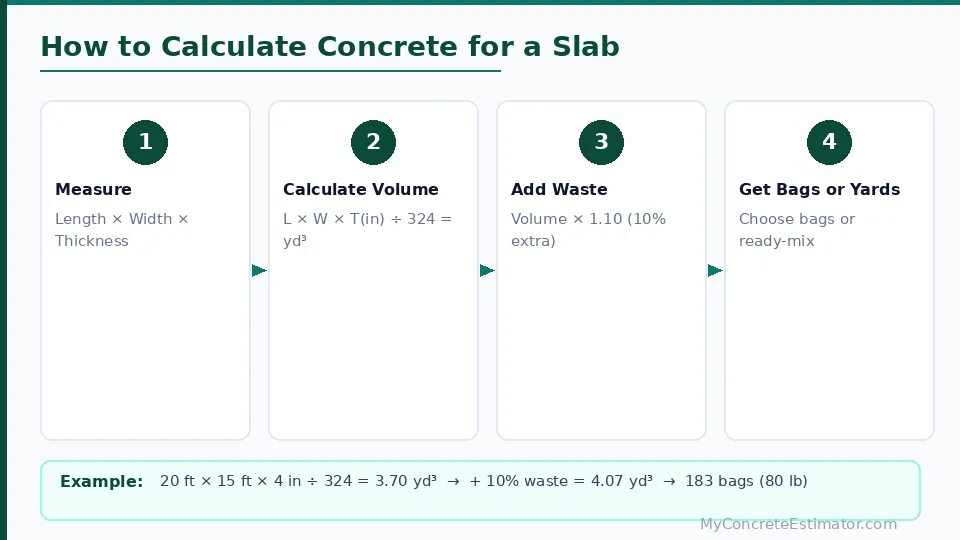
Step 1: Measure Your Slab Dimensions
Use a tape measure to get the length and width of your planned slab in feet. For circular slabs (round patios, column pads), measure the diameter instead. Then determine your thickness in inches — this is the vertical depth of the concrete pour.
Measure at multiple points if the ground is uneven. Use the deepest measurement as your thickness to avoid running short. A dipped sub-grade that adds even half an inch across a 400 ft² slab can add roughly 0.6 yd³ of unplanned concrete.
Step 2: Calculate the Volume
For a rectangular slab, the formula is:
Cubic Yards = Length (ft) × Width (ft) × Thickness (in) ÷ 324
The 324 divisor combines two conversions: inches to feet (÷ 12) and cubic feet to cubic yards (÷ 27). Since 12 × 27 = 324, this single number handles both in one step.
For a circular slab, use:
Cubic Yards = π × Radius² (ft) × Thickness (in) ÷ 324
Worked example: A patio slab 20 ft long × 15 ft wide × 4 inches thick = 20 × 15 × 4 ÷ 324 = 3.70 cubic yards of raw concrete.
Step 3: Add a Waste Factor
Never order exactly the calculated volume. Add a waste factor to account for spillage, uneven sub-grade, and mixing losses:
- 5% — Simple, well-measured rectangular slabs with good access
- 10% — Standard for most residential pours (recommended)
- 15% — Complex shapes, uneven ground, or hand-mixed pours
Using the example above: 3.70 yd³ × 1.10 = 4.07 yd³ order volume.
Step 4: Convert to Bags or Ready-Mix
If you are using bagged concrete, convert your volume to bag count using the official yield per bag:
- 80 lb bag = 0.60 ft³ (45 bags per cubic yard)
- 60 lb bag = 0.45 ft³ (60 bags per cubic yard)
- 40 lb bag = 0.30 ft³ (90 bags per cubic yard)
These yields are confirmed on both Quikrete (TDS #1101) and Sakrete official data sheets. Our concrete bag calculator for slab projects uses these exact numbers.
Step 5: Check Your Results and Order
Before ordering, cross-check your calculator output against the quick reference: 1 cubic yard covers 81 ft² at 4 inches thick, or 54 ft² at 6 inches. If your number is wildly off from that ratio, re-measure your slab.
Concrete Slab Quick Reference Table by Size
This table shows concrete volume, bag counts, and estimated costs for the most common slab sizes at 4 inches thick with 10% waste. Ready-mix pricing uses $150/yd³ (national average). Bag pricing uses $6.50 per 80 lb bag.
| Slab Size | Area (ft²) | Cubic Yards | 80 lb Bags | Ready-Mix Cost | Common Use |
|---|---|---|---|---|---|
| 10×10 ft | 100 | 1.36 | 62 | $204 | Small patio, AC pad |
| 12×12 ft | 144 | 1.96 | 88 | $294 | Shed base |
| 16×16 ft | 256 | 3.48 | 157 | $522 | Large shed |
| 20×20 ft | 400 | 5.43 | 245 | $815 | 2-car compact garage |
| 20×30 ft | 600 | 8.15 | 367 | $1,222 | Large garage / workshop |
| 24×24 ft | 576 | 7.83 | 352 | $1,174 | Standard 2-car garage |
| 30×30 ft | 900 | 12.22 | 550 | $1,833 | Large patio / slab |
| 30×40 ft | 1,200 | 16.30 | 733 | $2,444 | House foundation |
| 40×60 ft | 2,400 | 32.59 | 1,467 | $4,889 | Full house slab |
How Thick Should a Concrete Slab Be?
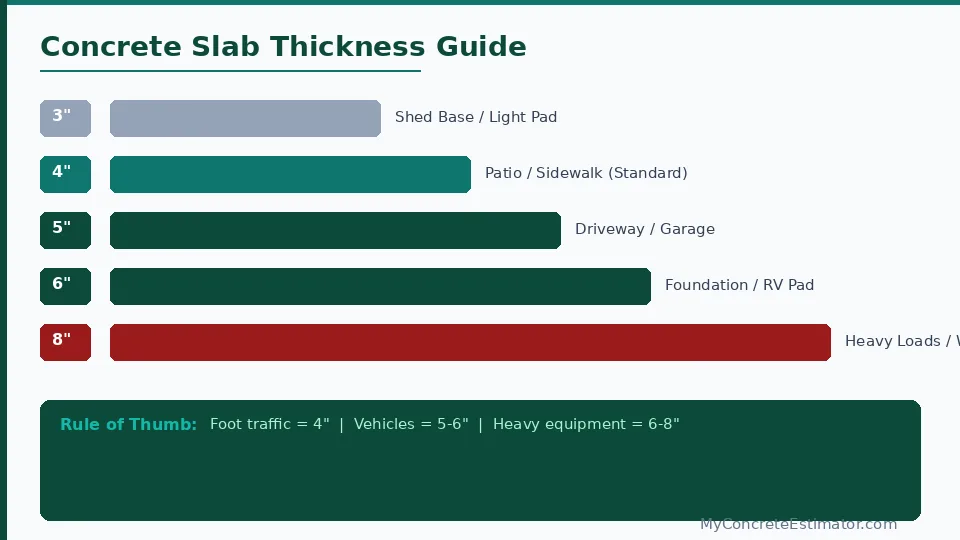
Thickness is the single biggest factor in both material cost and structural performance. Going from 4 inches to 6 inches adds about 50% more concrete but dramatically increases load capacity and crack resistance.
| Application | Recommended Thickness | PSI | Reinforcement |
|---|---|---|---|
| Sidewalk / footpath | 4 inches | 2,500–3,000 | Wire mesh or fiber |
| Patio / concrete pad | 4 inches | 3,000 | Wire mesh or fiber |
| Shed base | 4 inches | 3,000 | Wire mesh |
| Driveway (cars) | 4–5 inches | 3,000–4,000 | Wire mesh or rebar |
| Garage floor | 4–5 inches | 3,500–4,000 | Rebar recommended |
| Driveway (trucks/RVs) | 6 inches | 4,000+ | #4 rebar @ 12–18″ OC |
| RV pad | 6 inches | 4,000+ | #4 rebar required |
| House foundation | 4–6 inches | 4,000+ | Engineered design required |
| Workshop / heavy loads | 6–8 inches | 4,000+ | #4 rebar grid |
A simple rule: if vehicles or heavy equipment will be on the slab, go with 5–6 inches. If it is foot traffic only (patios, walkways, shed pads), 4 inches is standard and saves you roughly 33% on concrete material versus a 6-inch pour.
Comparison: Bags vs Ready-Mix vs Hiring a Contractor
There are 3 methods to get concrete for your slab project. Each has trade-offs depending on your pour size, budget, and experience level.
| Method | Best For | Cost per yd³ | Pros | Cons |
|---|---|---|---|---|
| Bagged Concrete (Quikrete / Sakrete) | Under 1 yd³ | $290–$390 | No minimum order, no delivery fee, buy as needed | Labor-intensive mixing, slower pour, inconsistent quality risk |
| Ready-Mix Truck | Over 1.5 yd³ | $130–$180 | Faster pour, consistent quality, less labor | Minimum order (usually 1 yd³), delivery fee, short-load surcharge |
| Hire a Contractor | Structural slabs, large projects | $6–$12/ft² installed | Professional finish, permits handled, warranty | Highest cost, scheduling wait times |
So, ready-mix is the best method for any slab over 1.5 cubic yards because it is cheaper per yard than bags, pours faster (critical for large slabs that need to be finished before the concrete sets), and delivers consistent quality. For small pours under 1 cubic yard — like an AC pad or small shed base — bagged concrete from Home Depot or Lowe’s is more practical since you avoid delivery fees and minimum order requirements.
Rebar vs Wire Mesh for Concrete Slabs
Reinforcement controls cracking and adds structural capacity. The right choice depends on what the slab supports.
Wire mesh (welded wire reinforcement) is sufficient for most 4-inch residential slabs — patios, sidewalks, and shed bases on compacted soil. It holds cracks together but provides minimal structural reinforcement. Standard spec: 6×6 W1.4 grid at about $0.50–$0.60 per square foot.
Rebar is recommended when the slab carries vehicles, heavy equipment, or structural loads. Typical residential spec: #4 rebar (½-inch diameter) at 12–18 inches on center in both directions. Cost: $1.00–$2.00 per square foot depending on spacing. For a 20×20 ft slab with #4 rebar at 18-inch spacing, plan on about 540 linear feet of rebar.
Fiber reinforcement can replace wire mesh for crack control in light-duty slabs but does not replace structural rebar where load capacity matters.
Our rebar calculator for concrete slab projects calculates exact rebar quantities, spacing, and lap splice waste.
How Much Does a Concrete Slab Cost? (2026 Pricing)
Installed concrete slab costs in 2026 range from $6 to $12 per square foot, with most residential projects landing between $8–$10/ft². Here is what that looks like for common slab sizes:
| Slab Size | Area | Materials Only | Installed (with labor) |
|---|---|---|---|
| 10×10 ft | 100 ft² | $200–$400 | $600–$1,200 |
| 12×12 ft | 144 ft² | $290–$580 | $865–$1,730 |
| 20×20 ft | 400 ft² | $800–$1,600 | $2,400–$4,800 |
| 24×24 ft | 576 ft² | $1,150–$2,300 | $3,460–$6,910 |
| 30×40 ft | 1,200 ft² | $2,400–$4,800 | $7,200–$14,400 |
Regional variation matters. Southeast and Midwest markets run $5.50–$9/ft². Northeast adds 15–25%. West Coast adds 20–35%. Always get 3+ local quotes before committing.
For a detailed breakdown including labor, gravel, reinforcement, and finishing costs, see our Concrete Sla.
When to Use Bagged Concrete vs Ready-Mix
This is one of the most common questions, and the answer is straightforward — it comes down to volume:
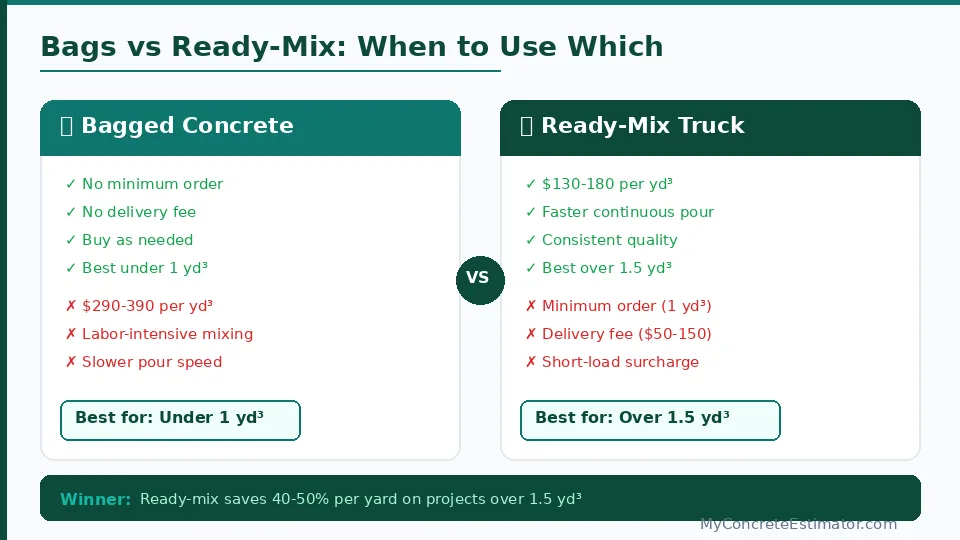
- Under 0.5 yd³ — Bagged concrete is practical. That is under 23 bags of 80 lb mix. Manageable for one person in a few hours.
- 0.5–1.0 yd³ — Bags are doable but labor-intensive. Worth calling a ready-mix supplier for a quote to compare.
- 1.0–1.5 yd³ — Ready-mix is almost always cheaper and faster once you factor in delivery. This is the transition zone.
- Over 1.5 yd³ — Ready-mix strongly recommended. You cannot keep pace with a large pour using bags. The concrete sets while you are still mixing.
Bagged concrete costs $290–$390 per cubic yard in materials alone (45 bags × $6.50–$8.50 per 80 lb bag). Ready-mix runs $130–$180 per cubic yard delivered in full loads. Bags are more expensive per yard but have no minimum order and no delivery fee — which is why they win on small projects.
Tips for Planning and Pouring a Concrete Slab
Check local permit requirements before you start. Many jurisdictions require a permit for concrete slabs over 200 ft². Foundation slabs almost always require a permit and inspection. Call your local building department — a 5-minute phone call can save you a costly tear-out later.
Compact the sub-grade before placing gravel. The single most common cause of slab cracking is a poorly prepared sub-base. Use a plate compactor to compact the native soil, then lay 4 inches of crushed stone (¾-inch minus) and compact again in 2-inch lifts.
Use the right gravel — not pea gravel. Crushed angular stone (like ¾-inch Class II) locks together and provides a stable base. Round pea gravel shifts under load and does not compact properly.
Set control joints every 8–12 feet. Concrete will crack — control joints give it a weak point to crack along, keeping cracks hidden in the joints. The rule of thumb: joint spacing in feet should not exceed 2.5 times the slab thickness in inches. For a 4-inch slab, that means joints every 10 feet maximum.
Order 10% more concrete than your calculated volume. Running short mid-pour is far worse than having a small surplus. Leftover concrete can be used for small projects, stepping stones, or simply disposed of at the end of the pour.
Schedule your pour for mild weather. Ideal pouring temperature is 50–80°F (10–27°C). Below 40°F, concrete curing slows dramatically and freeze risk increases. Above 90°F, rapid drying causes surface cracking. If you must pour in hot weather, start early morning and have a water mist ready.
Keep the slab moist for 7 days after pouring. Cover with plastic sheeting or a curing blanket. This allows the concrete to reach proper strength. Concrete that dries too fast loses significant strength — it needs water to cure, not just to mix.
Do not drive on a new slab for at least 7 days. Light foot traffic is safe after 24–48 hours. Vehicles should wait a full week minimum. Full design strength (the rated PSI) takes 28 days to develop.
Use a vapor barrier for interior slabs. A 10-mil polyethylene sheet under the concrete prevents moisture from wicking up through the slab. This is critical for garage floors, basements, and any slab that will have flooring installed over it.
Get 3 contractor quotes if you are not doing it yourself. Concrete contractor pricing varies 30–50% between companies in the same market. A complete quote should itemize: excavation, gravel base, forms, reinforcement, concrete, finishing, and cleanup.
How Long Does Concrete Take to Cure?
Concrete gains strength progressively after pouring:
- 24–48 hours — Safe for light foot traffic
- 3–7 days — Significant strength gain; safe for heavier foot traffic
- 7 days — Generally safe for passenger vehicles on driveways
- 28 days — Full design strength achieved (the rated PSI number)
Temperature affects curing time. In hot weather (above 80°F), keep the surface moist to prevent rapid drying. In cold weather (below 40°F), use insulated blankets and never pour if temperatures will drop below freezing within 48 hours.
For a deeper breakdown, see our Concrete Curing Time Guide.
Concrete Slab Formula Explained
For readers who want to understand exactly how the math works, here is the complete formula breakdown:
Rectangular slab:
Volume (ft³) = Length (ft) × Width (ft) × Thickness (ft)
Volume (yd³) = Volume (ft³) ÷ 27
Or the shortcut: Volume (yd³) = Length (ft) × Width (ft) × Thickness (in) ÷ 324
Circular slab:
Volume (ft³) = π × Radius² (ft) × Thickness (ft)
Volume (yd³) = Volume (ft³) ÷ 27
Or the shortcut: Volume (yd³) = π × Radius² (ft) × Thickness (in) ÷ 324
Key conversion factors:
- 1 cubic yard = 27 cubic feet = 0.765 cubic meters
- 1 cubic yard of concrete weighs approximately 4,050 lbs (about 2 tons)
- 1 cubic yard covers 81 ft² at 4 inches thick, 54 ft² at 6 inches thick
- 80 lb bag yields 0.60 ft³ → 45 bags per cubic yard
- 60 lb bag yields 0.45 ft³ → 60 bags per cubic yard
- 40 lb bag yields 0.30 ft³ → 90 bags per cubic yard
Concrete Slab Calculator — Frequently Asked Questions
A 10×10 ft slab at 4 inches thick requires 1.23 cubic yards (1.36 yd³ with 10% waste). That equals about 62 bags of 80 lb concrete. At this volume, compare the cost of bags versus a ready-mix short load. See our detailed guide: how many bags of concrete for a 10×10 slab.
A 12×12 ft slab at 4 inches thick needs 1.78 cubic yards (1.96 yd³ with waste), which works out to approximately 88 bags of 80 lb concrete. At nearly 2 cubic yards, ready-mix delivery is recommended over mixing bags by hand.
A 20×20 ft slab at 4 inches thick requires 4.94 cubic yards (5.43 yd³ with 10% waste). At 6 inches thick, it jumps to 7.41 yd³. This volume should always use ready-mix.
A 20×30 ft slab at 4 inches thick needs 7.41 cubic yards (8.15 yd³ with 10% waste). At 6 inches, that increases to 12.22 yd³. This is a full truck load — order ready-mix.
A 30×40 ft slab at 4 inches thick requires 14.81 cubic yards (16.30 yd³ with 10% waste). You will need at least two truck loads for a pour this size.
Use 4 inches for patios, walkways, and shed bases. Use 5 inches for garage floors with regular vehicle traffic. Use 6 inches for foundations, RV pads, driveways with heavy trucks, and any slab that will carry structural loads.
Installed concrete slab costs in 2026 range from $6 to $12 per square foot, depending on thickness, finish, reinforcement, and region. A 20×20 ft patio runs $2,400–$4,800 installed.
Wire mesh is sufficient for light-duty 4-inch slabs (patios, walkways). Rebar is recommended for driveways, garage floors, and any slab that carries vehicles or heavy loads. Use #4 rebar at 12–18 inch spacing both ways.
3,000 PSI is standard for most residential slabs. Use 3,500–4,000 PSI for driveways, garages, and cold climates. Always specify air-entrained concrete for exterior slabs in freeze-thaw regions.
A standard 4-inch gravel sub-base requires about 1.23 cubic yards per 100 square feet of slab, or roughly 1.7 tons. Use ¾-inch crushed stone, compacted in 2-inch lifts. Our calculator includes gravel quantities in the shopping list.
Add 10% for most residential pours. Use 5% for simple, well-measured rectangular slabs. Use 15% for complex shapes or uneven ground. Running short mid-pour is far more expensive than ordering a small surplus.
Light foot traffic is safe after 24–48 hours. Vehicles should wait 7 days. Full design strength (rated PSI) takes 28 days. Keep the slab moist for the first 7 days for best results.
They are structurally identical — both are slabs-on-grade calculated the same way. “Pad” is typically used for smaller pours (AC pads, generator pads), while “slab” refers to larger surfaces (patios, driveways, foundations). Our calculator works for both.
Yes. Break the slab into rectangles, calculate each section separately, and add the volumes together. Our calculator supports rectangular and circular shapes — for L-shapes, run the calculator twice and sum the results.
Standard concrete weighs 150 lbs per cubic foot. A 4-inch slab weighs about 50 lbs per square foot. A 6-inch slab weighs about 75 lbs per square foot. A 20×20 ft garage slab at 6 inches weighs approximately 30,000 lbs (15 tons).