
Delivery is the part of a concrete bill most homeowners never see coming. The concrete itself might run $125–$195 per yard, but order less than a full truck and you’ll pay a short-load fee — typically $30–$60 for every yard under the supplier’s minimum. And if the truck can’t reach your pour, a concrete pump adds $90–$350 per hour with a multi-hour minimum. The two calculators below work out exactly what delivery adds to your pour, and the guide underneath explains truck minimums, pump types, and how to avoid paying fees you don’t need to.
Short-Load Fee Calculator
Find out what your supplier charges when you order less than a full truck
Concrete Pump Cost Estimator
Estimate boom or line-pump charges for your pour, minimums included
Pump type
📑 Table of Contents
[ Hide ]How Much Is a Short Load Fee?
A short-load fee is what a ready-mix supplier charges when you order less concrete than the truck’s minimum load. Running a mixer truck costs the supplier nearly the same whether it carries 2 yards or 10, so they make up the difference with a fee on every yard you’re short. Typical short-load fees run $30–$60 per yard under the minimum (2026 estimates — always confirm with your supplier, because rates vary widely by market).
The math is simple: (truck minimum − yards ordered) × fee per yard. Here’s what that looks like with a common 4-yard minimum and a $40/yard fee:
| Yards ordered | Yards under the 4-yd minimum | Short-load fee @ $40/yd |
|---|---|---|
| 1 yard | 3 yards short | $120 |
| 2 yards | 2 yards short | $80 |
| 3 yards | 1 yard short | $40 |
| 4+ yards | 0 — full load | $0 |
Notice how fast the fee bites on small orders: a single yard of concrete at $160/yard becomes a $280 delivery once the $120 fee lands. Some suppliers charge a flat short-load fee ($100–$200 per load) instead of a per-yard rate — the calculator above handles either one, since a flat fee is just the per-yard field set so the total comes out right. Either way, the fee is charged on top of the concrete itself, and it shows up as its own line on the ticket.
What Is the Minimum Load for a Concrete Truck?
Most ready-mix suppliers set a minimum order of 4–5 cubic yards, though it varies by company and market. A standard mixer truck carries 8–10 yards, and the minimum exists because dispatching a truck, batching a load, and washing out afterward costs the plant real money regardless of load size.
| Supplier type | Typical minimum order | Short-load policy |
|---|---|---|
| Large national ready-mix plants | 4–5 yards | Per-yard fee, $30–$60/yd under minimum |
| Regional / independent batch plants | 3–4 yards | Per-yard fee or flat $100–$200/load |
| Volumetric (mobile-mix) trucks | 1–2 yards | Usually none — you pay for what they mix |
Volumetric trucks deserve a callout: these are the mobile batch plants that mix concrete on site. Because they only batch what you use, many have 1–2 yard minimums and no short-load fee at all — which can make them the cheapest option for pours in the 1–3 yard range. The trade-off is a slightly higher per-yard price ($150–$200/yd is common) and slower output than a big drum mixer.
Short-Load Fee vs Standard Delivery Charges
Homeowners often lump every delivery line-item together, but the short-load fee is separate from standard delivery charges — and you can be hit with both on the same ticket:
| Charge | What it covers | Typical range (est.) |
|---|---|---|
| Short-load fee | Ordering under the truck minimum | $30–$60/yd under minimum |
| Delivery / haul charge | Getting the truck to your site | $0–$100/load, sometimes baked into the per-yard price |
| Fuel surcharge | Diesel cost adjustment | $10–$40/load, varies with fuel prices |
| After-hours / Saturday pour | Plant overtime for off-hours batching | $100–$300 per load |
| Standby / demurrage | Truck waiting past free unload time (usually ~60 min) | $2–$4 per minute |
The one that blindsides people most is standby time: most suppliers include about 60 minutes of unload time, then charge per minute after that. A short-handed crew that takes two hours to place 6 yards can rack up $120–$240 in standby fees — more than the short-load fee they were worried about. Have your forms, crew, and tools ready before the truck arrives, and keep the chute area clear so the driver can start discharging immediately.
When comparing quotes, ask each supplier to break out these five lines separately. Two quotes at “$160/yard” aren’t equal if one hides a $150 Saturday fee and the other doesn’t. The short-load calculator above covers the fee line; add the others from your quote to get the true delivered price.
How to Avoid Short Load Fees
Sometimes the fee is unavoidable — but often there’s a cheaper path:
Order bagged concrete for small pours. The break-even point sits around 1–1.5 cubic yards. An 80-lb bag of concrete mix yields about 0.6 cubic feet, so one cubic yard takes roughly 45 bags. At ~$5 per bag, a yard of bagged concrete costs about $225 in materials with zero delivery fee — versus $160/yard of ready-mix plus a $120 short-load fee ($280 delivered). Below about a yard and a half, bags usually win; above that, the truck wins even with the fee. The calculator flags this for you automatically.
Combine pours into one order. A patio and a sidewalk poured the same week are two short loads; poured the same day, they’re one full load. If a neighbor has a project going, ask about splitting a truck — contractors do this constantly.
Round up deliberately. If you need 3.5 yards against a 4-yard minimum, you’re paying the fee on half a yard ($20 at $40/yd). Ordering the full 4 yards costs you the extra half yard of concrete (~$80) — more than the fee, but you get usable concrete instead of a pure surcharge. For footings and thickened edges, the extra mud usually finds a home.
Call a volumetric truck. As noted above, mobile-mix trucks routinely take 1–2 yard orders with no short-load fee. Get a quote before assuming the big plant is your only option.
How Much Does It Cost to Pump Concrete?
Concrete pumping typically costs $90–$350 per hour depending on the pump type, with a 3–4 hour minimum and a $150–$200 setup/travel fee (2026 estimates). The pump is always priced separately from the concrete — you’ll pay the ready-mix supplier for the mud and the pump company for the placement, often on two different tickets.
A realistic residential pump bill looks like this: 3 hours of line-pump time at $120/hr against a 4-hour minimum = 4 billed hours ($480), plus a $175 setup fee = $655 total. A boom pump on the same job runs hotter: 3 hours at $250/hr against the 4-hour minimum = $1,000, plus $175 setup = $1,175 — nearly double, which is why matching the pump to the job matters. The minimum is what surprises most first-timers — even a 90-minute pour gets billed for the full minimum because mobilizing the truck and crew is the expensive part. Use the estimator above with your own hours and your pump company’s minimum to get your number.
Line Pump vs Boom Pump: Cost Comparison
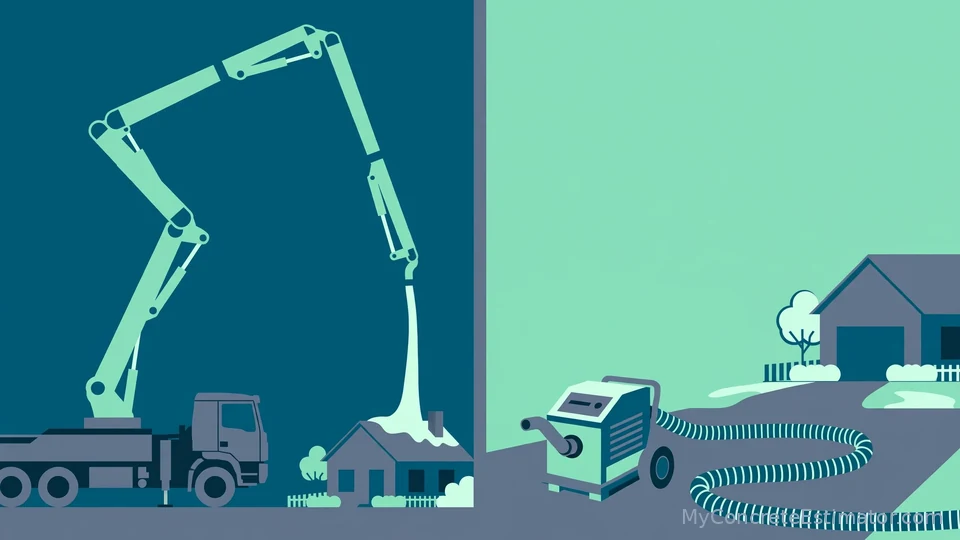
The two pump types serve completely different jobs — and the price gap is large:
| Line pump (ground pump) | Boom pump | |
|---|---|---|
| Hourly rate (est.) | $90–$150/hr | $150–$350/hr |
| Typical minimum | 3–4 hours | 4 hours |
| Setup / travel fee | $150–$200 | $150–$200 |
| Reach | Up to ~300 ft of hose on the ground | 100+ ft vertical and horizontal via articulated arm |
| Best for | Driveways, patios, slabs the truck can’t reach, backyard pours | Foundations, multi-story work, long reaches over obstacles, high-volume pours |
| Typical 4-hr residential job | $510–$800 | $750–$1,600 |
For most residential work, the line pump is the right call. A trailer-mounted line pump with 200+ feet of hose handles the classic problem — the pour is in the backyard and the mixer truck can’t get past the house — at roughly half the hourly rate of a boom. Boom pumps earn their premium when concrete has to go up (foundations, retaining walls, elevated slabs) or over something the hose can’t snake around. Output matters too: a boom pump places concrete dramatically faster, which is why commercial contractors accept the higher rate — on a 40-yard foundation pour, the boom finishes in hours what a line pump does all day.
When Is a Concrete Pump Worth It?
A pump feels like a luxury until you price the alternative. Here’s how contractors think about it:
Get a pump when the chute can’t reach. A mixer truck’s chute reaches roughly 12–18 feet from the truck. If any part of your pour is farther than that — a backyard patio behind the house, a slab at the end of a long driveway — you’re either pumping or wheelbarrowing. Wheelbarrowing 5+ yards of concrete is a full crew-day of brutal labor; a line pump at $600–$800 often costs less than the labor it replaces.
Get a pump when there’s elevation or distance involved. Pouring more than ~100 feet from where the truck can park, pouring downhill or uphill, or placing concrete inside a fenced yard with no gate access — these are pump jobs. Hoses snake around corners and through gates; wheelbarrows don’t.
Skip the pump when the truck can back right up to the forms. A street-side sidewalk, a driveway apron, a garage slab with clear access — if the chute reaches, the chute is free. Don’t pay $655 to solve a problem you don’t have.
On big slabs, a pump buys speed and quality. A 30-yard shop floor poured by chute and buggy takes all day with a big crew; a boom pump places it in a few hours with fewer cold joints (the weak seams where one batch starts setting before the next arrives). For large pours, the pump isn’t an extra — it’s part of doing the job right.
Concrete Delivery Fees — Frequently Asked Questions
1How much is a short load fee for concrete?
2What is the minimum load for a concrete truck?
3How much does it cost to pump concrete?
4Line pump vs boom pump — which do I need?
5Is it cheaper to use bagged concrete instead of paying a short load fee?
6What does “portal-to-portal” mean for concrete pumping?
7Do I need a concrete pump for a driveway?