
By Mike Richardson, construction estimator with 10+ years of experience.
Concrete Footing Calculator
Calculate volume, bags & cost for footings, Sonotubes & piers
🛒 Bags Needed
💰 Estimated Cost
💪 Physical Effort
📋 Sonotube Reference — 80 lb Bags per Tube
▼| Diameter | 2 ft | 3 ft | 3.5 ft | 4 ft | 5 ft | 6 ft |
|---|
Bag counts include 10% waste. Based on 80 lb bags yielding 0.60 ft³ each. Always round up.
This calculator provides estimates only. Always verify with local building codes and consult a structural engineer for foundation design. This website is not affiliated with Quikrete®, Sakrete®, Sonotube®, or any concrete manufacturer.
Table of Contents
What Is a Concrete Footing and Why Do You Need One?
A concrete footing is the structural base that sits beneath walls, columns, posts, and piers. It spreads the weight of whatever sits above it across a wider area of soil so the structure doesn’t sink, shift, or crack over time. Think of it as the invisible anchor that keeps everything above ground level stable and code-compliant.
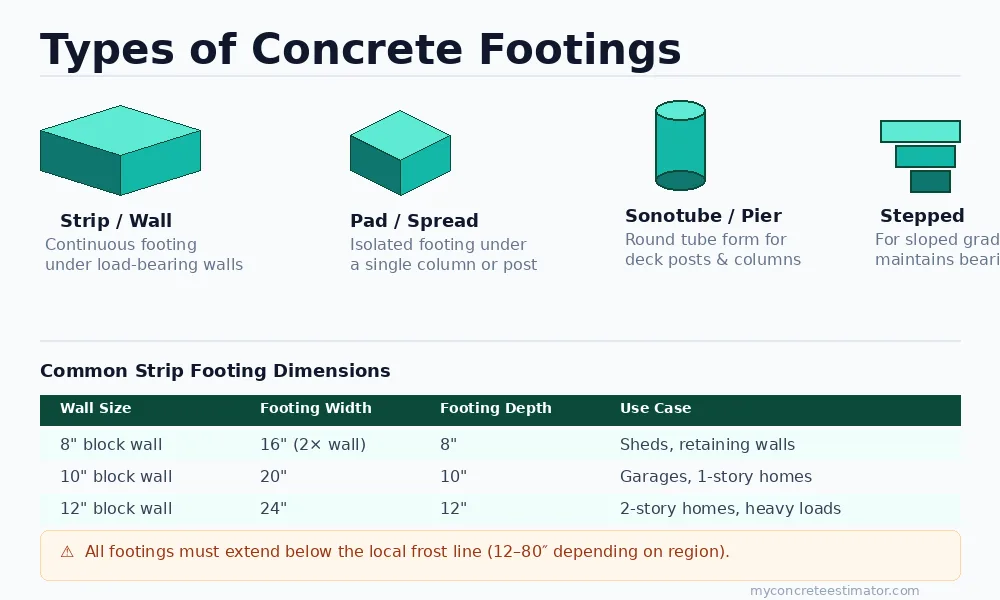
There are three main types of concrete footings used in residential and light commercial construction:
- Strip (continuous) footings — long, narrow slabs that run beneath load-bearing walls. Used for house foundations, garage perimeters, and retaining walls.
- Pad (isolated/spread) footings — square or rectangular pads poured beneath a single column or post. Common for shed corners, detached column bases, and equipment pads.
- Round pier (Sonotube) footings — cylindrical columns poured inside cardboard tube forms. Used for deck posts, fence posts, pergola columns, porch piers, and mailbox bases.
Getting the concrete volume right before you pour matters for two reasons. Order too little and you’ll end up with a cold joint — a weak seam where the first batch cured before the second arrived. Order too much and you’re paying for concrete you’ll need to dispose of. Our concrete footing calculator above handles both rectangular and round footings, outputs volume in cubic yards and cubic feet, tells you exactly how many bags you need, and estimates your cost — all before you make a single phone call.
How to Calculate Concrete for Footings
Calculating concrete for footings comes down to basic geometry — you’re finding the volume of either a rectangular prism or a cylinder, then converting that volume into cubic yards (for ordering ready-mix) or bag counts (for bagged concrete). Here’s how it works for each footing shape.
Rectangular / Strip Footing Formula
For any rectangular footing — whether it’s a 140-foot house perimeter or a single 2×2-foot pad — the formula is the same:
Volume (ft³) = Length (ft) × Width (ft) × Depth (ft)
Since width and depth are typically measured in inches on a job site, convert them to feet first by dividing by 12. Then divide your total cubic feet by 27 to get cubic yards.
Example: A 20-foot strip footing that’s 16 inches wide and 8 inches deep:
20 × (16 ÷ 12) × (8 ÷ 12) = 20 × 1.333 × 0.667 = 17.78 ft³ = 0.66 yd³
That’s about 30 bags of 80 lb concrete — or roughly half a cubic yard if you’re ordering ready-mix.
Round / Sonotube / Pier Footing Formula
Round footings use the cylinder volume formula:
Volume (ft³) = π × (Diameter ÷ 2)² × Height
The key is converting your diameter from inches to feet before plugging in. Divide the diameter by 24 to get the radius in feet, then square it, multiply by π (3.14159), and multiply by the depth in feet.
Example: A 12-inch Sonotube poured 48 inches (4 feet) deep:
3.14159 × (12 ÷ 24)² × 4 = 3.14159 × 0.25 × 4 = 3.14 ft³ ≈ 0.12 yd³
That’s about 6 bags of 80 lb concrete per tube — one of the most common deck footing pours in residential construction.
Waste Factor: Why You Always Add 5–10%
The formulas above give you the geometric (net) volume. On a real job site, you’ll always use more than that. Trench walls aren’t perfectly smooth. Sonotube bottoms sit on uneven subgrade. Concrete sticks to the wheelbarrow, the mixer, and the chute. A 10% waste allowance is standard practice for footings — our calculator includes this by default, and you can adjust it from 0% to 20% using the slider.
Concrete Footing Calculator: Step-by-Step Guide
Here’s how to use the calculator above to get your estimate in under 60 seconds:
Step 1: Select Your Footing Shape
Click Rectangular / Strip Footing for continuous wall footings and isolated pad footings. Click Round / Sonotube / Pier for cylindrical tube forms, deck piers, and column footings. The calculator switches formulas automatically based on your selection.
Step 2: Use a Preset or Enter Custom Dimensions
For common projects, tap a quick preset — the calculator pre-fills dimensions for sheds, garages, house perimeters, pad footings, and popular Sonotube sizes (8″ through 24″ diameter). If your project doesn’t match a preset, type your own measurements directly. Length is in feet; width and depth are in inches.
Step 3: Set the Number of Footings
Building a deck with 6 piers? Enter 6 in the “Number of Tubes” field. The calculator multiplies the per-footing volume by your count automatically.
Step 4: Adjust Waste Allowance
The default is 10%, which covers most residential jobs. Bump it to 15% for trenches in loose or rocky soil where walls tend to slough. Drop it to 5% for clean-formed pours where you’re using precise formwork.
Step 5: Read Your Results
Results update instantly — no button click needed. You’ll see volume in cubic yards, cubic feet, and cubic meters, plus bag counts for 80 lb, 60 lb, and 50 lb bags, cost estimates for both bagged and ready-mix, and physical effort data including total weight, car loads, and mixing time.
Why this matters: The smart recommendation box tells you whether to buy bags or order a truck. Under 1 cubic yard? Bags are fine. Between 1 and 3 yards? It’s borderline — compare prices. Over 3 yards? Call a batch plant.
Sonotube Concrete Calculator: Bags Per Tube by Size
Sonotube® is the brand name for spiral-wound fiber concrete form tubes made by Sonoco. The term is now used generically for any cardboard tube form — you’ll also see them called “tube forms” or “Quik-Tubes” at Home Depot and Lowe’s. Common residential sizes are 8, 10, 12, and 14 inches in diameter, sold in 4-foot lengths.
The table below shows how many 80 lb bags of concrete you need for each common Sonotube diameter and depth combination. All counts include a 10% waste factor and are rounded up to whole bags.
| Sonotube Diameter | 2 ft Deep | 3 ft Deep | 3.5 ft Deep | 4 ft Deep | 5 ft Deep | 6 ft Deep |
|---|---|---|---|---|---|---|
| 6″ | 1 | 1 | 2 | 2 | 2 | 3 |
| 8″ | 2 | 2 | 3 | 3 | 4 | 4 |
| 10″ | 2 | 3 | 4 | 4 | 5 | 6 |
| 12″ | 3 | 4 | 5 | 6 | 7 | 9 |
| 14″ | 4 | 5 | 6 | 7 | 9 | 11 |
| 16″ | 5 | 7 | 8 | 10 | 12 | 14 |
| 18″ | 6 | 9 | 10 | 12 | 15 | 18 |
| 24″ | 10 | 15 | 18 | 21 | 26 | 31 |
How to read this table: Find your Sonotube diameter in the left column, then move right to the depth that matches your project. The number is the total 80 lb bags per tube. For 60 lb bags, multiply by 1.33. For multiple tubes, multiply the per-tube count by the number of tubes.
The most common residential deck footing — a 12-inch Sonotube poured 4 feet deep — needs 6 bags of 80 lb concrete. A standard 6-post deck at that size needs about 36 bags total (including waste), which weighs almost 3,000 lbs and will require at least 3 car trips from the store.
Comparison: Bags vs. Ready-Mix Concrete for Footings
One of the most common questions DIYers face: should you buy bagged concrete and mix it yourself, or call a ready-mix truck? Here’s a straightforward comparison:
| Factor | Bagged Concrete (80 lb) | Ready-Mix Truck |
|---|---|---|
| Best For | Under 1 cubic yard | Over 1–2 cubic yards |
| Cost per yd³ | ~$290 (45 bags × $6.50) | ~$140–$165 delivered |
| Minimum Order | 1 bag | Usually 1 yd³ ($150+ short-load fees) |
| Pour Speed | 4–5 min per bag | Entire load in 10–30 minutes |
| Equipment Needed | Mixer or wheelbarrow + hoe | Chute or pump access |
| Strength | 3,500–4,000 PSI (Quikrete) | 2,500–5,000 PSI (specify when ordering) |
| Shelf Life | Use within 3 months (absorbs moisture) | Must pour within 90 min of batching |
| Best Brands | Quikrete, Sakrete | Local batch plant |
So, bagged concrete is the best choice for small jobs like deck piers, post holes, and individual pad footings under 1 cubic yard. Ready-mix delivery makes more sense for continuous strip footings, house perimeters, and any pour over 2 cubic yards — it’s cheaper per yard and dramatically faster. The break-even is usually around 1.5 to 2 cubic yards, which is roughly 70–90 bags of 80 lb mix. At that point, the labor of mixing bags by hand outweighs the truck’s delivery fee.
Footing Dimensions: What Size Footing Do You Need?
Footing size depends on three things: the load it’s carrying, the bearing capacity of your soil, and your local building code. Here are the common standards for residential construction:
Strip Footing Sizes (Wall Footings)
| Wall Thickness | Typical Footing Width | Typical Depth | Common Use |
|---|---|---|---|
| 8″ block wall | 16″ (2× wall width) | 8″ | Sheds, retaining walls, partitions |
| 10″ block wall | 20″ | 10″ | Garages, single-story homes |
| 12″ block wall | 24″ | 12″ | Two-story homes, heavy loads |
The general rule is: the footing width should be at least twice the wall thickness, and the footing depth (thickness) should equal or exceed the wall thickness. These are IRC (International Residential Code) minimums — your local code may require more, especially in cold climates or expansive soils.
Round Footing / Sonotube Sizes (Deck Piers)
| Application | Sonotube Diameter | Minimum Depth | Notes |
|---|---|---|---|
| Fence post | 8″ | 24–36″ | Depth varies by fence height and wind load |
| Mailbox / sign post | 8–10″ | 24–30″ | Check local setback requirements |
| Standard deck (4×4 post) | 10″ | 36–42″ | Must reach below frost line |
| Heavy deck (6×6 post) | 12″ | 42–48″ | Most common residential deck footing |
| Pergola / gazebo | 12–14″ | 36–48″ | Size based on roof load and span |
| Porch / structural pier | 16–18″ | 48–60″ | Engineer-designed for heavier loads |
| Pole barn column | 18–24″ | 48–72″ | Deep piers for tall, wind-loaded structures |
The footing diameter should be at least 3 times the post dimension. A 4×4 post (actual 3.5″) needs a minimum 10-inch footing. A 6×6 post (actual 5.5″) needs at least a 12-inch footing. For any structural application, check your local building code and consider a structural engineer’s review.
Frost Line Depth by Region
Every concrete footing must extend below the local frost line — the depth to which the ground freezes in winter. If a footing sits above the frost line, the soil beneath it will freeze, expand (heave), and push the footing upward, cracking the structure above it. Here’s a rough guide by U.S. climate zone:
| Region / Climate Zone | Frost Line Depth | Example States |
|---|---|---|
| Deep South / Coastal | 0–6 inches | FL, LA, southern TX, HI |
| Mid-South / Temperate | 6–18 inches | GA, NC, TN, AR, southern CA |
| Mid-Atlantic / Transition | 18–36 inches | VA, MD, KY, MO, KS, NV |
| Northern US / Cold | 36–48 inches | NY, PA, OH, IN, IL, NE, CO |
| Upper Midwest / Northern Plains | 48–60 inches | MN, WI, MI, ND, SD, WY |
| Extreme Cold | 60–80+ inches | northern MN, AK, ME, northern MT |
Always check with your local building department for the exact frost depth requirement in your jurisdiction. The depths above are general guidelines — your inspector will tell you the precise number for your permit. For deck footings, IRC Section R403.1.4 requires footings to extend below the frost line or be designed for frost-protected shallow foundations.
Tips for Pouring Concrete Footings
Dig to undisturbed soil, not fill
The bottom of your footing must bear on soil that hasn’t been previously excavated or backfilled. If you dig too deep and try to refill with loose dirt, the footing will settle unevenly. Compact any subgrade material with a tamper or plate compactor before pouring.
Keep the trench bottom level
An uneven trench bottom creates weak spots in your footing. Use a string line and a level to check the bottom of your excavation before pouring. For long strip footings, shoot grades with a laser level or transit if possible.
Suspend the rebar — don’t lay it on dirt
Rebar sitting on bare soil doesn’t reinforce anything — it needs at least 3 inches of concrete cover on all sides. Use rebar chairs (dobies) or wire supports to hold the steel in position. For strip footings, continuous #4 or #5 rebar with 2–3 bars is standard; for round piers, a single vertical bar with 3″ cover from the edges is typical.
Set vertical dowels while the concrete is wet
If a wall, column, or post base will sit on this footing, insert vertical rebar dowels or J-bolts into the wet concrete before it sets. Use a string line to keep them aligned. Coming back later to drill and epoxy rebar is expensive and weaker.
Pour all footings at the same depth
Mixed footing depths under the same structure cause differential settlement — one side sinks more than the other, and the structure cracks. If the grade slopes, use stepped footings that maintain the same bearing depth at every point.
Don’t pour in freezing temperatures
Concrete needs to stay above 50°F for at least 48 hours while curing. If the forecast calls for freezing temperatures overnight, use insulated curing blankets or delay the pour. Concrete that freezes before it cures loses up to 50% of its potential strength.
Add gravel under Sonotubes for drainage
Place 4–6 inches of compacted gravel at the bottom of each Sonotube hole before setting the tube. This creates a drainage pad that prevents water from pooling under the footing and weakening the soil bearing capacity over time.
Brace Sonotubes before you pour
An unbraced tube will shift, lean, or float when you dump 6 bags of wet concrete into it. Backfill around the tube halfway, check plumb with a level, then brace it with diagonal 2×4 stakes. Check plumb again after each lift of concrete.
Pour Sonotubes in lifts, not all at once
For tubes deeper than 3 feet, pour in 12-inch lifts and rod (poke with a rebar stick) each lift to release trapped air voids. Dumping all the concrete at once traps air pockets and creates weak spots inside the pier.
Order 10% extra — always
Trenches are dug with backhoes, not laser cutters. Walls slough, bottoms are uneven, and concrete sticks to everything it touches. A 10% waste factor is standard practice. Running short mid-pour forces a cold joint, which is the weakest point in any footing.
Concrete Footing Volume Reference Table
Use this quick reference to sanity-check your calculator results or estimate on the fly. The table shows concrete volume per linear foot and per 10-foot run for common strip footing dimensions:
| Footing Size (Width × Depth) | Volume per Linear Foot (ft³) | Volume per 10 ft Run (yd³) | 80 lb Bags per 10 ft Run |
|---|---|---|---|
| 12″ × 6″ | 0.50 | 0.19 | 9 |
| 16″ × 8″ | 0.89 | 0.33 | 16 |
| 18″ × 8″ | 1.00 | 0.37 | 18 |
| 20″ × 10″ | 1.39 | 0.51 | 25 |
| 24″ × 12″ | 2.00 | 0.74 | 37 |
These figures are net volume — add 10% for waste on any actual order. For a full house perimeter (say 140 linear feet at 24″ × 12″), that’s 280 ft³ net, about 10.4 yd³ — firmly in ready-mix truck territory.
Concrete Footing Costs: What to Budget
Footing costs depend on the project size, your region, and whether you’re mixing bags or ordering a truck. Here are realistic cost benchmarks based on national averages:
| Project Type | Footing Dimensions | Concrete Needed | Material Cost (Est.) |
|---|---|---|---|
| 6 deck piers (12″ × 4 ft) | 12″ dia × 48″ deep | 0.70 yd³ (36 bags) | $234 (bags) |
| 10×12 shed perimeter | 12″ wide × 12″ deep | 1.63 yd³ | $245–$270 (ready-mix) |
| 20×20 garage perimeter | 16″ wide × 12″ deep | 3.95 yd³ | $590–$650 (ready-mix) |
| 30×40 house perimeter | 24″ wide × 12″ deep | 10.37 yd³ | $1,550–$1,700 (ready-mix) |
These are material costs only. A professional footing pour including excavation, formwork, rebar, and labor typically runs $18–$55 per linear foot for continuous footings, or $75–$150 per pier installed. Always get at least 3 quotes from local contractors.
Common Concrete Footing Mistakes to Avoid
Ignoring the frost line. This is the single most common — and most expensive — footing mistake. If your footing doesn’t extend below the local frost depth, the ground will heave it upward every winter. The fix is demolition and a complete re-pour. Always verify the required frost depth with your local building department before you dig.
Skipping the waste allowance. Calculating the exact geometric volume and ordering exactly that amount guarantees you’ll come up short. Trenches aren’t perfect rectangles. Sonotube holes aren’t perfect cylinders. Add at least 10% to every order.
Using the wrong formula for round footings. A round Sonotube footing uses π × r² × h, not length × width × depth. Running a 12-inch pier through the rectangular formula overestimates the concrete by about 27%. Use the Round tab in our calculator — or any cylinder volume formula — for pier and Sonotube footings.
Pouring on disturbed soil. Backfilled or loosened soil will compact under the weight of the concrete and structure, causing settlement. Your footing must sit on undisturbed native soil or properly compacted fill verified by a geotechnical report.
Forgetting to multiply by quantity. One pad footing under one post is 2 cubic feet. Eight pad footings under eight posts is 16 cubic feet — plus waste. It sounds obvious, but ordering for one footing when you’re building eight is a surprisingly common oversight.
It depends on the footing shape and size. For a rectangular footing, multiply length (ft) × width (ft) × depth (ft) and divide by 27 for cubic yards. For a round Sonotube footing, use π × (diameter ÷ 24)² × depth (ft). For example, a 20-foot strip footing that’s 16 inches wide and 8 inches deep needs about 0.66 cubic yards (18 cubic feet) of concrete — roughly 30 bags of 80 lb mix. Always add 10% for waste.
A 12-inch Sonotube poured 4 feet deep requires about 6 bags of 80 lb concrete (including 10% waste). At 3 feet deep, you’ll need about 4 bags. At 5 feet deep, you’ll need about 7 bags. For 60 lb bags, multiply these numbers by 1.33. Use our Sonotube reference table above for all common diameter and depth combinations.
A concrete footing must extend at least 12 inches below the undisturbed ground level and below the local frost line. Frost depth ranges from 0 inches in southern Florida to 80+ inches in northern Minnesota and Alaska. For most of the northern U.S., expect 36–48 inches. Always check with your local building department for the exact frost line requirement in your area — it’s a code requirement, not a suggestion.
For rectangular footings: Length (ft) × Width (ft) × Depth (ft) = cubic feet. Divide by 27 for cubic yards. For round pier or Sonotube footings: π × radius² (ft) × depth (ft). Convert diameter from inches to feet by dividing by 12, then divide by 2 for the radius. Add 5–10% waste factor to the result. Our calculator above does this automatically — just enter your dimensions.
For a standard residential deck with 4×4 posts, use at least a 10-inch diameter Sonotube. For 6×6 posts (more common for larger decks), use a 12-inch diameter tube. The general rule is the footing diameter should be at least 3 times the post dimension. Depth must extend below your local frost line — typically 36 to 48 inches in cold climates. Always confirm with your local building code before digging.
For DIY material costs: bagged concrete runs about $6.50 per 80 lb bag, which yields 0.60 cubic feet. Ready-mix delivery is $140–$165 per cubic yard, with minimum load fees for orders under 1 yard. For professional installation including excavation, rebar, formwork, and labor, expect $18–$55 per linear foot for continuous footings or $75–$150 per individual pier footing. A 30×40 house perimeter footing costs roughly $1,550–$1,700 in concrete materials alone.
Use bagged concrete for jobs under 1 cubic yard — small deck piers, post holes, and individual pad footings. Order ready-mix for anything over 2 cubic yards — house foundations, garage perimeters, and continuous strip footings. The break-even is around 1.5–2 cubic yards (roughly 70–90 bags of 80 lb mix). At that point, the labor of mixing bags by hand outweighs the truck delivery fee, and ready-mix is actually cheaper per cubic yard ($150 vs ~$290 for bagged).
For a single 12-inch diameter deck footing poured 4 feet deep, you need about 6 bags of 80 lb concrete. A typical 6-post deck at that size needs 36 bags total (including 10% waste), weighing about 2,880 lbs. For a 10-inch diameter pier at 3.5 feet deep, figure 4 bags per footing. Use our calculator’s round footing tab to get exact counts for your specific diameter and depth.
A Sonotube is a cylindrical cardboard form tube used to create round concrete piers and footings. You dig a hole, place the tube vertically, backfill around it, check plumb, pour concrete into the tube, and let it cure. After curing (24–48 hours), the cardboard can be peeled off or left in place underground. Sonotubes come in diameters from 6 to 24 inches and lengths up to 12 feet. The most common residential sizes are 8, 10, 12, and 14 inches, sold at Home Depot and Lowe’s under the “tube form” or “Quik-Tube” name.
A 30×40-foot foundation has 140 linear feet of perimeter footing. At a common size of 24 inches wide × 12 inches deep, that’s 280 cubic feet or about 10.4 cubic yards of concrete. With 10% waste, order 11.5 cubic yards from your ready-mix plant. At $150 per cubic yard, that’s roughly $1,725 in concrete materials — definitely a truck delivery job, not bags.
The standard rule is that a footing should be at least twice the width of the wall it supports. An 8-inch block wall needs a 16-inch wide footing. A 12-inch wall needs a 24-inch wide footing. This is the IRC minimum — your soil type and load conditions may require wider footings. A geotechnical engineer can determine exact requirements based on your soil’s bearing capacity, which typically ranges from 1,500 to 4,000 PSF for residential construction.
Yes — this is called a monolithic pour, and it’s common for garage foundations and small building footings. You pour the footing and stem wall in a single continuous operation, which eliminates the cold joint between footing and wall and saves time. The formwork is more complex, but the structural result is stronger. Use a monolithic slab calculator for projects that combine a slab with a thickened-edge footing.
Almost always, yes. Rebar reinforcement prevents cracking from soil movement, frost heave, and load stress. For strip footings, use at least 2 continuous horizontal bars (#4 or #5 rebar) with 3 inches of concrete cover. For round pier footings, a single vertical rebar with 3 inches of cover from the edges is typical. Rebar must be suspended on chairs or dobies — laying it directly on soil does nothing. Check your local code for specific reinforcement requirements.
For most residential footings, 3,000 PSI (C25) concrete is sufficient. This is the standard strength for foundations, footings, and walls. Use 3,500–4,000 PSI for footings supporting heavy loads, multi-story structures, or in areas with aggressive soil conditions. Bagged concrete mixes like Quikrete typically deliver 4,000 PSI at 28 days. When ordering ready-mix, specify the PSI when you call — the batch plant will adjust the mix design accordingly.
Concrete reaches about 70% of its design strength in 7 days and full strength (28-day strength) in 4 weeks. For residential footings, most building codes allow you to begin building on top of the footing after 7 days of curing, provided temperatures stayed above 50°F during that period. For Sonotube piers, you can typically set post anchors and brackets while the concrete is still wet (within the first 30–60 minutes), then wait 24–48 hours before applying structural loads.