Concrete Thickness Guide 2026 — How Thick for Slabs, Driveways & More
How thick should your concrete be? The answer depends on what the slab is carrying, what soil it sits on, and what your local building code requires. Get it wrong and you are looking at cracks, settlement, and a slab that cannot support the loads you need it to.
This guide gives you the exact thickness for every common residential and light commercial project — driveways, garages, patios, sidewalks, foundations, and heavy-load applications — backed by IRC Section R506 code requirements and real-world contractor practice.
Why Concrete Thickness Matters
Thickness is not just about strength — it affects everything about how a slab performs over its 30- to 40-year lifespan.
- Load distribution: A thicker slab spreads weight over a larger area of the subgrade. A 4-inch slab under a passenger car concentrates 3,000–5,000 lbs on four small tire patches. A 6-inch slab distributes that same load across roughly 40% more soil area, reducing the risk of settling and cracking.
- Crack resistance: Thicker slabs resist bending forces (called flexural stress) far better than thin ones. Going from 4 inches to 5 inches increases bending resistance by roughly 56% — not 25% as you might guess — because strength scales with the square of thickness.
- Code compliance: The International Residential Code (IRC) Section R506 sets a minimum of 3.5 inches for slab-on-grade construction. Most jurisdictions amend this to 4 inches minimum for habitable spaces. Fail an inspection and you are tearing it out.
- Freeze-thaw durability: In cold climates (IECC zones 5–8), thicker slabs survive frost heave better because they have more mass to resist upward pressure from expanding soil.
- Long-term cost: An extra inch of concrete on a 600 sq ft driveway costs $300–$750 at pour time. Replacing a failed 4-inch slab with a proper 5-inch one costs $6,000–$12,000. Thickness is the cheapest insurance you can buy.
Concrete Thickness Chart by Project Type
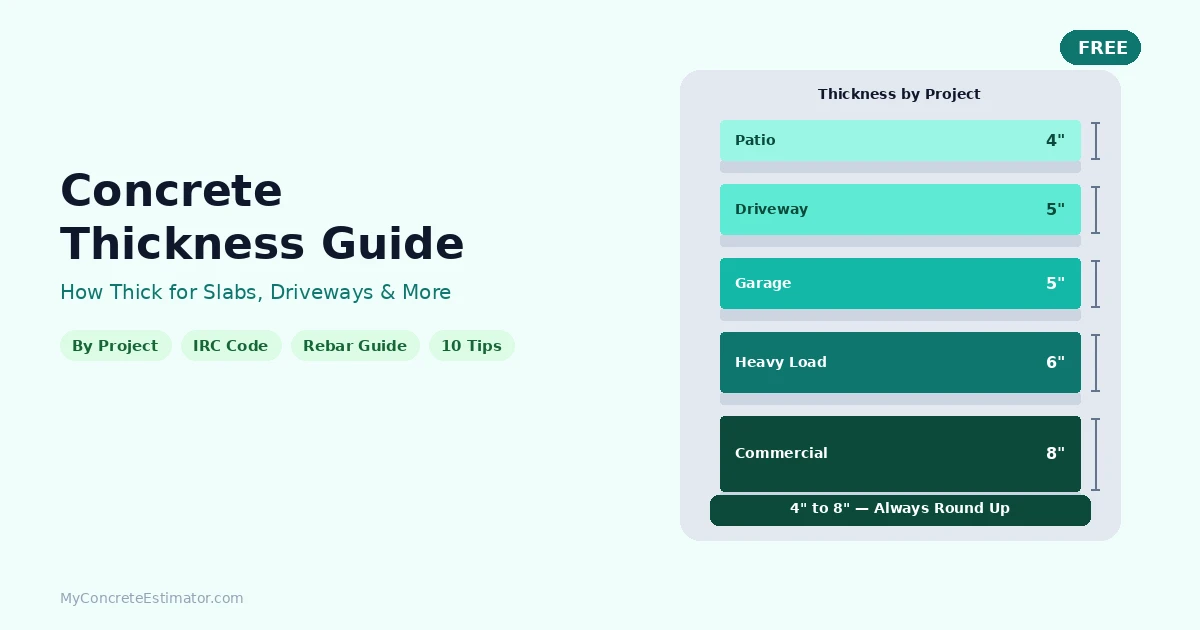
This is the reference chart. It covers every common residential and light commercial application with the recommended thickness, concrete strength, reinforcement, and base requirements.
| Project Type | Recommended Thickness | Minimum PSI | Reinforcement | Base Required |
|---|---|---|---|---|
| Sidewalk (pedestrian only) | 4 inches | 3,000 PSI | Wire mesh or fiber | 4″ compacted gravel |
| Patio | 4 inches | 3,000–3,500 PSI | Wire mesh or fiber | 4″ compacted gravel |
| Garden path / stepping pads | 3.5–4 inches | 3,000 PSI | Fiber (optional) | 2–4″ gravel |
| Residential driveway (cars) | 5 inches | 3,500–4,000 PSI | Wire mesh or #3 rebar @ 18″ OC | 4–6″ compacted gravel |
| Driveway (trucks / heavy vehicles) | 6 inches | 4,000 PSI | #4 rebar @ 12–18″ OC | 6″ compacted gravel |
| Driveway apron (street to property) | 6 inches minimum | 4,000 PSI | #4 rebar @ 12″ OC | 6″ compacted gravel |
| Garage floor (1–2 car) | 4–5 inches | 3,500 PSI | Wire mesh or #3 rebar @ 18″ OC | 4″ compacted gravel + vapor barrier |
| Garage floor (workshop / heavy use) | 5–6 inches | 4,000 PSI | #4 rebar @ 16–18″ OC | 6″ compacted gravel + vapor barrier |
| RV pad / heavy equipment slab | 6–8 inches | 4,000–4,500 PSI | #4 rebar @ 12″ OC both ways | 6–8″ compacted gravel |
| Shed / outbuilding slab | 4–5 inches | 3,000–3,500 PSI | Wire mesh or fiber | 4″ compacted gravel |
| Commercial parking lot | 6–8 inches | 4,000–4,500 PSI | #4 rebar @ 12″ OC both ways | 6–8″ crushed stone |
| Warehouse / industrial floor | 6–10 inches | 4,500–5,000 PSI | #5 rebar grid or post-tension | 8–12″ engineered base |
| Foundation slab (monolithic) | 4 inches (field) + 12″ thickened edge | 3,500 PSI | #4 rebar per engineer’s plan | 4″ gravel + 6-mil vapor barrier |
Key takeaway: Pedestrian-only surfaces (patios, sidewalks) get 4 inches. Anything that carries a vehicle gets 5 inches minimum. Heavy vehicles and commercial loads need 6–8 inches. Foundations follow engineering plans.
How to Determine the Right Concrete Thickness
Four factors drive the decision. You need to evaluate all four — not just one.
1. Expected Loads
This is the most important factor. Ask yourself: what is the heaviest thing that will ever sit on or cross this slab?
| Load Type | Typical Weight | Minimum Slab Thickness |
|---|---|---|
| Foot traffic only | 150–250 lbs per person | 3.5–4 inches |
| Passenger car | 3,000–5,000 lbs | 5 inches |
| Pickup truck / SUV | 5,000–7,000 lbs | 5–6 inches |
| Delivery truck / loaded trailer | 10,000–26,000 lbs | 6 inches |
| RV / motorhome | 15,000–30,000 lbs | 6–8 inches |
| Fire truck / garbage truck | 40,000–80,000 lbs | 8–10 inches (engineered) |
2. Soil Type and Bearing Capacity
The slab sits on the subgrade, and weak soil means the concrete has to do more work. Soil bearing capacity is measured in pounds per square foot (psf).
| Soil Type | Bearing Capacity | Slab Thickness Adjustment |
|---|---|---|
| Bedrock / dense gravel | 8,000+ psf | Use standard thickness |
| Compacted sand / gravel mix | 3,000–5,000 psf | Use standard thickness |
| Stiff clay | 2,000–4,000 psf | Add 1 inch + use rebar |
| Soft clay / silt | 1,000–2,000 psf | Add 2 inches + rebar + thicker base |
| Organic soil / fill | Under 1,000 psf | Remove and replace — do not pour on it |
| Expansive clay | Variable (swells when wet) | Engineer required — may need post-tension or void forms |
Rule of thumb: If you can push a ½-inch rebar into the soil by hand, the soil is too soft for standard slab construction. You need a thicker gravel base, a thicker slab, or both.
3. Climate and Freeze-Thaw Exposure
In IECC climate zones 5 through 8 (roughly the northern half of the US), concrete slabs endure repeated freeze-thaw cycles. Water penetrates the surface, freezes, expands by 9%, and breaks the concrete from the inside.
Thicker slabs resist this better because they have more mass and depth to absorb frost heave forces. In freeze-thaw zones:
- Use a minimum of 5 inches for any slab exposed to weather (driveways, patios, sidewalks).
- Use air-entrained concrete (4–7% air content) — this is more important than extra thickness for freeze-thaw resistance.
- Ensure the gravel base drains freely — standing water under the slab is the primary cause of frost heave damage.
4. Local Building Code Requirements
Your local jurisdiction has the final word. Most municipalities adopt the IRC (International Residential Code) with local amendments.
Common code requirements:
- IRC R506.1: Minimum 3.5-inch slab thickness for concrete floors on grade. Most jurisdictions amend this to 4 inches.
- IRC R506.2.1: Base course of 4 inches of clean graded sand, gravel, or crushed stone required under the slab.
- IRC R506.2.3: A vapor retarder of at least 6 mil is required between the base and the slab for enclosed, conditioned spaces (garages, habitable areas).
- IRC R506.2.4: Steel reinforcement must be positioned in the upper half to upper third of the slab depth.
- IRC R403: Foundation footings must be minimum 12 inches wide and extend below the frost line.
Always check with your local building department before pouring. Some cities require 5 inches minimum for driveways, and some freeze-thaw zones require 6 inches for any exterior slab.
Concrete Thickness for Driveways
Driveways take more abuse than any other residential slab. They carry daily vehicle traffic, endure turning stress (especially at the apron), and sit exposed to weather year-round.
Standard Residential Driveway (Cars and Light Trucks)
Recommended thickness: 5 inches
A 4-inch driveway can technically support a passenger car, but 5 inches is the industry standard because:
- It provides a 56% increase in bending resistance over 4 inches (strength scales with thickness squared).
- It handles the occasional delivery truck, moving van, or loaded pickup without damage.
- It meets or exceeds code in every US jurisdiction.
- The cost difference between 4 and 5 inches on a 600 sq ft driveway is only $300–$600 in extra concrete.
Use 3,500–4,000 PSI concrete with wire mesh (6×6 W1.4×W1.4) or #3 rebar at 18 inches on center both ways. Place on a minimum 4-inch compacted gravel base.
Heavy-Duty Driveway (Trucks, RVs, Trailers)
Recommended thickness: 6 inches
If you park an RV, boat trailer, dump truck, or heavy equipment on your driveway — even occasionally — go to 6 inches. The extra inch costs roughly $0.75–$1.50 per square foot but handles loads up to 26,000 lbs (a loaded box truck).
Use 4,000 PSI concrete with #4 rebar at 12–18 inches on center both ways. Place on 6 inches of compacted gravel.
Driveway Apron
Recommended thickness: 6 inches minimum
The apron is where the driveway meets the street. It takes the highest stress because vehicles turn across it at an angle, concentrating load on one tire. Most municipalities require a permit for the apron and specify 6 inches minimum with rebar. Some require 8 inches.
Heated Driveways
If you are installing a hydronic radiant heating system under the driveway (to melt snow), you need a minimum of 5 inches — and 6 inches is better — to cover the PEX tubing with at least 2 inches of concrete above it. The tubing sits on top of insulation board, which rests on the gravel base. Total assembly depth is typically 6–7 inches of concrete over 2 inches of rigid foam insulation.
Concrete Thickness for Garage Floors
Garage floors have two jobs: support your vehicles and resist cracking from temperature swings (garages are semi-conditioned spaces that cycle between hot and cold).
Standard 1–2 Car Garage
Recommended thickness: 4–5 inches
A 4-inch garage floor is code-compliant and adequate for parking two standard passenger cars. However, I recommend 5 inches because:
- You might park a heavy truck, trailer, or boat in the future.
- The extra inch costs $150–$400 total on a typical 2-car garage (20×24 ft, 480 sq ft).
- Thicker floors resist cracking from tool drops, jack stands, and point loads better.
Use 3,500 PSI concrete with wire mesh or #3 rebar at 18 inches OC. A 6-mil vapor barrier is required between the gravel base and the slab per IRC R506.2.3 — this prevents moisture from wicking up through the concrete and damaging floor coatings or stored items.
Workshop / Heavy-Use Garage
Recommended thickness: 5–6 inches
If you are running a workshop with a car lift, heavy workbenches, welding equipment, or a lathe — go to 6 inches. A 2-post car lift concentrates 8,000–10,000 lbs on two small base plates. A 4-inch slab will crack under a car lift. Use 4,000 PSI concrete with #4 rebar at 16–18 inches OC.
For car lifts specifically, many manufacturers require a 6-inch slab minimum with 3,000 PSI concrete and rebar reinforcement. Check the lift manufacturer’s specs before you pour.
Garage Thickened Edge (Perimeter Footing)
Most garage slabs use a monolithic pour with a thickened edge that serves as the footing. The field area is 4–5 inches thick, but the perimeter thickens to 12 inches deep by 12 inches wide, reinforced with two #4 rebar running horizontally. This thickened edge carries the wall loads and anchors the slab against frost heave.
Concrete Thickness for Patios and Sidewalks
These are the simplest slabs to size because they carry only foot traffic and patio furniture.
Patios
Recommended thickness: 4 inches
A 4-inch patio slab handles everything a residential patio needs — people, furniture, a grill, a hot tub (with a thickened section — see below). Use 3,000–3,500 PSI concrete with wire mesh or fiber reinforcement on 4 inches of compacted gravel.
Hot tub exception: A filled hot tub can weigh 3,000–6,000 lbs. If you plan to place a hot tub on the patio, thicken that section to 6 inches with #4 rebar at 12 inches OC. Do not place a hot tub on a standard 4-inch slab — it will settle and crack.
Sidewalks
Recommended thickness: 4 inches
Standard for all residential sidewalks. Public sidewalks in the right-of-way may require 5 inches per local code — check with your municipality. Control joints every 4–5 feet prevent random cracking.
If the sidewalk crosses a driveway approach (where vehicles drive over it), thicken that section to 6 inches — it is no longer a sidewalk at that point, it is a driveway apron.
When You Need Thicker Concrete
Sometimes standard thicknesses are not enough. Here are the situations where you should add 1–2 inches beyond the recommendations above.
Poor or expansive soil. If your soil is soft clay, organic fill, or expansive clay that swells when wet, standard thicknesses will fail. Soft soils need a thicker gravel base (6–8 inches), a thicker slab (add 1–2 inches), and rebar reinforcement. Expansive clay often requires a structural engineer and may need post-tensioned slab construction.
Heavy point loads. Car lifts, column footings, heavy machinery, and storage racks concentrate thousands of pounds on small areas. A 4-inch slab under a car lift will punch through. Add thickened pads (6–8 inches) at known point-load locations, reinforced with #4 rebar at 12 inches OC.
Freeze-thaw zones. In IECC climate zones 5–8 (Minnesota, Wisconsin, Michigan, New England, etc.), go to 5 inches minimum for any exterior slab. Combine with air-entrained concrete and a free-draining gravel base.
Vehicle turning areas. Where vehicles make tight turns (aprons, turnarounds, parking areas), the slab sees concentrated lateral and twisting forces. Use 6 inches with rebar.
Sloped driveways. Steep driveways (over 5% grade) channel water along the surface, which accelerates erosion and freeze-thaw damage at the base. Use 6 inches with surface drainage cuts.
Adjacent to structures. Where a slab abuts a foundation wall or garage, the edge takes extra load from vehicles bumping up against it or snow plows pushing against it. Thicken the edge to 6 inches for the first 2–3 feet.
Reinforcement Guide by Concrete Thickness
Reinforcement is not optional for any slab thicker than 3.5 inches — and even then, it is strongly recommended. Here is what to use at each thickness.
| Slab Thickness | Load Type | Recommended Reinforcement | Position in Slab |
|---|---|---|---|
| 3.5 inches | Foot traffic only | Fiber reinforcement (1.5 lb/yd³) or welded wire mesh (6×6 W1.4×W1.4) | Mid-depth |
| 4 inches | Foot traffic + light loads | Welded wire mesh (6×6 W1.4×W1.4) | Upper third (1–1.5″ from top) |
| 5 inches | Passenger vehicles | Wire mesh OR #3 rebar @ 18″ OC both ways | Upper third (1.5–2″ from top) |
| 6 inches | Heavy vehicles / trucks | #4 rebar @ 12–18″ OC both ways | Upper third (2″ from top) |
| 8 inches | Commercial / heavy industrial | #4 or #5 rebar @ 12″ OC both ways | Two layers — top and bottom third |
| 10+ inches | Structural / engineered | Per structural engineer’s plan | Per engineer’s plan |
Wire Mesh vs. Rebar vs. Fiber — When to Use Each
| Reinforcement Type | Cost per Sq Ft | Best For | Limitations |
|---|---|---|---|
| Welded wire mesh (6×6 W1.4×W1.4) | $0.15–$0.35 | Patios, sidewalks, light-duty garage floors | Does not add structural capacity — only holds cracks together |
| Rebar (#3 or #4) | $0.50–$2.00 | Driveways, heavy garage floors, any vehicular slab | Requires chairs/supports, more labor to install |
| Synthetic fiber | $0.10–$0.25 | Supplementary crack control in any slab | Does not replace rebar for structural loads — reduces plastic shrinkage cracking only |
| Steel fiber | $0.40–$0.75 | Industrial floors, warehouse slabs | Can make finishing more difficult — requires experienced crew |
My recommendation: For any slab that carries vehicles, use rebar — not wire mesh. Wire mesh is a crack-control measure, not structural reinforcement. It holds cracks together after they form but does not prevent them or add load capacity. Rebar does both.
How Thickness Affects Concrete Cost
Every extra inch of thickness adds material cost. Here is the cost impact for a typical 600 sq ft driveway (20×30 ft):
| Thickness | Concrete Volume | Material Cost (concrete only) | Total Installed Cost |
|---|---|---|---|
| 4 inches | 7.4 cubic yards | $1,110–$1,480 | $3,600–$5,400 |
| 5 inches | 9.3 cubic yards | $1,395–$1,860 | $4,200–$6,600 |
| 6 inches | 11.1 cubic yards | $1,665–$2,220 | $4,800–$7,800 |
Going from 4 to 5 inches adds roughly $600–$1,200 to the total installed cost of a driveway. Going from 4 to 6 inches adds $1,200–$2,400. Compared to the $6,000–$12,000 cost of demolishing and replacing a failed slab, the extra inch is always worth it.
10 Tips for Getting Concrete Thickness Right
1. Always Round Up, Never Down
If you are between 4 and 5 inches, go with 5. The cost difference is small but the performance difference is massive — 56% more bending resistance.
2. Design for the Heaviest Load — Not the Everyday Load
Your driveway usually holds a 4,000-lb sedan. But twice a year a concrete truck, moving van, or dumpster delivery crosses it. Design for that truck, not the sedan.
3. Thicken Edges and Aprons Separately
The weakest point on any slab is the edge. Thicken the perimeter by 2 inches and the driveway apron to 6 inches minimum, regardless of field thickness.
4. Do Not Trust the Subgrade — Verify It
Compact the gravel base to 95% Standard Proctor density. A hand tamper is not enough for driveways and garages — use a plate compactor or a jumping jack compactor. Uncompacted gravel will settle unevenly and crack the slab.
5. Use Chairs and Supports to Position Rebar Correctly
Rebar sitting on the ground does nothing. It must be positioned in the upper third of the slab (per IRC R506.2.4). Use rebar chairs (dobies) at 3–4 foot intervals to hold the steel at the correct height during the pour.
6. Check Grade Pins Before the Pour
Set grade stakes or screed rails at the correct height across the entire slab area. Verify with a laser level. An extra ½ inch on a 600 sq ft pour wastes almost 1 cubic yard of concrete ($150–$200). A ½ inch too thin creates a weak spot.
7. Add Thickened Pads Under Known Point Loads
If you know where a car lift, column, heavy workbench, or hot tub will go, thicken those specific areas to 6–8 inches with #4 rebar. This is far cheaper than thickening the entire slab.
8. Account for the Vapor Barrier in Garage Floors
A 6-mil polyethylene vapor barrier goes between the gravel base and the concrete. It prevents moisture migration but can cause the concrete to cure unevenly. Some contractors place a thin sand blotter layer (1 inch of sand) over the poly to absorb bleed water — this is good practice for garage floors that will receive coatings.
9. Never Reduce Thickness to Save Money
Going from 5 to 4 inches on a 600 sq ft driveway saves $300–$600. If the thinner slab fails in 8–10 years instead of lasting 30–40 years, you spend $8,000+ to replace it. There is no worse place to cut costs.
10. When in Doubt, Ask for a Soil Test
A basic soil bearing test costs $200–$500 and tells you exactly what your subgrade can support. This is especially important for heavy-load slabs, expansive clay areas, and any site with fill material. A soil engineer can save you from pouring on ground that cannot carry your slab.
4 Inches vs. 5 Inches vs. 6 Inches — When to Upgrade
| Factor | 4 Inches | 5 Inches | 6 Inches |
|---|---|---|---|
| Bending resistance (relative) | 1.0× | 1.56× | 2.25× |
| Vehicle support | Not recommended | Cars and light trucks | Heavy trucks, RVs, equipment |
| Extra concrete per 600 sq ft | Baseline | +1.9 cubic yards | +3.7 cubic yards |
| Extra cost (installed) | Baseline | +$600–$1,200 | +$1,200–$2,400 |
| Best for | Patios, sidewalks, garden paths | Driveways, garage floors | Heavy driveways, workshop, aprons |
Final Thoughts
Concrete thickness is the single most impactful decision you make during a slab project — more important than finish type, color, or even the brand of concrete. A properly thick slab with basic wire mesh will outperform a too-thin slab with premium rebar every time.
Use the chart at the top of this page as your starting point, adjust for soil and climate, and always round up. The extra inch is the cheapest part of the entire project and the one thing you cannot fix after the pour.
If you want to estimate how much concrete you need at your chosen thickness, try our Concrete Slab Calculator — it gives you cubic yards, bags, and cost in under 30 seconds. For full installed pricing with labor and add-ons, use our Slab Cost Estimator.
A residential driveway should be 5 inches thick for standard passenger cars and light trucks. Use 6 inches if you park heavy vehicles like RVs, loaded trailers, or trucks over 10,000 lbs. The driveway apron (where it meets the street) should always be 6 inches minimum because it handles turning stress from vehicles.
A standard 1–2 car garage floor should be 4–5 inches thick with 3,500 PSI concrete. For workshops or garages with car lifts, go to 5–6 inches with 4,000 PSI concrete and #4 rebar. Most car lift manufacturers require a 6-inch slab minimum. All garage floors need a 6-mil vapor barrier between the gravel base and the concrete per IRC R506.2.3.
A concrete patio should be 4 inches thick with 3,000–3,500 PSI concrete on a 4-inch compacted gravel base. Wire mesh or fiber reinforcement is sufficient for foot traffic and patio furniture. If you plan to place a hot tub on the patio, thicken that section to 6 inches with #4 rebar — a filled hot tub can weigh 3,000–6,000 lbs.
Residential sidewalks should be 4 inches thick with 3,000 PSI concrete. Public sidewalks in the right-of-way may require 5 inches per local code. If the sidewalk crosses a driveway approach where vehicles drive over it, thicken that section to 6 inches — it is functioning as a driveway apron at that point, not a sidewalk.
IRC Section R506.1 sets a minimum of 3.5 inches for concrete floors on grade. Most local jurisdictions amend this to 4 inches minimum. Driveways typically require 4–5 inches by local code, and the apron section often requires 6 inches. Always check with your local building department — requirements vary by city and state.
A 4-inch driveway can technically support a passenger car, but it is not recommended. A 5-inch driveway provides 56% more bending resistance and handles occasional heavy vehicles (delivery trucks, moving vans) without damage. The cost difference is only $300–$600 on a 600 sq ft driveway. Most contractors and building departments recommend 5 inches as the minimum for driveways.
For heavy trucks (10,000–26,000 lbs) like delivery trucks and loaded trailers, use 6 inches of 4,000 PSI concrete with #4 rebar at 12–18 inches on center. For fire trucks or garbage trucks (40,000–80,000 lbs), you need 8–10 inches with an engineered design. RV pads should be 6–8 inches with rebar reinforcement.
Yes — thicker concrete resists cracking much better because bending resistance scales with the square of thickness. A 5-inch slab is 56% stronger in bending than a 4-inch slab, and a 6-inch slab is 125% stronger (2.25× the resistance). However, thickness alone does not prevent all cracking — you also need proper control joints, adequate curing, reinforcement, and a compacted base.
For a 4-inch slab carrying only foot traffic (patio, sidewalk), welded wire mesh or fiber reinforcement is usually sufficient. Rebar is not required by code for a 4-inch pedestrian slab but is strongly recommended if the soil is poor, the slab is large, or it will carry any vehicle loads. For any slab 5 inches or thicker, or any slab carrying vehicles, use rebar.
Most car lift manufacturers require a minimum of 6 inches of concrete with 3,000 PSI strength and rebar reinforcement. A 2-post lift concentrates 8,000–10,000 lbs on two small base plates — a 4-inch slab will crack under this concentrated load. Some 4-post lifts are more forgiving but still require 5 inches minimum. Always check the lift manufacturer’s specifications before pouring.
Each extra inch of thickness adds approximately $0.50–$1.25 per square foot in material cost, or roughly $300–$750 for a 600 sq ft driveway. Including labor, the total installed cost increase is $600–$1,200 per extra inch. This is minimal compared to the $6,000–$12,000 cost of demolishing and replacing a slab that failed because it was too thin.
Use 3,500–4,000 PSI concrete for residential driveways. Standard 3,000 PSI is acceptable for patios and sidewalks but marginal for driveways. If your driveway will carry heavy vehicles or is in a freeze-thaw zone, go with 4,000 PSI. In northern climates, use air-entrained concrete (4–7% air content) regardless of PSI to resist freeze-thaw damage.
A shed slab should be 4–5 inches thick with 3,000–3,500 PSI concrete. Use 4 inches for a standard storage shed and 5 inches if you plan to store heavy equipment like riding mowers, ATVs, or workshop tools. Wire mesh reinforcement is sufficient for most sheds. A 4-inch compacted gravel base is standard.
Yes — IRC Section R506.2.1 requires a 4-inch base of clean graded sand, gravel, or crushed stone under concrete slabs on grade. The gravel base provides drainage (preventing water from pooling under the slab), uniform support, and a barrier between the concrete and the native soil. Skip the gravel base and you risk settlement, cracking, and frost heave damage.
In freeze-thaw zones (IECC climate zones 5–8), use 5 inches minimum for any exterior slab — patios, driveways, and sidewalks. Driveways should be 5–6 inches. Combine thicker concrete with air-entrained concrete (4–7% air content) and a free-draining gravel base of at least 4–6 inches. The gravel prevents water from pooling under the slab, which is the primary cause of frost heave damage.