
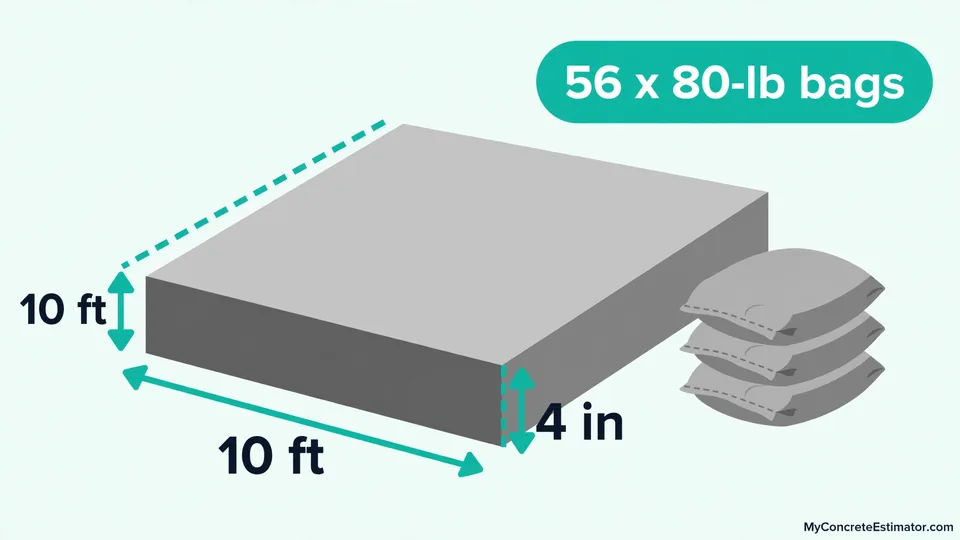
For a 10×10 concrete slab poured 4 inches thick, you need 56 × 80-lb bags of concrete (33.33 cubic feet, or 1.23 cubic yards). That is the single most common size for a DIY patio or shed base, and it sits right at the upper edge of what most people can mix by hand in a day. A 10×10 slab covers exactly 100 square feet — so a “100 sq ft slab” is the same pour. The matrix table below gives exact counts for 80, 60, and 40-lb bags at every standard thickness.
📑 Table of Contents
[ Hide ]How Many Bags of Concrete for a 10×10 Slab?
A 10×10 slab at 4 inches thick takes 56 × 80-lb bags, 75 × 60-lb bags, or 112 × 40-lb bags. Four inches is the standard thickness for patios, walkways, and shed bases, so most people land on one of these numbers. If you are pouring 5 or 6 inches — for heavier loads — the counts climb to 70 and 84 eighty-pound bags respectively. The full matrix below covers every common thickness.
| Slab thickness | 80-lb bags | 60-lb bags | 40-lb bags |
|---|---|---|---|
| 3 inches | 42 | 56 | 84 |
| 4 inches | 56 | 75 | 112 |
| 5 inches | 70 | 93 | 139 |
| 6 inches | 84 | 112 | 167 |
These figures assume a perfectly formed slab with a level subgrade. In real life, hardly anyone pours a perfect slab — which is why the waste section below matters. If your slab size is even slightly different (say 10×12 or 9×10), run your exact dimensions through the Concrete Bag Calculator instead of guessing from this table.
The Formula: How We Calculate Bag Counts
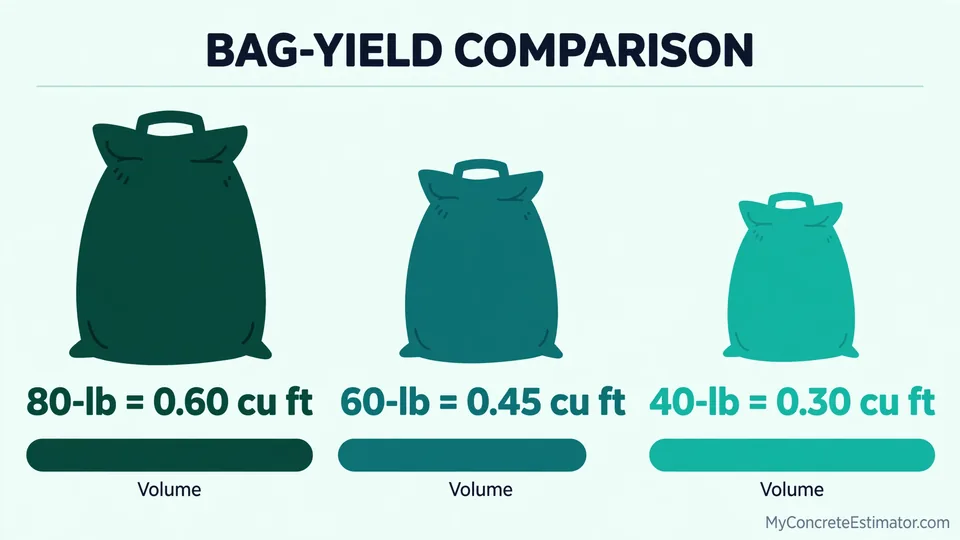
Bag count comes from three steps: find the volume, divide by each bag’s yield, then round up. Here it is worked out for the headline case. First, volume: 10 ft × 10 ft × (4 in ÷ 12) = 10 × 10 × 0.333 = 33.33 cubic feet. Second, bag yields: an 80-lb bag of premix makes about 0.60 cu ft, a 60-lb bag makes about 0.45 cu ft, and a 40-lb bag makes about 0.30 cu ft. Third, divide: 33.33 ÷ 0.60 = 55.55, rounded up to 56 × 80-lb bags.
The same math produces every number in the matrix. Notice that bag size does not change the total volume you pour — it only changes how many bags you carry. One hundred twelve 40-lb bags and fifty-six 80-lb bags give you the exact same slab; the 40-lb option just costs more per pound and doubles your trips from the truck. Want the worked numbers for a custom size? The Concrete Volume Calculator gives you cubic feet and yards first, and the Concrete Bag Calculator converts that straight into bag counts for any bag size.
Add 5–10% Extra for Waste
Buy 5–10% more bags than the math says — for a 4-inch 10×10 slab, that means 59–62 × 80-lb bags instead of 56. The table counts assume a perfect pour. Real subgrades are not perfect. Excavation runs slightly deep in spots, form boards bulge a fraction, and you will lose concrete to the wheelbarrow, the mixer drum, and the ground around the forms. On a 100 sq ft slab, those small overages add up fast.
The safe play: take the waste-adjusted count and round up to a whole pallet quantity. Dry, unopened bags keep indefinitely if stored off the ground and out of the rain, so a few leftover bags are never wasted — they become the repair concrete for a future project. What you cannot do is run back to the store mid-pour. Once concrete starts setting, a 45-minute store run can leave you with a cold joint right through the middle of the slab. Running short is the single most common DIY failure on slab pours.
When Bags Stop Making Sense (Read This Before Buying 112 Bags)
Once a project crosses about 2 cubic yards, ordering a ready-mix truck is usually cheaper and always easier than bags. A 4-inch 10×10 slab is 1.23 yd³ — comfortably a bag project. But look at the thick end of the table: a 6-inch slab is 1.85 yd³, needing 84 × 80-lb bags. That is over three thousand pounds of concrete to mix by hand. At that scale, a short-load delivery starts winning on both cost and sanity.
Ready-mix suppliers charge a base rate plus a short-load fee (typically $150–$300 per pour, estimates — confirm with your supplier) when you order under their minimum, usually 4–5 yards. Run the comparison before you commit: the Delivery Fee Calculator prices short loads against bag totals, and the Concrete Cost Calculator shows the full DIY-vs-delivered breakdown. Rule of thumb: under ~60 bags, bags usually win. Over ~80 bags, get a truck quote before you buy a single pallet.
What People Pour 10×10 Slabs For
The 10×10 is the workhorse DIY slab — big enough to matter, small enough to pour in one session. Here are the four projects it fits best, with the thickness call for each.
Patio
A 10×10 patio seats a small bistro set or a couple of lounge chairs comfortably. Pour it 4 inches thick with a 6×6 W1.4/W1.4 welded wire mesh sheet in the middle, and cut control joints into thirds (roughly 3.3 ft spacing) to control cracking.
Shed base
The classic 8×10 shed sits on a 10×10 pad with a foot of working room around it — though many people pour 10×12 to be safe. Four inches is plenty for storage sheds. Slope the slab slightly (about 1/8 inch per foot) away from the shed so water does not pool against the walls.
Hot tub pad
A 10×10 pad fits most residential hot tubs with room to walk around them. This one needs 4 inches minimum, and 5–6 inches is better for larger tubs — a filled 400-gallon tub plus occupants can weigh over 4,000 lbs. Add rebar (not just wire mesh) and check your local code before pouring.
AC condenser pad
Oversized for a single unit, but a 10×10 pad works when two condensers share a location or the equipment needs service access on all sides. Four inches on compacted gravel is standard. Keep the pad 2–4 inches above surrounding grade so water drains away from the equipment.
How to Mix and Pour a 10×10 Slab
For 56 bags, rent a powered mixer — mixing this much by hand will break both your pace and your back. A standard 3.5 cu ft mixer handles two 80-lb bags per batch, so expect roughly 28 batches. Mix each batch for about 3 minutes once the water is in; over-mixing weakens the concrete, under-mixing leaves dry pockets. Have a helper stage unopened bags beside the mixer and a second person screed while you mix — the pour will take 3–4 hours at a comfortable pace.
Set your forms first and double-check the diagonal: on a 10×10 form, both diagonals should measure 14 ft 1.7 in (14.14 ft). Stake every 2–3 feet, especially at the corners. Wet the subgrade (not soaked, just damp) before the first batch lands so dry soil does not steal water from the concrete. Float and edge after the bleed water disappears — never finish the surface while it is still shiny and wet, or you will trap water under a weak crust.