
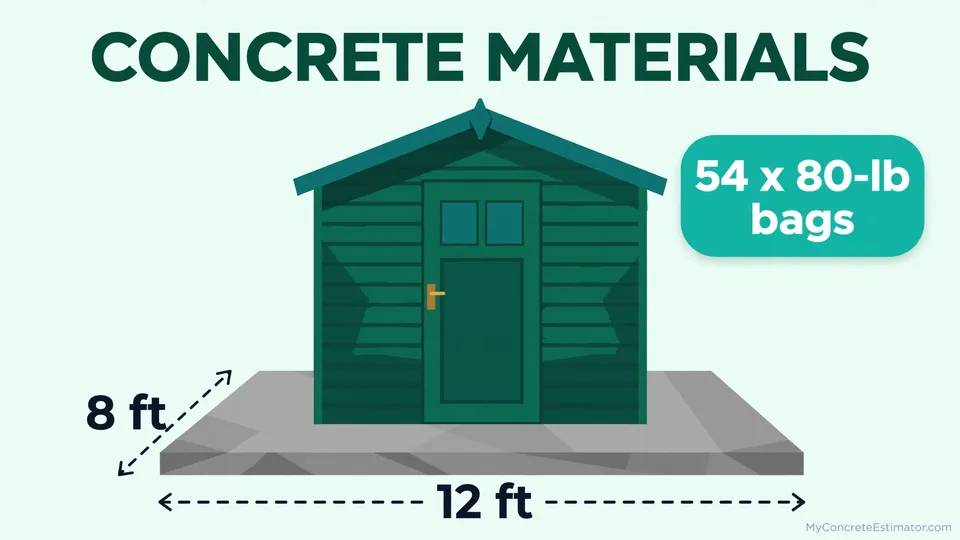
An 8×12 slab poured 4 inches thick needs 54 eighty-pound bags of concrete. That’s 32 cubic feet — 1.19 cubic yards — of concrete, and it’s one of the most common shed-slab sizes there is. Whether you’re pouring a base for a new storage shed or replacing an old one, the numbers below give you the exact bag count for every common slab thickness, plus the formula so you can check any size yourself on our Concrete Bag Calculator.
📑 Table of Contents
[ Hide ]How Many Bags of Concrete for an 8×12 Slab?
At the standard 4-inch thickness, an 8×12 slab needs 54 eighty-pound bags. That works out to 32 cubic feet, or 1.19 cubic yards, of concrete. If you’re buying the smaller bags instead, plan on 72 sixty-pound bags or 107 forty-pound bags for the same slab. Here’s the full matrix for every common thickness — same 96 square feet, different bag counts:
| Slab thickness | 80-lb bags | 60-lb bags | 40-lb bags |
|---|---|---|---|
| 3″ | 40 | 54 | 80 |
| 4″ | 54 | 72 | 107 |
| 5″ | 67 | 89 | 134 |
| 6″ | 80 | 107 | 160 |
Two things worth noting before you head to the store. First, always round up, never down — the math for a 4-inch slab gives 53.3 bags, and you can’t buy a third of a bag, so 54 is the real-world answer. Second, these counts assume the concrete you mix matches the bag’s stated yield (about 0.6 cubic feet per 80-lb bag), which holds true when you mix to the bag’s water ratio. Running the numbers for a different size or thickness? Our Concrete Bag Calculator does the same math in seconds.
How to Calculate It: The Bag Formula
Volume in cubic feet divided by the bag’s yield equals the number of bags. The math is the same every time, so once you see it worked out, you can do any slab on a scrap of paper. Here’s the 8×12 at 4 inches, step by step:
First, convert the thickness to feet: 4 inches ÷ 12 = 0.33 feet. Multiply length × width × thickness in feet: 8 × 12 × 0.33 = 32 cubic feet. Then divide by the yield of an 80-lb bag, which is about 0.6 cubic feet: 32 ÷ 0.6 = 53.3, which rounds up to 54 bags.
The yields are standard across brands like Quikrete and Sakrete: an 80-lb bag yields about 0.6 cubic feet, a 60-lb bag about 0.45, and a 40-lb bag about 0.30. So a 5-inch 8×12 slab works out to 8 × 12 × (5÷12) = 40 cubic feet, and 40 ÷ 0.6 = 66.7 → 67 bags, matching the table above. If you’d rather not do arithmetic on pour day, the Concrete Volume Calculator handles the cubic-feet step for you.
Add 5–10% Extra for Waste
For an 8×12 slab at 4 inches, buy 57 to 60 bags instead of exactly 54. Concrete estimating always includes a waste factor, and on a small hand-mixed pour it’s the difference between finishing strong and running short with wet concrete in the forms.
Where does the extra go? Spillage off the mixer chute, concrete left clinging to the wheelbarrow, forms that bulge slightly outward under the load, and subgrade that dips an extra half inch here and there. None of these are mistakes — they’re just what happens on a real job. Five percent extra here is 3 more bags; ten percent is 6. Most home centers accept returns of unopened bags with a receipt, so the downside of buying a few extra is a single trip back, while the downside of running short is a cold joint — a visible seam where new concrete meets concrete that started setting.
When Bags Stop Making Sense
Once a pour passes about 2 cubic yards, price out a ready-mix truck before buying bags. An 8×12 slab at 4 inches is 1.19 cubic yards, squarely in bag territory. At 6 inches it climbs to 1.78 cubic yards and 80 bags — that’s borderline, and a short-load delivery starts to look competitive.
Why the 2-yard rule of thumb? Beyond that point, hand-mixing takes longer than the concrete gives you — you can’t place 2-plus yards with a drum mixer before the first batches start setting — and the per-bag cost adds up past what a plant charges. Check the math both ways with the Delivery Fee Calculator to see what a short-load truck would cost in your area, and run the total project numbers through the Concrete Cost Calculator. For anything bigger than this 8×12, the truck usually wins on both cost and sanity.
8×12 Shed Slab: Concrete or Gravel Base?
An 8×12 concrete slab is the right call for a permanent shed you’ll load up and keep for decades. The most common residential shed footprints are 8×10 and 8×12, and both sit beautifully on a 4-inch slab. Concrete gives you a level, rot-proof, rodent-proof floor that won’t shift under a riding mower or a loaded tool chest. Your shed anchors to it, and you never think about the floor again.
That said, gravel has its fans for good reasons. A compacted gravel pad costs roughly half what a concrete slab does, drains freely so water never pools under the shed, and in many towns it sidesteps permit questions entirely. The tradeoff is that gravel settles and ruts over time, and a shed on gravel needs a pressure-treated skid or floor frame to keep the wood off the damp ground.
If you pour concrete, make it 4 inches thick for a real shed — that’s enough for lawn equipment, a motorcycle, and normal storage. A 3-inch slab is fine only for a light-duty garden shed on firm, well-drained soil. In freeze-thaw climates, put the slab over a compacted gravel sub-base and check local frost-line rules; a floating slab on soil that heaves every winter will crack no matter how well you mix it.
How to Mix and Pour Your 8×12 Slab
Rent a mixer, stage your bags along the forms, and work in steady batches. A typical rental drum mixer holds about two 80-lb bags per load, so 54 bags means roughly 27 batches. One person runs the mixer and shuttles wheelbarrows while the other spreads, screeds, and finishes — plan on four to six hours for a two-person crew, plus setup.
Prep matters more than mixing technique: level and compact a 4-inch gravel sub-base, set 2×4 forms dead level (a 2×4 gives you a true 3.5 inches, which is close enough to 4 for a shed pad), and slope the slab about an eighth of an inch per foot away from where the shed doors will face so water drains off. Screed with a straight 2×4, smooth it with a bull float, and give it a broom finish for traction. Then keep foot traffic off for two days and the shed off for at least a week — concrete gains strength on a curve, not all at once.