
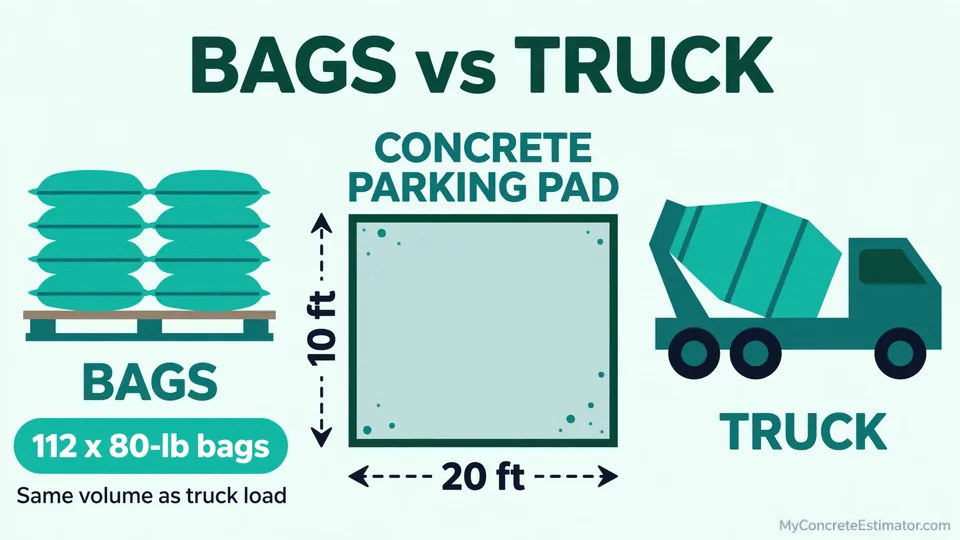
A 10×20 slab poured 4 inches thick needs 112 eighty-pound bags of concrete. That’s 66.67 cubic feet — 2.47 cubic yards — which puts this size right at the edge of what you should hand-mix: one step thicker and a ready-mix truck becomes the smarter move. Below you’ll find the exact bag counts for every thickness, the formula, and an honest bags-vs-truck breakdown for this size, or check any dimensions instantly on our Concrete Bag Calculator.
📑 Table of Contents
[ Hide ]How Many Bags of Concrete for a 10×20 Slab?
At the standard 4-inch thickness, a 10×20 slab needs 112 eighty-pound bags. That’s 66.67 cubic feet, or 2.47 cubic yards — over two and a half tons of dry mix before you add water. With smaller bags, the count climbs to 149 sixty-pound bags or 223 forty-pound bags. The full matrix:
| Slab thickness | 80-lb bags | 60-lb bags | 40-lb bags |
|---|---|---|---|
| 3″ | 84 | 112 | 167 |
| 4″ | 112 | 149 | 223 |
| 5″ | 139 | 186 | 278 |
| 6″ | 167 | 223 | 334 |
This is a 200-square-foot slab, so the numbers scale up fast: each extra inch of thickness adds about 27 eighty-pound bags. As always, round up — the raw math for 4 inches comes to 111.1 bags, and 112 is the real-world buy. And if these numbers make you pause, good — the section below on bags vs. a ready-mix truck is exactly what this size demands you read. For a different size or thickness, our Concrete Bag Calculator runs the same math for any dimensions.
How to Calculate It: The Bag Formula
Cubic feet of concrete divided by the bag’s yield equals the number of bags. Work it once and you’ll trust the table above — and you’ll be able to price any odd size on the spot. For the 10×20 at 4 inches:
Convert thickness to feet: 4 ÷ 12 = 0.33 feet. Volume = 10 × 20 × 0.33 = 66.67 cubic feet. Divide by the 80-lb bag yield of about 0.6 cubic feet: 66.67 ÷ 0.6 = 111.1 → round up to 112 bags.
The yields don’t change between brands (Quikrete, Sakrete, store brands): 80-lb ≈ 0.6 cubic feet, 60-lb ≈ 0.45, 40-lb ≈ 0.30. Check the 6-inch row as practice: 10 × 20 × 0.5 = 100 cubic feet, and 100 ÷ 0.6 = 166.7 → 167 bags, exactly the table figure. Skip the arithmetic on pour day with the Concrete Volume Calculator.
Add 5–10% Extra for Waste
For the 4-inch 10×20, buy 118 to 124 bags, not exactly 112. On a pour this size, the waste factor isn’t optional padding — it’s where experienced estimators separate themselves from the people making a panicked second run to the store.
Subgrade is never perfectly level across 200 square feet, forms flex under that much weight, and you’ll lose some to spillage and what’s left stuck in the mixer drum after 56 batches. Five percent here is 6 extra bags; ten percent is 11. Unopened bags go back to the store with a receipt; a half-finished pour with the crew standing around does not get a do-over. Budget the waste bags like you’d budget for the mixer rental — as part of the job, not an accident.
Bags vs. Ready-Mix: When the Truck Wins (Read This First)
For a 10×20 slab, a ready-mix truck with a short-load fee almost always beats 112+ bags of hand-mixing. This is the size where the crossover happens, so let’s do the math honestly instead of just listing bag counts.
At 4 inches you’re pouring 2.47 cubic yards. A standard ready-mix truck carries up to 10 yards, and most plants enforce a short-load minimum of around 4–5 yards — below that, you pay a short-load fee on top of the concrete. So your delivery would be 2.47 yards of concrete plus a short-load fee (2026 estimates: roughly $75–$150, confirm with your local supplier). The concrete itself runs roughly $130–$180 per yard in most markets (2026 estimates), so the whole load lands around $400–$600 delivered. Compare that to bags: 112 eighty-pound bags at roughly $4.50–$5 each (2026 estimates) is $500–$560 in bags alone, plus a $50–$75 mixer rental, plus your entire weekend.
And that’s the best case. At 5 inches the slab is 3.09 cubic yards — 139 bags. At 6 inches it’s 3.7 cubic yards — 167 bags. You’re still under most short-load minimums, meaning the truck price barely moves while the bag count keeps climbing. The truck dumps 3.7 yards in about twenty minutes; 167 bags means roughly 84 mixer batches, two or three full days of labor for a small crew, and a serious risk of cold joints where one day’s pour meets the next. Run your exact numbers through the Delivery Fee Calculator to see the short-load math for your area, then compare full project costs with the Concrete Cost Calculator. For a 10×20, the honest answer is: price the truck before you buy a single bag.
10×20 for a Garage Floor or Parking Pad
A 10×20 slab is the classic one-car garage footprint or parking pad. At 200 square feet, there’s room to park and walk around the vehicle, and it fits cleanly in most side yards. If this is a garage floor inside walls, 4 inches is standard for passenger vehicles — it’s what most residential garage slabs are poured at.
For a parking pad that will see heavier use, go thicker. Pickup trucks, work vans, and especially RVs want 5–6 inches with proper reinforcement: 6×6 wire mesh at minimum, or #4 rebar on a 16-inch grid for real truck traffic. A 4-inch pad handles a sedan fine, but repeated heavy loads on a thin slab is how you get corner cracks in year three. Whichever thickness you choose, put control joints every 8–10 feet — on a 10×20 that means one joint across the 10-foot direction and one or two down the 20-foot run — so the concrete cracks where you planned, not where it wants to.
Two more details that separate a good pad from a problem: slope the surface about an eighth of an inch per foot away from the house or garage doors so water runs off instead of pooling, and pour over 4 inches of compacted gravel. The gravel drains, gives the slab a stable base, and keeps the bottom of the pour from wicking moisture out of the mix — which matters for strength.
How to Mix and Pour a 10×20 Pad
If you bag-mix this size, pour it in two sections with a planned construction joint — never try to do it all in one go. Split the slab into two 10×10 pours on consecutive days, with a straight bulkhead between them, and you keep every batch inside the concrete’s working time. Each half is about 56 bags: 28 mixer loads, a full day’s work for a two-person crew, and a manageable amount of concrete to screed before it stiffens.
Stage smartly: line the bags up along the forms the night before, keep a hose with a measured bucket for consistent water, and have one person dedicated to the mixer while one or two spread and finish. The first wheelbarrow of the day is always the slowest, so start early and build a rhythm. And one honest word — if you’ve read this far and the 56-batches-per-half math still looks like a plan, reread the truck section above. A 10×20 is where most DIYers discover the difference between “possible” and “wise.”