
For a 12×12 concrete slab poured 4 inches thick, you need 80 × 80-lb bags of concrete (48 cubic feet, or 1.78 cubic yards). That is 144 square feet — the classic shed pad or patio size — and it is about as much as most DIYers can realistically mix and place in one session. The matrix table below gives exact counts for 80, 60, and 40-lb bags at every standard thickness.
📑 Table of Contents
[ Hide ]How Many Bags of Concrete for a 12×12 Slab?
A 12×12 slab at 4 inches thick takes 80 × 80-lb bags, 107 × 60-lb bags, or 160 × 40-lb bags. That 4-inch number covers the standard shed base or patio. Pour thicker for heavier duty — 5 inches takes 100 eighty-pound bags, and 6 inches takes 120. The full matrix below covers every common thickness.
| Slab thickness | 80-lb bags | 60-lb bags | 40-lb bags |
|---|---|---|---|
| 3 inches | 60 | 80 | 120 |
| 4 inches | 80 | 107 | 160 |
| 5 inches | 100 | 134 | 200 |
| 6 inches | 120 | 160 | 240 |
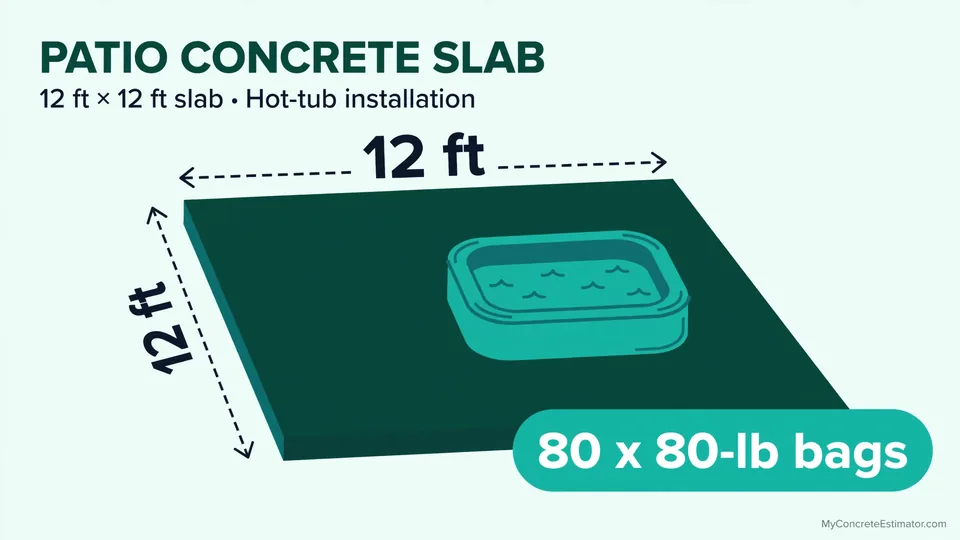
Eighty bags is a serious day of mixing — roughly 6,400 lbs of premix. It is still a bag project at 4 inches, but only just. Before you commit, read the bags-vs-truck section below, because one step thicker pushes this slab into ready-mix territory. For any size that is not exactly 12×12, run your dimensions through the Concrete Bag Calculator rather than scaling these numbers in your head.
The Formula Behind the Numbers
Volume first, then divide by bag yield, then round up. A 12×12 slab at 4 inches: 12 ft × 12 ft × (4 in ÷ 12) = 12 × 12 × 0.333 = 48 cubic feet. An 80-lb bag of premix yields about 0.60 cu ft, a 60-lb bag about 0.45 cu ft, and a 40-lb bag about 0.30 cu ft. Divide: 48 ÷ 0.60 = 80 bags exactly.
The 60-lb column is a good illustration of rounding: 48 ÷ 0.45 = 106.67, which rounds up to 107. You cannot buy two-thirds of a bag, and running short mid-pour is the costliest mistake on a slab this size. If you want to start from volume for a custom size, the Concrete Volume Calculator gives you cubic feet and yards in seconds.
Add 5–10% Extra for Waste
For an 80-bag pour, 5–10% extra means buying 84–88 × 80-lb bags instead of 80. Subgrade is never perfectly level, form boards bow slightly under pressure, and you will lose concrete to the mixer drum, the wheelbarrow, and the ground around the forms. On 144 sq ft, those small losses add up to real volume.
Unopened bags stored dry keep indefinitely, so leftovers are never wasted — they become the premix for fence posts or small repairs. A store run mid-pour, on the other hand, can cost you a cold joint through the middle of the slab if the concrete starts setting before you get back. On a slab this big, always buy the extra bags.
When Bags Stop Making Sense
At about 2 cubic yards, a ready-mix truck usually beats bags on cost and always beats them on effort. A 12×12 slab at 4 inches is 1.78 yd³ — still a bag project. But at 5 inches it is 2.22 yd³ (100 bags), and at 6 inches it is 2.67 yd³ (120 bags, or 9,600 lbs of premix). That is a brutal day of mixing by hand.
Suppliers charge a short-load fee (typically $150–$300 per pour, estimates — confirm with your supplier) under their 4–5 yard minimum, so get both numbers before you decide. The Delivery Fee Calculator prices a short load against your bag total, and the Concrete Cost Calculator shows the full side-by-side. As a rule of thumb: 4 inches → bags; 5 inches → get a truck quote; 6 inches → truck, almost always.
What People Pour 12×12 Slabs For
The 12×12 is the sweet spot for sheds, patios, and hot tub pads — the most-poured backyard slab size in the country. Here are the three projects that drive nearly all of these searches.
Shed base
The 12×12 pad is the standard base for 10×12 sheds, leaving a foot of working room on two sides. Pour 4 inches thick on 4 inches of compacted gravel, and slope it about 1/8 inch per foot so water runs off instead of pooling under the shed. Set J-bolts or post brackets into the wet concrete while you have the chance — drilling and anchoring after the fact is slower and weaker.
Patio
At 144 sq ft, a 12×12 patio fits a full dining set with room to move. Use welded wire mesh and cut control joints on a 4-foot grid — every 4 feet both ways — to manage cracking. Four inches is the standard residential patio thickness.
Hot tub pad
A 12×12 pad comfortably fits a 7–8 ft hot tub with walking room all around. Pour hot tub pads 4 inches minimum, 5–6 inches for larger tubs, and use rebar — not just wire mesh. A filled 400-gallon tub with occupants can top 4,000 lbs, and a pad that flexes under that load will crack and settle. Check your local code for thickness and reinforcement requirements before you pour.
Mixing and Pouring Tips
Eighty bags is a two-mixer or two-person operation — do not plan this solo with one small mixer. A 3.5 cu ft mixer takes two 80-lb bags per batch, so expect 40 batches. With one person mixing and one screeding and finishing, a 12×12 pour takes a full day. Mix each batch about 3 minutes after the water is in, and keep a steady rhythm so batches do not sit waiting — concrete that waits too long starts to set before it is placed.
Check your form diagonals before the first batch: a 12×12 form should measure 16.97 ft on both diagonals. Stake every 2–3 feet. Dampen the subgrade (moist, not puddled) so it does not pull water out of the concrete. And do not finish the surface while bleed water is still visible — wait for the sheen to disappear, then float, edge, and broom for traction.