
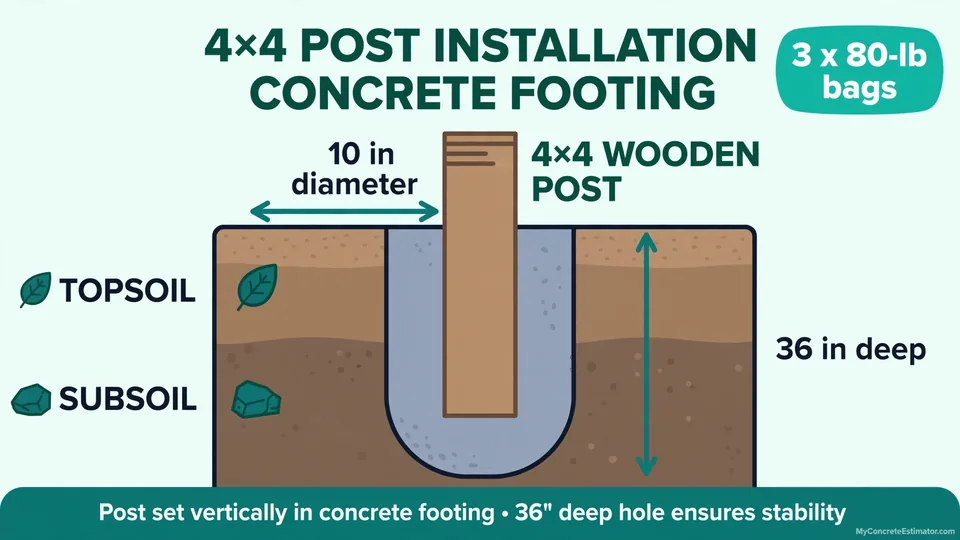
A 10-inch-wide, 36-inch-deep fence post hole takes 3 × 80-lb bags of concrete. That is the quick answer — and the matrix below covers every common combination: 8-, 10-, and 12-inch holes at 24, 36, and 48 inches deep, so you can size the hole for any 4×4 or 6×6 post.
📑 Table of Contents
[ Hide ]How Many Bags of Concrete Does a Fence Post Need?
Most fence posts need 2 to 4 eighty-pound bags of concrete each. The count depends on the hole’s diameter and depth — not on the post itself. Corner, gate, and end posts get wider, deeper holes, so they take more. Find your hole size in the matrix below (80-lb bags per hole, partial bags rounded up):
| Hole diameter | 24″ deep | 36″ deep | 48″ deep |
|---|---|---|---|
| 8″ | 2 | 2 | 3 |
| 10″ | 2 | 3 | 4 |
| 12″ | 3 | 4 | 6 |
Setting more than a handful of posts? Run your exact hole size through our concrete fill calculator for a per-hole count, or check any diameter and depth in seconds with the concrete bag calculator.
What Is the Formula for Post-Hole Concrete?
A post hole is a cylinder: volume = π × radius² × height, with everything measured in feet. Take the headline example: a 10-inch hole has a 5-inch radius (0.417 ft), and 36 inches deep is 3 ft. Volume = 3.1416 × 0.417² × 3 ≈ 1.64 cubic feet.
Bag yields are standard across brands: an 80-lb bag yields about 0.60 cu ft, a 60-lb bag about 0.45 cu ft, and a 40-lb bag about 0.30 cu ft. Divide and round up: 1.64 ÷ 0.60 = 2.73 → 3 bags. That is exactly how every number in the matrix above was calculated.
For an exact figure on any hole — including odd auger sizes — run it through our concrete volume calculator instead of doing the math by hand.
Add 5–10% for Waste
Holes are almost never as neat as the math assumes. Augers dig a little wide, hand-dug holes bell out at the bottom, and some mix always ends up on the ground. Add 5–10% on top of the matrix numbers — practically, that means buying one extra bag for every 8 to 10 posts. The wrong time to discover you are one bag short is with wet concrete already sitting in the holes.
When Bags Stop Making Sense
Once your total passes about 2 cubic yards, a ready-mix truck is usually cheaper than bags. Do the fence-line math: 20 posts at 3 bags each is 60 bags — about 1.33 cubic yards, and still a bag job. But 40 posts at 4 bags each is 160 bags, nearly 3.5 yards — a truck wins on price, labor, and your back.
Short loads (under roughly 4–5 yards) carry a short-load fee, so check the crossover point for your project with our delivery fee calculator and price both options with the concrete cost calculator. Typical short-load surcharges run $150–$300 per pour (2026 estimates — confirm with your local supplier).
4×4 vs 6×6 Posts: How Wide Should the Hole Be?
Size the hole to the post: the standard rule is a hole diameter about 3× the post’s actual width. A 4×4 post is really 3.5 inches square, so a 10–12 inch hole is the sweet spot. A 6×6 post is really 5.5 inches square, which calls for a 12–16 inch hole — go to the wide end for gate and corner posts that carry real load.
Depth matters more than width for holding power. Bury at least one-third of the post’s above-ground height, with an absolute minimum of 24 inches — and always go deeper than your local frost line (see next section).
Dig Below the Frost Line
Any post set above the frost line will heave — freeze-thaw cycles grip the concrete and jack it upward, sometimes inches in a single winter. Frost depth runs from just a few inches in the Gulf South to 36–48 inches or more across the northern tier, so “36 inches deep” is not a universal answer. Check your local building department’s frost-depth figure, then dig at least 6 inches deeper than it. The extra digging is cheap insurance against a leaning fence two winters from now.
Dry Pour vs Wet Mix: Which Should You Use?
For line posts, a dry pour with fast-setting mix is fine; for gates, corners, and end posts, mix it wet. A dry pour means dumping the dry mix into the hole, setting the post, then adding water on top — ground moisture does the rest. It is fast, but it depends on damp soil: in dry climates, soak the hole first.
Wet mixing (in a wheelbarrow or mixer) gives full-strength, evenly hydrated concrete — use it anywhere the post carries load or resists wind. A 50-lb fast-setting bag yields about 0.375 cu ft, so our headline 10″ × 36″ hole takes roughly 5 fast-setting bags if you go that route.
How to Mix and Pour for Fence Posts
Start with 3–6 inches of crushed gravel in the hole for drainage, set the post, brace it plumb in both directions, then pour. Mound the concrete slightly above grade and slope it away from the post so water sheds off instead of pooling against the wood. Do not backfill until the mix has set: fast-setting concrete is firm in 20–40 minutes, standard mix needs 24–48 hours. Wait a full day before hanging a gate on any post — two days with standard mix.