
This guide gives you 2026 Florida concrete prices per square foot, per cubic yard, and per project, plus an instant Florida cost estimator, the pavers-vs-concrete comparison every Florida driveway bid turns into, and the flood-zone, permit, and contractor knowledge you need before you sign anything.
Florida Concrete Cost Estimator
Instant installed-price estimate for any Florida project — priced for Florida labor & materials
Project type
Reinforcement
DIY route
Pro installed
Florida tip
For a 400 sq ft driveway in Orlando, budget around $4,000 installed — then get 3 local quotes. Comparable pavers run roughly $4,000–$12,000 for the same area; pavers cost more up front but repair one piece at a time.
📑 Table of Contents
[ Hide ]How Much Does Concrete Cost in Florida?
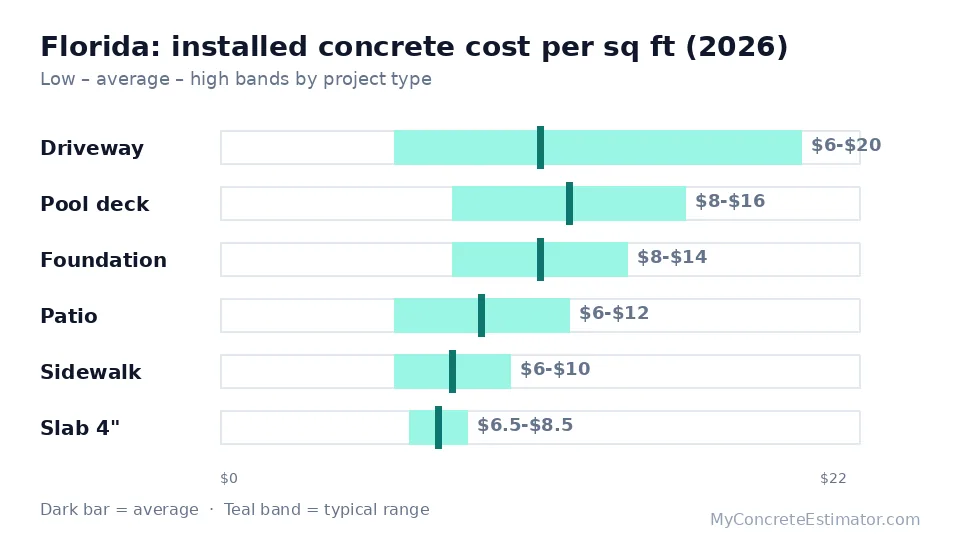
For most residential projects, Florida concrete prices fall into predictable bands. The table below reflects installed prices — materials, labor, standard site prep, and contractor overhead — based on 2026 contractor and cost-guide data for the major Florida metros.
| Project type | Low | Average | High |
|---|---|---|---|
| Driveway | $6 / sq ft | $11 / sq ft | $20 / sq ft |
| Patio | $6 / sq ft | $9 / sq ft | $12 / sq ft |
| Concrete slab (4") | $6.50 / sq ft | $7.50 / sq ft | $8.50 / sq ft |
| Sidewalk | $6 / sq ft | $8 / sq ft | $10 / sq ft |
| Pool deck | $8 / sq ft | $12 / sq ft | $16 / sq ft |
| Home foundation | $8 / sq ft | $11 / sq ft | $14 / sq ft |
The "low" end assumes a straightforward job: easy access, flat lot, plain broom finish, wire mesh reinforcement. The "high" end covers stamped or decorative finishes, flood-zone engineering, demolition of old concrete, and premium South Florida labor (Miami–Fort Lauderdale runs roughly 10% above Orlando). Two Florida quirks move prices more than anything else: whether the site sits in a flood zone — where building code changes what a slab is allowed to be — and whether you're comparing poured concrete against pavers, the question almost every Florida driveway bid turns into. Both are covered in detail below.
Concrete Cost Per Cubic Yard in Florida
If you're buying materials yourself — for a DIY pour or just to sanity-check a contractor's quote — ready-mix concrete in Florida runs about $150–$190 per cubic yard delivered for standard residential mixes, with $165 a fair planning number in the major metros. Florida plants price slightly above the national average thanks to higher aggregate costs in the south and strong demand in the growth corridors.
| Mix | Typical use | Price / cubic yard |
|---|---|---|
| 3,000 PSI | Patios, sidewalks, footings | $150 – $170 |
| 4,000–5,000 PSI | Driveways (Florida standard) | $165 – $190 |
| Fiber-reinforced | Crack resistance, thin pours | $175 – $195 |
| Short-load delivery fee | Orders under ~4 yards | $75 – $175 extra |
Two Florida specifics. First, driveway mixes here run stronger: Tampa-area contractors commonly spec 4,000–5,000 PSI for driveways, not the 3,500–4,000 PSI that's typical elsewhere — sand subgrades and heavy rain make the extra strength worth it, and it's baked into the installed price. Second, the short-load fee: batch plants charge extra for small orders because the truck still rolls. Under about 4 yards, ask for the fee up front — rounding up your order is often cheaper than paying it. In summer, most plants also add a retarder admixture ($5–$10 per yard) for hot-weather pours, which is money well spent when it's 95°F with 80% humidity.
Not sure how many yards your project needs? Our concrete bag calculator and concrete volume calculator do the math from your dimensions.
Concrete Driveway Cost in Florida
A concrete driveway in Florida costs $6–$20 per square foot installed for a reinforced 4-inch driveway, per 2026 Florida contractor guides — a wider band than most states because South Florida labor and decorative work push the top end. Here's what that means for common sizes:
| Driveway size | Plain broom finish | Stamped / decorative |
|---|---|---|
| 1-car (10 × 20 ft) | $1,200 – $4,000 | $2,000 – $7,200 |
| 2-car (20 × 20 ft) | $2,400 – $8,000 | $4,000 – $14,400 |
| 3-car (30 × 20 ft) | $3,600 – $12,000 | $6,000 – $21,600 |
| RV pad (14 × 40 ft, 6") | $5,600 – $13,500 | $8,400 – $20,000 |
Florida-specific driveway notes: go 5 inches thick if you park heavy trucks or an RV — the upgrade costs roughly $0.75–$1.50 more per square foot and buys real insurance on sandy subgrades that wash out after storms. Spec 4,000+ PSI in the bid; it's the Florida driveway standard and contractors who quote 3,000 PSI to win the job are cutting the wrong corner. And plan the base like it matters — because on Florida sand it matters more than the concrete: 4–6 inches of compacted limerock or crushed concrete, properly crowned for drainage, is what keeps a driveway from settling after the first hurricane season.
Use the concrete driveway calculator for exact yardage, or the driveway cost estimator for a full price breakdown.
Pavers vs Concrete Driveway in Florida: The Real Comparison
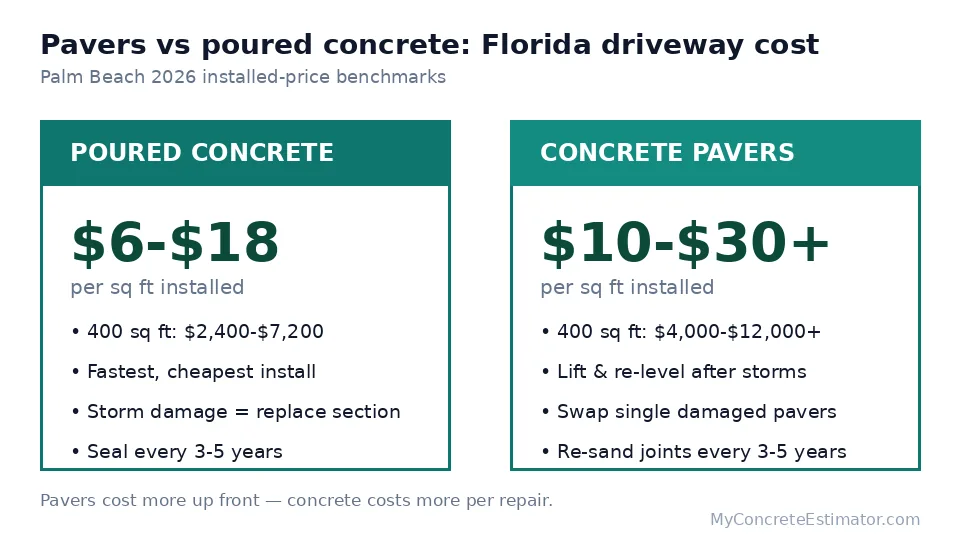
This is the question that defines the Florida market. Poured concrete and concrete pavers compete head-to-head here in a way they don't in most states, because Florida's storms, sand, and salt air stress both materials differently. The 2026 Palm Beach benchmark puts poured concrete at $6–$18 per square foot and pavers at $10–$30+ per square foot installed.
| Poured concrete | Concrete pavers | |
|---|---|---|
| Installed cost | $6 – $18 / sq ft | $10 – $30+ / sq ft |
| 400 sq ft driveway | $2,400 – $7,200 | $4,000 – $12,000+ |
| After a storm washes out the base | Slab cracks or settles — replacement is the fix | Lift, re-level the sand, re-lay the same pavers |
| Repairing damage | Patch or replace whole sections ($$$) | Swap individual pavers ($) |
| Surface repairs in salt air | Spalling needs resurfacing; seal every 3–5 yrs | Reseal joints/sand every 3–5 yrs |
| Lifespan | 25–30 years | 25–50 years (pavers outlast the sand bed, not vice versa) |
The honest read: pavers cost 40–70% more up front for a comparable driveway. They earn that back in Florida's specific conditions — when a storm undermines the base, a paver driveway can be lifted and re-leveled in a day, while a settled concrete slab gets saw-cut and replaced. Stains and oil spots disappear with a paver swap; on concrete they need grinding or resurfacing. But pavers aren't maintenance-free: joint sand washes out in heavy rain, weeds colonize neglected joints, and a bad paver install on thin sand settles just as fast as bad concrete.
Concrete Patio & Pool Deck Cost in Florida
A plain concrete patio in Florida costs $6–$12 per square foot installed, and Florida patios lean decorative — the year-round outdoor season means patios get used hard, and stamped work is common. Note that many Florida cost-guide pages floating around are 3–4 years stale; the figures below are 2026:
| Patio size | Plain / broom | Stamped | Exposed aggregate |
|---|---|---|---|
| 10 × 10 ft | $600 – $1,200 | $800 – $2,800 | $750 – $2,000 |
| 12 × 12 ft | $900 – $1,700 | $1,150 – $4,000 | $1,080 – $2,900 |
| 16 × 20 ft | $1,900 – $3,850 | $2,600 – $9,000 | $2,400 – $6,400 |
| Pool deck (12 × 30 ft) | $2,900 – $4,300 | $3,500 – $5,800 | $3,200 – $5,000 |
Stamped concrete in the Miami metro runs $8–$28 per square foot — the top end reflects intricate patterns, integral color, and South Florida labor. One Florida-specific tip: lighter colors and cool-deck or textured coatings keep a pool deck noticeably cooler underfoot in August, and textured finishes add slip resistance that matters around water. Dark stamped patterns look great in photos and feel like a griddle in person.
Pool decks deserve the callout because Florida is a pool state: budget $8–$16 per square foot installed, and make sure the bid includes proper slope-to-drain — standing water on a flat deck breeds algae within weeks in Florida humidity, and re-sloping cured concrete is expensive.
Concrete Slab & Foundation Costs in Florida
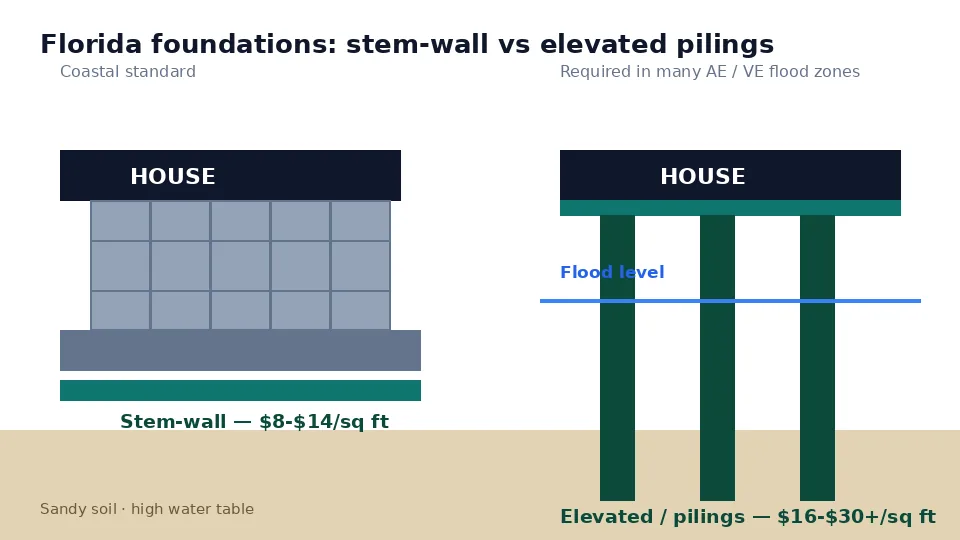
This is where Florida diverges from the rest of the country. The state builds on sand over limestone with a high water table, frequent flood zones, and hurricane wind loads — so the foundation system is driven by water and code, not by soil movement. Florida builders use three systems, and which one your site needs is often decided by your flood-zone letter:
| Monolithic slab | Stem-wall | Elevated / pilings | |
|---|---|---|---|
| How it works | Footing + slab poured as one piece | Block stem wall on footings, slab poured inside | Structure raised on driven piles above flood level |
| Best for | Inland, well-drained, non-flood sites | Most Florida homes — the coastal standard | Flood zones (AE, VE), coastal lots |
| Installed cost | $6.50 – $8.50 / sq ft | $8 – $14 / sq ft | $16 – $30+ / sq ft |
| 1,500 sq ft home | $9,750 – $12,750 | $12,000 – $21,000 | $24,000 – $45,000+ |
| Flood-zone rules | Often restricted by code | Allowed with engineered details | Required in many zones |
| Moisture risk | Higher — slab sits at grade | Lower — floor elevated above grade | Minimal — living space above flood level |
Stem-wall is the Florida default for new residential construction: a concrete-block stem wall on deep footings raises the finished floor above grade, which buys moisture protection and a crawl space for plumbing. Under the 8th Edition of the Florida Building Code, slabs in flood zones face strict rules — non-structural slabs must be frangible (≤4 inches thick, unreinforced) so they break away without damaging the structure, or designed as structurally independent. On the coast, foundations use deep footings or pilings driven to bearing because the sand near shore can't be trusted.
What Drives Concrete Costs Up in Florida
Six Florida-specific factors separate a $6/sq ft job from a $20/sq ft job:
1. Flood-zone and hurricane code. The 8th Edition Florida Building Code adds engineered details — deeper footings, frangible-slab rules, tie-downs, elevated structures — that don't exist inland. Flood-zone engineering routinely adds 15–25% to a project before a yard of concrete is poured.
2. Sand and a high water table. Florida's sandy soils compact poorly and the water table can sit just feet below grade. That means imported structural base (limerock, crushed concrete), geotextile fabric, and real drainage design — the base prep that contractors in other states treat as optional is load-bearing here.
3. Heat and humidity. Pouring at 95°F with tropical humidity is a race: the concrete sets fast on top while staying wet underneath, which complicates finishing. Crews pour at dawn, use retarder admixtures, and cure with compounds or wet methods. Summer bids run 5–10% higher than dry-season ones.
4. Salt air and storms (the maintenance tax). Coastal concrete needs sealing every 3–5 years to resist chloride intrusion and spalling; hurricanes wash out bases and drop trees on slabs. Budget maintenance, not just installation — this is the cost competitors' tables never show.
5. Permits and HOAs. Most Florida counties and cities require permits for driveways and flatwork ($100–$400 typical); many HOAs — which govern huge swaths of Florida suburbs — must approve finishes, colors, and sometimes mandate pavers over poured concrete. Get HOA approval in writing before the pour.
6. Access and demolition. Tearing out an old driveway ($1–$3 per sq ft for demo and haul-off), tight backyard access for a patio, or a lot that needs fill to reach grade all push labor up. Hurricane-season scheduling chaos can also push bids up — book dry-season work early.
Concrete Prices by Florida City
Labor is the main reason prices move between metros. Miami–Fort Lauderdale consistently prices highest; Orlando is the baseline; rural Florida is cheapest but watch for delivery minimums.
| Metro | Driveway (per sq ft) | Notes |
|---|---|---|
| Miami–Fort Lauderdale | $7 – $22 | ~10% premium; highest labor, stamped-heavy |
| Orlando | $6 – $18 | Baseline; strong contractor competition |
| Tampa–St. Pete | $6.50 – $19 | ~5% above Orlando; 4–5k PSI driveways standard |
| Jacksonville | $6 – $16 | Slightly below baseline; more inland work |
| Rural Florida | $5.50 – $14 | Cheapest labor; confirm plant delivery range |
DIY vs Hiring a Concrete Contractor in Florida
A small patio or sidewalk is a realistic Florida DIY project — materials for a 12 × 12 ft patio run about $400–$600, plus a $200–$300 mixer rental. But be honest about the Florida curveballs: finishing concrete in 95°F heat with 80% humidity is a race against the set time, and anything that needs drainage engineering (driveways, anything near a flood zone, anything on sand that needs real base) belongs to a crew.
The math from our estimator tells the story: a 400 sq ft driveway costs roughly $850 in materials but $4,000 installed. That $3,150 gap buys proper limerock base, a crew that can screed before the heat wins, and — critically in Florida — drainage that actually drains. DIY driveways on unprepared sand are the most common source of "my driveway settled in a year" stories.
If you hire out: get three written quotes, verify the contractor holds the proper Florida state or county license plus general liability insurance, and make sure the bid specifies thickness, PSI (4,000+ for driveways), reinforcement type, and base prep. Never pay more than 30–50% up front, and be wary of any bid 30%+ below the others.
How to Save Money on Concrete in Florida
Pour in the dry season (November–April). Cooler, drier weather means easier scheduling, sometimes 5–10% lower bids, and far better curing conditions than August. It also avoids hurricane-season disruptions entirely.
Keep the design simple. Rectangles are cheap; curves, borders, and multiple elevations are where labor hours pile up. A plain rectangle with a broom finish is the best value per square foot in concrete.
Bundle projects. Having the driveway, patio, and sidewalk poured in one mobilization saves the crew's setup cost — often 10–15% versus separate jobs.
Get the pavers quote too. On some Florida jobs, the paver premium is smaller than expected — and if your lot has drainage quirks, the repairability can make pavers the cheaper lifetime option. Never accept a concrete-only bid without seeing the paver number.
Handle demo yourself (carefully). Breaking out old concrete is labor-intensive but unskilled; renting a jackhammer for a weekend can save $1–$3 per square foot. Haul-off still costs — budget the dump fees.
Ask about the short-load fee before you order. If you're DIYing under 4 yards, the fee can exceed the concrete cost. Round up or split a load with a neighbor.
Building a multi-state project? Compare with our Texas concrete cost guide — the state-by-state differences in code, soil, and labor are bigger than most people expect.