
This guide gives you 2026 Arizona concrete prices per square foot, per cubic yard, and per project, plus an instant Arizona cost estimator, the extreme-heat pouring practices every Arizona bid should include, caliche and foundation know-how, and the permit and contractor knowledge you need before you sign anything.
Arizona Concrete Cost Estimator
Instant installed-price estimate for any Arizona project — priced for Arizona labor & materials
Project type
Reinforcement
DIY route
Pro installed
Arizona tip
For a 400 sq ft driveway in Phoenix–Mesa, budget around $3,800 installed — then get 3 local quotes. Pour October–April if you can: milder weather cures better and crews bid sharper.
📑 Table of Contents
[ Hide ]How Much Does Concrete Cost in Arizona?
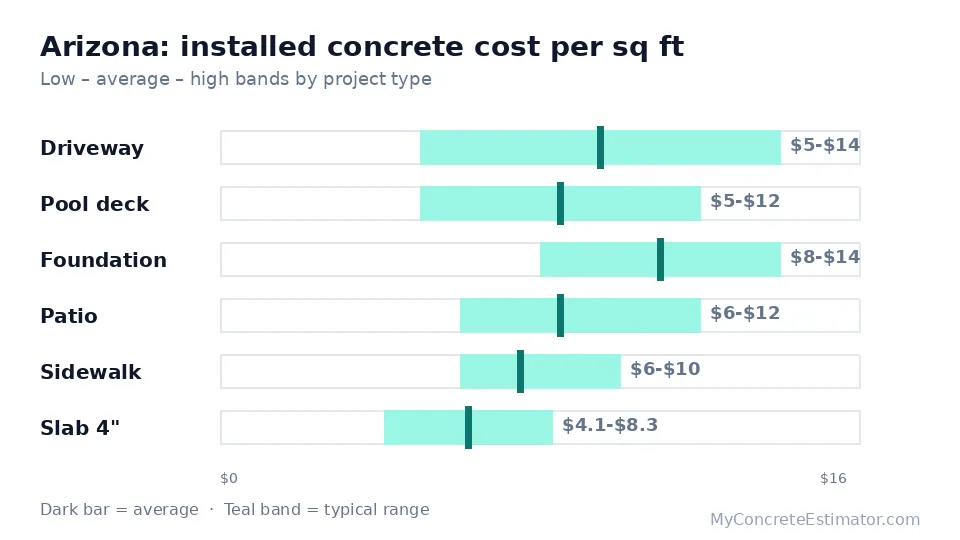
For most residential projects, Arizona concrete prices fall into predictable bands. The table below reflects installed prices — materials, labor, standard site prep, and contractor overhead — based on 2026 contractor and cost-guide data for the Phoenix and Tucson metros.
| Project type | Low | Average | High |
|---|---|---|---|
| Driveway | $5 / sq ft | $9.50 / sq ft | $14 / sq ft |
| Patio | $6 / sq ft | $8.50 / sq ft | $12 / sq ft |
| Concrete slab (4") | $4.10 / sq ft | $6.20 / sq ft | $8.30 / sq ft |
| Sidewalk | $6 / sq ft | $7.50 / sq ft | $10 / sq ft |
| Pool deck | $5 / sq ft | $8.50 / sq ft | $12 / sq ft |
| Home foundation | $8 / sq ft | $11 / sq ft | $14 / sq ft |
The "low" end assumes a straightforward job: easy access, flat lot, plain broom finish, wire mesh reinforcement. The "high" end covers stamped or decorative finishes, caliche excavation, demolition of old concrete, and premium Scottsdale-area labor. Two Arizona quirks move prices more than anything else: extreme heat — summer pours need admixtures, dawn scheduling, and aggressive curing, all of which show up in the bid — and caliche, the rock-hard soil layer under much of the Phoenix metro that turns simple digging into jackhammer work. Both are covered in detail below.
Concrete Cost Per Cubic Yard in Arizona
If you're buying materials yourself — for a DIY pour or just to sanity-check a contractor's quote — ready-mix concrete in Arizona runs about $150–$185 per cubic yard delivered for standard residential mixes, with $158 a fair planning number in the Phoenix metro. Phoenix plants commonly quote 5,000 PSI mixes at $153–$161 per yard, per 2026 home-services data — Arizona specs stronger mixes than many states because driveways here take punishing UV and heat cycling.
| Mix | Typical use | Price / cubic yard |
|---|---|---|
| 3,000 PSI | Patios, sidewalks, footings | $150 – $170 |
| 4,000–5,000 PSI | Driveways (Arizona standard) | $158 – $185 |
| Fiber-reinforced | Crack resistance, thin pours | $170 – $195 |
| Retarder admixture | Hot-weather pours (summer essential) | $5 – $10 extra / yard |
| Short-load delivery fee | Orders under ~4 yards | $75 – $175 extra |
Two Arizona specifics. First, the retarder admixture: from May through September, most Phoenix-area plants dose summer mixes with set-retarding admixture as a matter of course — at 110°F, plain concrete can start setting before the crew finishes floating it. The $5–$10 per yard is the cheapest insurance on the ticket. Second, the short-load fee: batch plants charge extra for small orders because the truck still rolls. Under about 4 yards, ask for the fee up front — rounding up your order is often cheaper than paying it.
Not sure how many yards your project needs? Our concrete bag calculator and concrete volume calculator do the math from your dimensions.
Concrete Driveway Cost in Arizona
A concrete driveway in Arizona costs $5–$14 per square foot installed for a reinforced 4-inch driveway, per 2026 Arizona contractor data. Here's what that means for common sizes:
| Driveway size | Plain broom finish | Stamped / decorative |
|---|---|---|
| 1-car (10 × 20 ft) | $1,000 – $2,800 | $2,000 – $4,800 |
| 2-car (20 × 20 ft) | $2,000 – $5,600 | $4,000 – $9,600 |
| 3-car (30 × 20 ft) | $3,000 – $8,400 | $6,000 – $14,400 |
Rural and small-town bids can land below these bands — town-level contractor data from places like Douglas and Cave Creek shows driveway work quoted as low as $3.87–$4.45 per square foot — but treat those as bare-bones numbers: they typically assume ideal access, no demolition, and minimal base work. In the Phoenix metro, a realistic mid-range bid for a 2-car driveway with #4 rebar and a 4,000+ PSI mix sits around $3,800–$4,500. Stamped concrete adds roughly $5 per square foot statewide (Phoenix-area stamped work benchmarks around $10.45 per square foot installed), and in Scottsdale and Paradise Valley, decorative driveways routinely push past $14.
Sizing your driveway first? The concrete driveway calculator and driveway cost estimator turn dimensions into yardage and dollars.
Pouring Concrete in Arizona's Extreme Heat
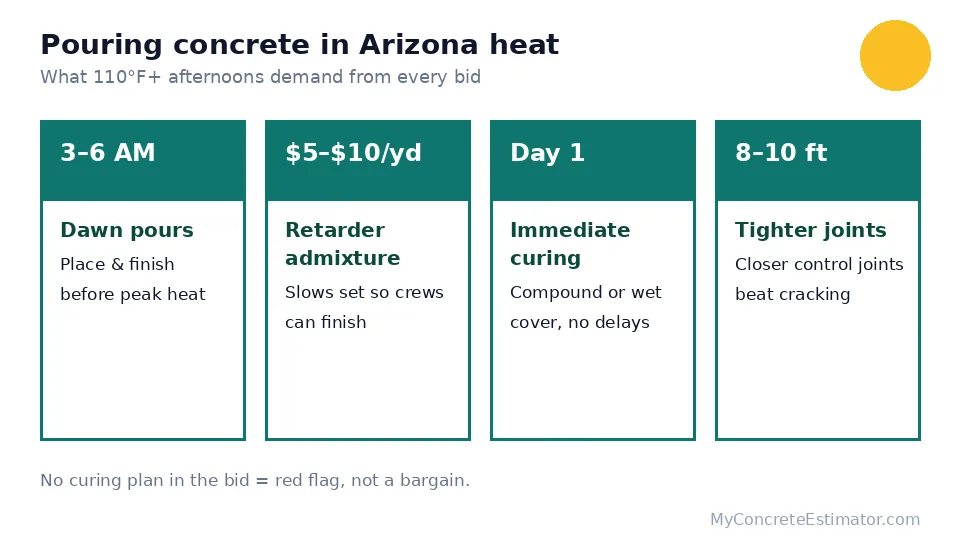
This is the section no national cost guide writes, and it's the one that matters most in Arizona. From late May through September, Phoenix daytime highs sit above 105°F for weeks at a stretch, and concrete behaves badly in that heat: it sets faster, surface water evaporates before finishing, and the result is plastic-shrinkage cracking — those spiderweb cracks that show up within hours of the pour. Every legitimate Arizona bid prices in hot-weather practices. If a quote doesn't mention them, that's a red flag, not a bargain.
What hot-weather concreting actually involves:
| Practice | What it does | Cost impact |
|---|---|---|
| Dawn pours (3–6 AM starts) | Places and finishes concrete before peak heat | Often baked into labor; some crews charge a premium |
| Retarder admixture | Slows set time so the crew can finish properly | $5 – $10 / cubic yard |
| Evaporation retarder / fogging | Keeps the surface workable during finishing | Minimal — standard on pro jobs |
| Immediate curing | Curing compound or wet cover applied right after finishing | $0.25 – $0.75 / sq ft |
| Sunshades & windbreaks | Slows surface drying on exposed pours | Crew equipment, usually included |
The curing step is where Arizona diverges hardest from the rest of the country. Our concrete curing time guide covers the standard 28-day strength curve, but in 110°F heat the first 24 hours decide everything: the surface must stay moist from the moment finishing ends. Contractors who skip this to save an hour are the reason Arizona has more cracked driveways per capita than anywhere else — ask every bidder, in writing, what their curing plan is. And if your schedule flexes, pour between October and April: milder weather cures better, crews bid sharper, and you'll dodge the monsoon entirely.
One more heat-driven cost most first-time buyers miss: control joints. Arizona slabs need them closer together than the same slab in a mild climate — typically every 8–10 feet for a 4-inch driveway instead of every 12 — because thermal movement is relentless. Saw-cutting a denser joint grid adds a little labor, but it's vastly cheaper than the random cracking that follows a sparse layout. If your bid doesn't mention joint spacing, ask.
Concrete Patio & Pool Deck Cost in Arizona
A concrete patio in Arizona costs $6–$12 per square foot installed — Phoenix-area data points cluster around $5.44 for a basic patio and $7–$12 for slab work with nicer finishes. For a 20 × 20 ft (400 sq ft) patio, budget roughly $2,400–$3,400 plain, $3,400–$4,800 exposed aggregate, or $4,400–$8,800 stamped. Two Arizona-specific patio notes: first, darker colors absorb brutal summer heat — light broom finishes and pale integral color stay walkable in July; second, expansion joints matter more here than in mild climates, because 40-degree day-night temperature swings in the desert shoulder seasons work every joint hard.
Pool decks deserve their own numbers because Arizona builds a lot of them. A concrete pool deck runs $5–$12 per square foot installed; Phoenix-area benchmarks show basic 4-inch reinforced decks around $4.91 per square foot, with textured and cool-deck finishes pushing toward the top of the band. For a 12 × 30 ft deck (360 sq ft), that's roughly $1,800–$4,300. Spec a slip-resistant, heat-reflective finish — standard acrylic "cool deck" coatings can drop surface temperature 20–30°F versus plain concrete, which is the difference between usable and unusable at 3 PM in August. And insist on proper slope-to-drain: monsoon downpours will find any low spot within a week.
Concrete Slab & Foundation Costs in Arizona
Arizona foundations live or die by what's under them. Much of the Phoenix metro sits on caliche — a calcium-carbonate-cemented hardpan layer that ranges from annoying to nearly rock — while other pockets have expansive clay soils that swell when wet. Both conditions change the foundation you need and what it costs. Angi's 2026 Phoenix data puts slab foundations at $4,700–$18,900 total and stem-wall foundations at $6,300–$18,900; per square foot, plan on:
| Foundation type | Typical use in Arizona | Cost / sq ft |
|---|---|---|
| Monolithic slab | Garages, additions, small structures | $6 – $8.50 |
| Stem-wall | Raised floor, moisture protection | $8 – $14 |
| Post-tension slab | Expansive-soil standard across the Valley | $9 – $15 |
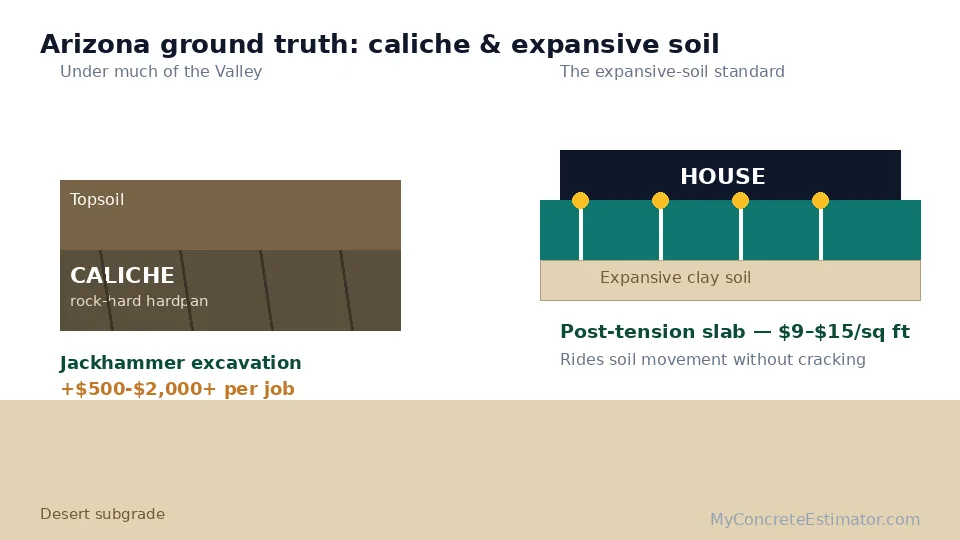
Caliche is the line item that surprises out-of-state buyers. Digging footings through a foot of caliche can require a ripper or hydraulic breaker, adding $500–$2,000+ to excavation on a typical residential job — Angi specifically flags caliche as a cost complication on Phoenix sidewalk and flatwork pages. Get the soil condition in writing before you sign: a bid that assumes easy digging and hits caliche on day one becomes a change order.
Post-tension slabs are Arizona's answer to expansive soils. Steel cables tensioned after the pour hold the slab in compression, letting it ride soil movement without cracking — they're the default for new production homes across much of the Valley. They run roughly $2–$3 more per square foot than a conventional monolithic slab, and they require a specialized crew: this is not a line item to value-engineer away on expansive ground. Our concrete slab calculator and slab cost estimator handle the dimensions; the rebar calculator covers reinforcement quantities for conventional slabs.
What Drives Concrete Costs Up in Arizona
Beyond the project itself, five Arizona conditions routinely move bids:
1. Caliche excavation. As covered above, the cemented hardpan under much of the Valley turns trenching into rock work. Budget $500–$2,000+ extra where caliche is known, and confirm who's responsible if the excavator hits more than expected.
2. Monsoon scheduling. Arizona's monsoon runs roughly July through September, and afternoon microbursts can dump an inch of rain in twenty minutes — on a fresh slab, that's a ruined finish. Good contractors build weather days into summer schedules and won't pour when storms are forecast; the schedule contingency (and occasionally a re-pour) is real money.
3. Demolition and removal. Tearing out old concrete runs $1–$3 per square foot in Arizona, plus dump fees. Older Phoenix homes often have multiple generations of patio and walkway stacked on each other — each layer adds a haul.
4. Access and haul distance. Desert lots on the metro fringe — think far Queen Creek, Buckeye, or Maricopa — pay more in truck time. A plant 45 minutes out charges for the round trip whether the load is 4 yards or 10.
5. Decorative finishes in high-end zip codes. Scottsdale, Paradise Valley, and Arcadia bid 15–30% above the metro average for stamped, stained, and exposed-aggregate work. The craftsmanship is genuinely better; so is the price.
Concrete Prices by Arizona City
Labor is the biggest regional variable. Phoenix–Mesa anchors the state as the competitive baseline; Tucson runs a touch cheaper; Flagstaff's mountain logistics and shorter pour season push costs up; rural Arizona bids lowest but with thinner contractor availability.
| Area | Relative pricing | Notes |
|---|---|---|
| Phoenix–Mesa | Baseline | Deepest contractor pool; most competitive bids |
| Tucson | ~5% below Phoenix | Slightly softer labor market |
| Flagstaff / Northern AZ | ~8% above Phoenix | Mountain haul costs; freeze-thaw detailing; shorter season |
| Rural Arizona | ~10% below Phoenix | Fewer bidders; longer truck times on big pours |
These are planning differentials, not quotes — the estimator above applies them automatically. Within the Phoenix metro itself, expect the east Valley (Mesa, Gilbert, Chandler) to bid slightly under Scottsdale and central Phoenix for identical work.
Flagstaff deserves a special note because it's the outlier: at 7,000 feet, winter lows regularly dip below freezing, so exterior concrete needs air-entrained mix (tiny air bubbles that absorb freeze-thaw expansion) — a $3–$5 per yard adder most Valley contractors never think about. The pour season also compresses to roughly April through October, which concentrates demand and firms up pricing. Tucson, meanwhile, tracks close to Phoenix on materials but benefits from a slightly less overheated labor market; the caliche is patchier there, so soil surprises cut both ways.
DIY vs Hiring a Concrete Contractor in Arizona
Arizona is a deceptively hard place to DIY concrete. The material math is friendly — a 10 × 10 ft patio at 4 inches needs about 1.25 cubic yards, roughly $200 in ready-mix plus a $250 mixer rental — but the climate is not. Finishing a slab as 105°F heat accelerates the set is a skill, and a botched finish can't be undone. Small, shaded projects (a walkway pad, a shed slab) in October through April are reasonable DIY territory. Anything structural, anything stamped, and anything poured between May and September belongs to a crew that does this every day.
If you hire out, Arizona has real contractor oversight — the Arizona Registrar of Contractors licenses residential contractors, and you should verify any bidder's license number before signing. Get three written bids, compare line items (thickness, PSI, reinforcement, base prep, curing plan) rather than just totals, and never pay more than a third up front.
How to Save Money on Concrete in Arizona
Pour in the cool season. October through April brings better curing, sharper bids, and zero monsoon risk. Summer pours cost more in admixtures and carry schedule risk — if you can wait, wait.
Keep the design simple. Every curve, step, and stamp pattern adds labor. A rectangular broom-finish slab is the cheapest concrete per square foot you can buy; decorative work roughly doubles it.
Bundle the demolition. If old concrete has to come out, having the same contractor demo and pour usually beats hiring a demo crew separately — one mobilization, one dump run.
Round up to full loads. With short-load fees at $75–$175, ordering a full 4+ yard load (or combining with a neighbor's project) is often cheaper than a small delivery plus the fee.
Choose the right thickness the first time. A 4-inch driveway that cracks under your work truck costs twice: the pour, then the replacement. Five inches for heavy vehicles is cheaper than doing it over.