
This guide gives you 2026 California concrete prices per square foot, per cubic yard, and per project, plus an instant California cost estimator, the seismic-code foundation rules every California bid should include, stamped-concrete pricing, ADU slab know-how, and the permit and contractor knowledge you need before you sign anything.
California Concrete Cost Estimator
Instant installed-price estimate for any California project — priced for California labor & materials
Project type
Reinforcement
DIY route
Pro installed
California tip
For a 400 sq ft driveway in Southern California, budget around $5,000 installed — then get 3 local quotes. California runs the highest concrete labor rates in the country, so the spread between bids can be thousands: compare line items, not just totals.
📑 Table of Contents
[ Hide ]How Much Does Concrete Cost in California?
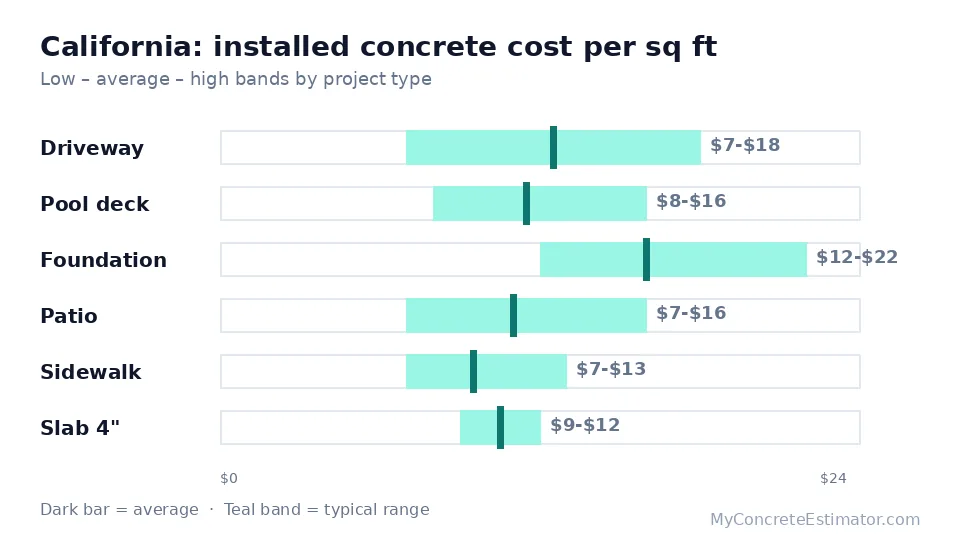
Let's start with the honest headline: California has the highest concrete prices of any state we've covered. The table below reflects installed prices — materials, labor, standard site prep, and contractor overhead — based on 2026 contractor and cost-guide data for the Los Angeles, Bay Area, and Central Valley markets.
| Project type | Low | Average | High |
|---|---|---|---|
| Driveway | $7 / sq ft | $12.50 / sq ft | $18 / sq ft |
| Patio | $7 / sq ft | $11 / sq ft | $16 / sq ft |
| Concrete slab (4") | $9 / sq ft | $10.50 / sq ft | $12 / sq ft |
| Sidewalk | $7 / sq ft | $9.50 / sq ft | $13 / sq ft |
| Pool deck | $8 / sq ft | $11.50 / sq ft | $16 / sq ft |
| Home foundation | $12 / sq ft | $16 / sq ft | $22 / sq ft |
The "low" end assumes a straightforward job in the Central Valley: easy access, flat lot, plain broom finish, standard reinforcement. The "high" end covers Bay Area labor, stamped or decorative finishes, seismic-engineered foundations, and demolition of old concrete. Three things push California above every other state: labor — concrete crews here cost more than anywhere in the country; seismic code — foundations carry more steel and engineering than a simple slab; and permits and inspections, which add real dollars and real weeks. All three are covered in detail below.
One more thing that shapes California pricing: this is a decorative-concrete state. Where a Texas homeowner might order plain broom finish and call it done, California bids routinely include stamping, coloring, or exposed aggregate — outdoor living space here is treated as an extension of the home, and contractors price accordingly. That means the "average" California project costs more partly because Californians buy more. The estimator at the top of this page lets you toggle finishes on and off so you can see exactly what the upgrade costs before you fall in love with a pattern.
Concrete Cost Per Cubic Yard in California
If you're buying materials yourself — for a DIY pour or to sanity-check a contractor's quote — ready-mix concrete in California runs about $165–$200 per cubic yard delivered for standard residential mixes, with $175 a fair planning number in the LA basin. Bay Area plants quote higher; Central Valley plants can dip below the range on straightforward orders.
| Mix | Typical use | Price / cubic yard |
|---|---|---|
| 3,000 PSI | Patios, sidewalks, footings | $165 – $185 |
| 4,000 PSI | Driveways (California standard) | $175 – $200 |
| Fiber-reinforced | Crack resistance, thin pours | $185 – $215 |
| High-early-strength | Fast-track schedules, cold pours | $10 – $20 extra / yard |
| Short-load delivery fee | Orders under ~4 yards | $100 – $200 extra |
Two California specifics. First, the short-load fee bites harder here than in most states because delivery distances in the LA and Bay Area metros are long — under about 4 yards, ask for the fee up front and consider rounding up your order. Second, weekend and off-hours delivery premiums are common in dense metros where plants schedule around traffic; a Saturday pour can carry a surcharge that never appears in the per-yard quote.
Not sure how many yards your project needs? Our concrete bag calculator and concrete volume calculator do the math from your dimensions.
One more quote-reading tip: California ready-mix quotes sometimes list the per-yard price without delivery, environmental fees, or fuel surcharge — then the ticket total lands 10–15% higher. When comparing plants, ask for the out-the-door total per yard including every fee. The cheapest per-yard number on paper is rarely the cheapest ticket, especially in the LA basin where delivery distances vary wildly by plant.
Concrete Driveway Cost in California
A concrete driveway in California costs $7–$18 per square foot installed for a reinforced 4-inch driveway, per 2026 California contractor data. Here's what that means for common sizes:
| Driveway size | Plain broom finish | Stamped / decorative |
|---|---|---|
| 1-car (10 × 20 ft) | $1,400 – $3,600 | $2,800 – $5,600 |
| 2-car (20 × 20 ft) | $2,800 – $7,200 | $5,600 – $11,200 |
| 3-car (30 × 20 ft) | $4,200 – $10,800 | $8,400 – $16,800 |
Why the wide spread? Labor is the single biggest variable — a Bay Area crew can bid 30–50% above a Central Valley crew for the identical driveway. Then come the California adders: demolition and haul-off of the old driveway ($1–$3 per square foot in most metros), thicker 5–6 inch pours for heavy vehicles, and decorative finishes, which California homeowners choose at far higher rates than the national average. Get the demolition line itemized separately — it's the most common place for bid games.
Planning the dimensions? Our concrete driveway calculator sizes the slab and the yardage, and the driveway cost estimator breaks the price down line by line.
Seismic Code & What It Adds to Foundation Costs
This is the section no other state's guide needs. California's building code — the California Building Code, Title 24 — treats every foundation as a seismic structure. For a homeowner, that translates into three cost realities:
1. More steel, deeper footings. A California home foundation is typically a stem-wall or engineered footing system with continuous rebar — top and bottom bars in every footing, verticals tied to the stem wall, and hold-downs or anchor bolts connecting the framing. Compared with a simple monolithic slab in a non-seismic state, the steel alone adds roughly $1.50–$3.00 per square foot, and the deeper excavation adds more.
2. Engineered plans. In higher seismic design categories — which cover most of coastal California — foundations need a structural engineer's stamp. Engineering runs $1,500–$4,000 for a typical residential foundation plan, and it's non-negotiable: no stamp, no permit.
3. Inspections at every stage. Footing inspection before the pour, rebar inspection, sometimes special inspection of hold-downs. Each inspection is a schedule gate — fail one and the crew stands idle while you fix it, which is why experienced California foundation contractors price a contingency into every bid.
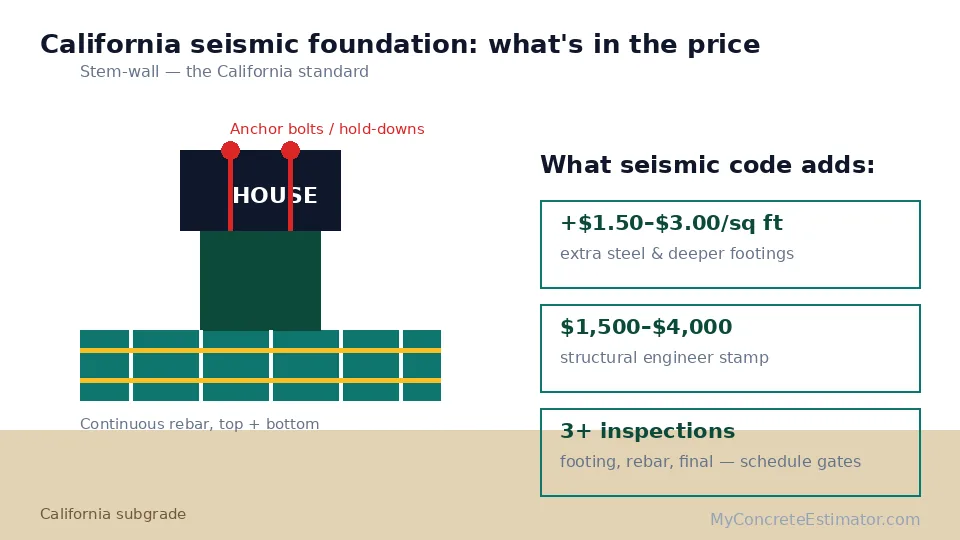
All-in, a California home foundation runs $12–$22 per square foot — roughly double the per-square-foot cost of a basic slab in Texas or Arizona. The estimator above includes a foundation-type toggle: monolithic, stem-wall (the California standard), and engineered seismic footing, so you can see the step-up yourself.
Concrete Patio, Pool Deck & Stamped Concrete Costs
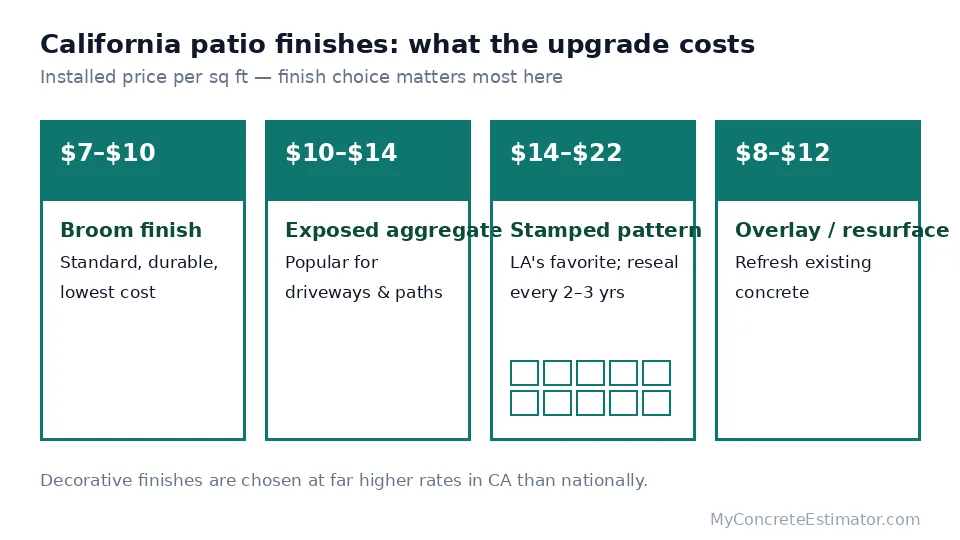
California is the country's stamped-concrete capital — the climate rewards outdoor living, and homeowners here spend accordingly. Installed prices for patios and pool decks run $7–$16 per square foot, with the finish choice mattering more here than in any other state:
| Finish | Price / sq ft installed | Notes |
|---|---|---|
| Plain broom | $7 – $10 | Standard, durable, lowest cost |
| Exposed aggregate | $10 – $14 | Popular for driveways and paths |
| Stamped pattern | $14 – $22 | LA data shows $8–$28; $18+ for high-end |
| Stained / integral color | $12 – $18 | Color fades; plan on resealing |
| Concrete overlay / resurfacing | $8 – $12 | Basic resurfacing per LA contractors |
A 20 × 20 ft patio (400 sq ft) runs roughly $2,800–$4,400 plain, or $5,600–$8,800 stamped. Pool decks skew higher — $8–$16 per square foot — because California pool decks almost always get a decorative or cool-touch finish. Two maintenance notes: reseal stamped work every 2–3 years (California UV is brutal on sealer), and on pool decks choose lighter colors — dark concrete around a pool is a barefoot regret by July.
ADU & Home Addition Slab Costs in California
California's ADU (accessory dwelling unit) boom has made small foundations one of the most-quoted concrete jobs in the state. A detached ADU — typically 400–800 square feet — needs a full seismic-compliant foundation, and the per-square-foot math surprises people because small jobs carry the same fixed costs (engineering, permits, mobilization) as big ones.
| ADU / addition size | Foundation cost range | Notes |
|---|---|---|
| 400 sq ft ADU | $6,000 – $12,000 | Fixed costs dominate; highest $/sq ft |
| 600 sq ft ADU | $8,000 – $15,000 | Most common ADU footprint |
| 800 sq ft ADU | $10,000 – $18,000 | Approaches small-home foundation pricing |
| Home addition (200–400 sq ft) | $4,000 – $10,000 | Tie-in to existing foundation adds cost |
Three ADU-specific watch-outs. First, engineering is mandatory — budget $1,500–$4,000 for the structural plans before the concrete bid. Second, additions must tie into the existing foundation with dowels and epoxy, which is fussy, slow work that contractors price accordingly. Third, access: ADUs go in backyards, and if the mixer can't reach, you're paying for a pump ($800–$1,500) or wheelbarrow labor. Ask every bidder how the concrete gets from the street to the forms — the answer moves the price.
What Drives Concrete Costs Up in California
Beyond the seismic and labor premiums, five California-specific factors move bids:
1. Permits and plan check. Most California cities require permits for flatwork beyond simple repair, and structural work goes through full plan check. Permit fees run $200–$600 for flatwork and $1,000+ for foundations, but the real cost is time — plan check can add 4–8 weeks in busy jurisdictions. Contractors price the waiting into overhead.
2. Expansive clay. The Sacramento Valley and parts of the Bay Area sit on expansive clay that swells when wet and shrinks when dry. Building on it means engineered bases, deeper footings, or post-tension slabs — add 10%+ to foundation budgets and never skip the soils report.
3. Demolition and haul-off. California disposal fees are among the nation's highest, and old concrete has to go somewhere. Budget $1–$3 per square foot for demo and haul-off on replacement work — in the Bay Area, the high end.
4. Wildfire-zone rebuild demand. In fire-affected areas, contractor demand spikes after every major fire season, and rebuilding to current fire and seismic code costs more than the original construction did. If you're rebuilding in a wildfire zone, expect premium bids and long lead times — and verify the bid prices to current code, not the code the old structure was built under.
5. Coastal access and logistics. Hillside lots, narrow coastal streets, and HOA-restricted work hours all slow crews down. A straightforward suburban pour and a hillside pour in the same city can differ by 30% on labor alone.
Concrete Prices by California Region
California isn't one market — it's at least four. The table below shows the regional multipliers used in the estimator above, grounded in 2026 contractor data:
| Region | vs. baseline | What drives it |
|---|---|---|
| Southern CA (LA / Orange County / San Diego) | Baseline | Largest contractor pool; competitive bidding |
| Bay Area (SF / San Jose / Oakland) | +15% | Highest labor rates in the state; access constraints |
| Central Valley (Fresno / Bakersfield / Sacramento) | −5% | Lower labor; expansive clay offsets some savings |
| Rural / Far North | −10% | Lower labor, but fewer contractors and longer hauls |
The practical takeaway: a $5,000 driveway in Los Angeles prices around $5,750 in the Bay Area and $4,500–$4,750 in the Central Valley or rural north. Always get bids from contractors who actually work your micro-market — an LA bid template doesn't survive contact with Bay Area labor rates.
Also note the seasonal rhythm: California's concrete market runs hottest March through October, when every contractor is booked and prices firm up. Winter bids — especially January and February — consistently come in lower as crews chase work. If your project can wait for the off-season, the same scope often prices 10–15% cheaper, and you'll get your pick of start dates instead of a six-week backlog.
DIY vs Hiring a Concrete Contractor in California
The DIY math in California is the same as anywhere — materials plus tool rental plus a contingency — but three local factors tilt the decision:
Permits don't care who pours. A DIY driveway still needs the same permit and inspections as a contractor's. If the thought of scheduling a footing inspection makes you tired, that's a vote for hiring out.
Seismic work is not DIY. Flatwork — patios, sidewalks, shed slabs — is fair game for a skilled homeowner. Anything structural (foundations, retaining walls, ADU slabs) needs engineering and licensed work; California inspectors will red-tag unpermitted structural concrete without hesitation.
The stakes of a bad pour are higher. At $12.50+ per square foot installed, a failed DIY driveway is a $5,000 mistake, not a $2,500 one. If you've never finished concrete before, practice on a small pad — not the driveway your cars will sit on for 30 years.
The estimator above shows both numbers side by side: the DIY route (materials + $250 rental + 10% contingency) versus pro installed. Use the gap to decide honestly.
How to Save Money on Concrete in California
You can't change the seismic code, but you can avoid overpaying within it:
1. Bid in the off-season. Late fall through winter is slower for California flatwork crews (holiday lull, shorter days). The same crew that quotes $14/sq ft in May might quote $11 in January.
2. Keep the design simple. Every curve, step, and saw-cut pattern is labor. A rectangular broom-finish patio costs dramatically less than a curved stamped one of the same size.
3. Bundle the work. Mobilization — crew, forms, truck — is a fixed cost. Adding the walkway to the driveway order is far cheaper per square foot than a separate trip.
4. Handle demo yourself (carefully). Breaking out an old patio with a rented jackhammer and hauling it in a rented dump trailer can save $1–$3 per square foot — but call 811 first, and don't touch anything structural.
5. Compare line items, not totals. California bid spreads are the widest in the country. Three bids, same scope in writing — thickness, PSI, reinforcement, base prep, finish, demo, permits. The cheapest total with vague line items is usually the most expensive job.