
This guide gives you 2026 New York concrete prices per square foot, per cubic yard, and per project, plus an instant New York cost estimator, the freeze-thaw and air-entrainment specs every New York bid should include, basement foundation know-how, NYC sidewalk and DOT guidance, and the permit and contractor knowledge you need before you sign anything.
New York Concrete Cost Estimator
Instant installed-price estimate for any New York project — priced for NY labor & materials
Project type
Reinforcement
DIY route
Pro installed
New York tip
For a 400 sq ft driveway in Hudson Valley / Albany, budget around $4,600 installed — then get 3 local quotes. Pour April–October if you can: you skip the winter-protection premium and crews bid sharpest in late winter.
📑 Table of Contents
[ Hide ]How Much Does Concrete Cost in New York?
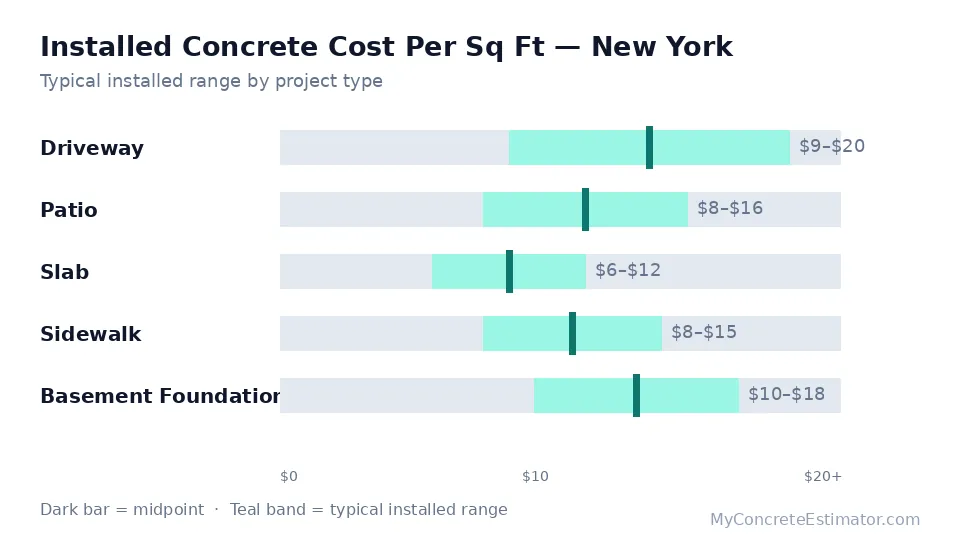
New York has the widest concrete price spread of any state in this guide — a plain upstate slab and a Manhattan sidewalk replacement barely belong in the same conversation. The table below reflects installed prices — materials, labor, standard site prep, and contractor overhead — based on 2026 contractor and cost-guide data for New York City and upstate markets.
| Project type | Low | Average | High |
|---|---|---|---|
| Driveway | $9 / sq ft | $13 / sq ft | $20 / sq ft |
| Patio | $8 / sq ft | $11 / sq ft | $16 / sq ft |
| Concrete slab (4") | $6 / sq ft | $9.50 / sq ft | $12.50 / sq ft |
| Sidewalk | $8 / sq ft | $11 / sq ft | $15 / sq ft |
| Pool deck | $9 / sq ft | $13 / sq ft | $18 / sq ft |
| Basement foundation | $10 / sq ft | $14 / sq ft | $18 / sq ft |
The "low" end assumes an upstate or Hudson Valley job: easy access, flat lot, plain broom finish, mesh reinforcement. The "high" end is New York City — union-scale labor, delivery surcharges, short-load fees, and DOT-compliant sidewalk work. Three New York realities move prices more than anything else: freeze-thaw winters that demand air-entrained, 4,000+ PSI concrete; NYC logistics — congestion, tight access, and delivery premiums that don't exist upstate; and basements, which replace the simple slab foundations common in southern states with a far more expensive foundation type. All three are covered in detail below.
Concrete Cost Per Cubic Yard in New York
If you're buying ready-mix directly — or sanity-checking a contractor's materials line — the per-yard price is the number that matters. New York per-yard pricing splits sharply between the city and everywhere else:
| Mix / region | Per cubic yard (delivered) |
|---|---|
| Standard 4,000 PSI — Upstate NY | $140–$170 |
| Standard 4,000 PSI — NYC metro | $150–$185 |
| 5,000 PSI / high-early — NYC metro | $207–$218 |
| Air-entrainment admixture | +$3–$5 / yd |
| Delivery fee (full truck, ~10 yd) | $160–$360 / truck |
| Short-load surcharge (<10 yd) | $75–$200+ / load |
| Weekend / off-hours delivery — NYC | +$150–$400 / truck |
The $150–$185 NYC band comes from a national per-yard guide updated in late 2026; the $207–$218 figure for 5,000 PSI high-early mix in the city is older contractor data — treat it as the premium end, not the going rate. Upstate batch plants run meaningfully cheaper, and the gap widens on small loads: a 3-yard residential delivery in Manhattan can carry surcharges that double the materials cost. When a contractor quotes you, ask for the per-yard materials line separately — it's the fastest way to spot an inflated bid. Our concrete bag calculator converts your slab dimensions to yardage so you can check their math.
Concrete Driveway Cost in New York
A standard 600 sq ft concrete driveway (20 × 30 ft) in New York runs $5,400–$12,000 installed — the $9–$20 per sq ft band from the table above. That range is wider than most states because "New York" covers two different construction economies:
- Upstate / Hudson Valley ($9–$13/sq ft): competitive contractor market, straightforward truck access, plain broom finish with wire mesh. A 400 sq ft driveway here lands around $3,600–$5,200.
- NYC metro / Long Island ($13–$20/sq ft): labor rates run 40–60% above upstate, access is tight, and many jobs need DOT-compliant sidewalk aprons tied into the driveway. The same 400 sq ft driveway runs $5,200–$8,000.
Every New York driveway should be 4,000 PSI minimum with air entrainment — freeze-thaw cycles and road salt will destroy a weaker mix within a few winters. Thickness matters too: 4 inches is standard for passenger cars, but go 5–6 inches if you'll park trucks or an RV on it. Stamped or exposed-aggregate finishes add $3–$6 per sq ft. Measure your space with our concrete driveway calculator, then run the numbers through the New York cost estimator above for an installed-price figure.
Freeze-Thaw & Air-Entrained Concrete: New York's Winter Rules
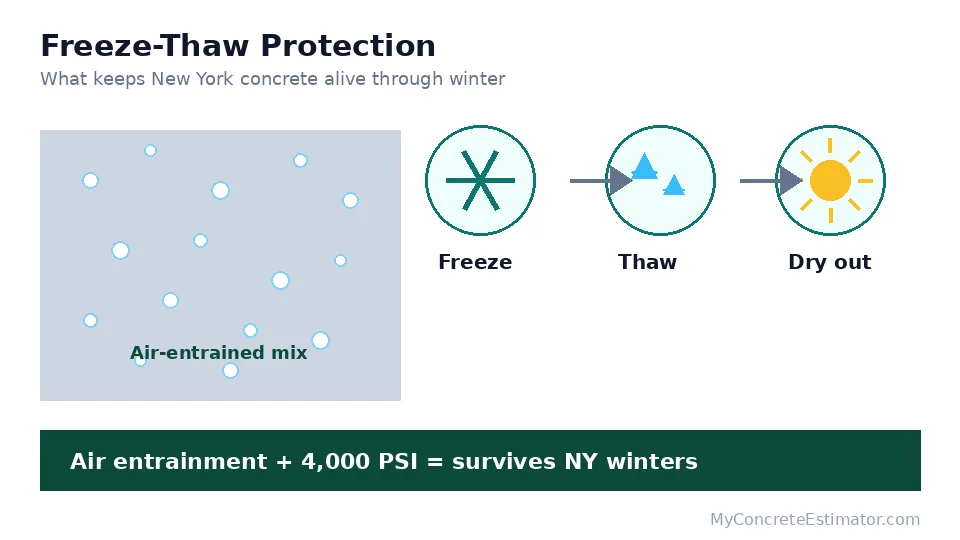
This is the section that separates a New York bid from a generic one. Concrete is porous; water seeps in, freezes, expands about 9%, and pries the surface apart — one winter of that cycle repeated dozens of times is what causes spalling, scaling, and crumbling edges. New York's defense is a two-part specification:
| Requirement | What to ask for | Cost impact |
|---|---|---|
| Air entrainment | 5–8% air content in the mix | +$3–$5 / cubic yard |
| Strength | 4,000 PSI minimum (driveways, sidewalks) | +$5–$10 / yard over 3,000 PSI |
| Sealer | Penetrating silane/siloxane, reapplied every 2–3 years | $0.75–$1.50 / sq ft |
| Curing | 7-day moist cure; no de-icer salts the first winter | Included in good bids |
Air entrainment creates microscopic bubbles in the concrete that give freezing water room to expand — it's cheap insurance and non-negotiable for any exterior flatwork in New York. If a bid doesn't mention air entrainment or specifies 3,000 PSI for a driveway, that's a red flag, not a bargain. Also plan the calendar: pouring between November and March requires winter protection — heated enclosures, insulated blankets, and sometimes accelerating admixtures — which typically adds 10% to the project cost. Our concrete curing time guide explains why cold-weather curing can't be rushed.
Concrete Patio & Pool Deck Cost in New York
Patios run $8–$16 per sq ft installed in New York, with the typical 300 sq ft backyard patio landing around $2,400–$4,800. Pool decks skew higher — $9–$18 per sq ft — because they need finer finishes, better drainage detailing, and often cantilevered edges around the pool shell.
Finish choice drives the number here more than region does. Plain broom finish sits at the low end; stamped concrete that mimics stone or slate adds $3–$6 per sq ft; exposed aggregate lands in the middle. One New York-specific note: dark stamped finishes absorb summer heat, but the bigger concern is winter — stamped surfaces need sealer reapplied every 2–3 years or freeze-thaw will pit the pattern. If you'd rather skip the maintenance, a broom finish with a border stamp gives most of the look for less upkeep. For pool decks, ask for a light-colored, textured finish — it stays cooler underfoot and grips better when wet.
Concrete Slab & Basement Foundation Costs in New York
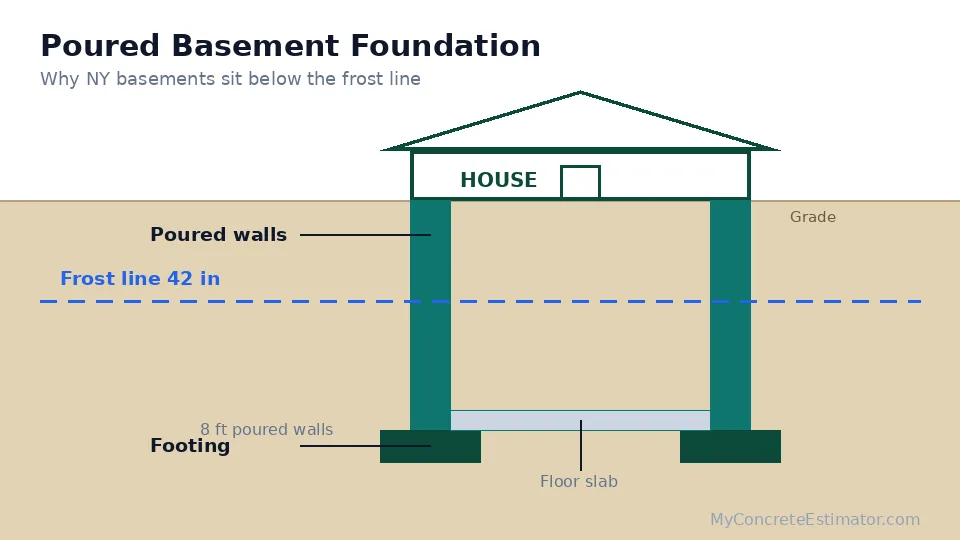
Unlike Texas or Florida, where monolithic slabs dominate, much of New York builds on full basements — 8-foot poured walls on footings set below the frost line (42 inches in most of the state). That changes the foundation math completely:
| Foundation type | Typical NY cost | When it's used |
|---|---|---|
| Monolithic slab (4–6") | $6–$9 / sq ft | Garages, additions, upstate ranches |
| Slab with frost-wall footing | $9–$13 / sq ft | Code-compliant slabs (footings below frost line) |
| Full poured basement (8' walls) | $10–$18 / sq ft of footprint | Most NY homes — living/storage space |
| Crawl space foundation | $8–$12 / sq ft | Where basements aren't wanted |
A 1,200 sq ft basement foundation typically runs $12,000–$21,600 — walls, footings, floor slab, dampproofing, and drainage included. Don't skip the drainage: perimeter drain tile and a sump pit are standard in New York's wet soils and high water tables, and waterproofing (not just dampproofing) is worth the upgrade if the basement will be finished. Rebar or wire mesh in the walls is standard; in high water-table areas near the Hudson or Long Island, ask about a rebar schedule for the footings. The estimator above includes basement as a foundation option so you can price it directly.
NYC Sidewalk & DOT Repair Costs
New York City has a quirk no other market in this guide shares: property owners are legally responsible for the sidewalk in front of their building, and the Department of Transportation issues violations for cracked, raised, or spalled flags. A DOT sidewalk violation isn't a fine on day one — it's an order to repair — but ignore it and the city does the work and bills you at premium rates.
Professional sidewalk replacement in NYC runs $8–$15 per sq ft, with most residential jobs (a few 5 × 5 ft flags) landing at $1,500–$4,000 all-in. DOT-compliant work has specific requirements: 4,000 PSI air-entrained mix, proper pitch for drainage, and permits pulled before work starts. Brownstone neighborhoods in Brooklyn and Manhattan add another wrinkle — tree-root damage is the #1 cause of sidewalk violations, and root pruning or barriers may be part of the job. If you received a violation notice, get three quotes fast: contractors who do DOT work regularly know the inspection standards and won't leave you with a re-do.
What Drives Concrete Costs Up in New York
Beyond the project itself, five New York factors routinely move bids:
- Winter pour protection (+10%). November–March pours need heated enclosures or insulated blankets, and sometimes accelerating admixtures. Concrete must stay above 50°F while curing — protection isn't optional, it's chemistry.
- NYC delivery logistics. Full-truck delivery fees of $160–$360, short-load surcharges under 10 yards, and weekend/off-hours premiums in the five boroughs. Tight access can require a line pump ($500–$1,200/day) instead of direct chute discharge.
- Labor rates. NYC metro concrete labor runs 40–60% above upstate. Prevailing-wage rules on larger jobs push it higher still.
- Demolition and haul-off ($2–$4/sq ft). Tear-out of old concrete — especially in the city, where debris disposal is expensive — is often a bigger line item than homeowners expect.
- Permits and inspections ($100–$500). Most municipalities require permits for flatwork; NYC DOT permits for sidewalk work add time and fees. Good contractors handle this — confirm it's in the bid, not an extra.
The single biggest lever you control is timing: book April–October work in late winter, when contractors are filling their spring schedules and bid sharpest. Winter work costs more and cures worse — the worst of both worlds.
Concrete Prices by Region: NYC vs Upstate
The statewide averages hide a real split. Use this table to calibrate expectations for your area — then get local quotes, because even within regions, prices move with contractor backlog:
| Region | Driveway ($/sq ft) | 4" slab ($/sq ft) | Ready-mix ($/yd) | Notes |
|---|---|---|---|---|
| NYC — five boroughs | $15–$20 | $10–$12.50 | $150–$185 | Highest labor; delivery surcharges; DOT rules |
| Long Island | $13–$17 | $9–$11 | $145–$175 | Near-city labor, sandy soils, high water table |
| Hudson Valley / Albany | $10–$14 | $7–$10 | $140–$165 | Balanced market; freeze-thaw still applies |
| Upstate (Buffalo, Rochester, Syracuse) | $9–$12 | $6–$9 | $135–$160 | Most competitive pricing; harshest winters |
| Rural / Adirondacks | $9–$13 | $6.50–$9.50 | $140–$170 | Cheaper labor, but haul distances add up |
Upstate's harsh winters deserve respect in the spec: Buffalo and Syracuse average 100+ inches of snow, which means maximum freeze-thaw exposure and heavy road-salt use. If anything, upstate flatwork needs better concrete than a Manhattan sidewalk — the labor is cheaper, but don't let anyone cheap out on the mix. The estimator above lets you pick your region so the math matches your market.
DIY vs Hiring a Concrete Contractor in New York
New York is a tough state for DIY concrete, and honesty requires saying so. The pour window is short, the mix spec matters more here than almost anywhere (air entrainment, 4,000 PSI, proper curing), and a failed slab can't be patched back to strength. That said, small flatwork — a 10 × 10 ft shed pad, a walkway section — is very doable for a careful DIYer.
| DIY | Pro installed | |
|---|---|---|
| 400 sq ft driveway (4") | ~$1,450 (materials + rental) | ~$5,200 (Hudson Valley) |
| 120 sq ft patio (4") | ~$550 | ~$1,320 |
| Sidewalk flags (100 sq ft) | ~$500 | ~$1,100 |
DIY math: materials at roughly $165/yard plus 5% waste, a mixer or ready-mix short load, and about $300 in tool rental (screed, bull float, edger). The estimator's DIY figure uses exactly this formula. Two rules: never DIY a foundation or structural slab — the engineering liability isn't worth it — and never pour below 40°F without proper protection, no matter how tempting a late-fall weekend looks. For anything over ~200 sq ft, a pro crew's speed is itself a quality factor: large slabs need to be placed and finished before the concrete sets, and a two-person DIY crew will lose that race.
How to Save Money on Concrete in New York
- Pour in season. April–October pours skip the 10% winter-protection premium and cure better. Book in February–March when contractors are hungry.
- Get 3+ quotes — and compare the specs, not just the price. A bid that's 20% cheaper because it specs 3,000 PSI without air entrainment is the most expensive bid you'll ever accept.
- Combine with neighbors. A full 10-yard truck split across two driveways kills the short-load surcharge for both jobs. This works especially well on NYC blocks.
- Keep the design simple. Every curve, step, and stamp pattern adds labor. A rectangular broom-finish slab is always the cheapest per square foot.
- Handle demo yourself — carefully. Breaking out old concrete saves $2–$4/sq ft, but only if you can haul the debris. In the city, disposal costs can erase the savings; get a haul-off quote first.
- Ask about the per-yard materials line. Contractors marking up ready-mix 30%+ is common. Knowing the $140–$185 band for your region keeps the conversation honest.
- Maintain what you pour. A $0.75–$1.50/sq ft sealer application every 2–3 years is the cheapest concrete you'll ever buy — it doubles the life of exterior flatwork in freeze-thaw country.